The long journey of our Lord Howe Wedding Lily – In My Garden Series
By Sharon Pearson, Jenny John, Di Clark & John Knight
These four articles were originally published in the South East APS NSW Newsletter, Issue 225 (November 2025), and have been gathered here to share the practical experiences of members growing native plants in their own gardens.
In my Garden with Sharon Pearson
Many years ago at an APS get-together at Coffs Harbour, Jay bought a Dietes robinsoniana, Lord Howe Wedding Lily…’I’ll give that one a go’ he said. For many years it was planted in Sydney, probably in too dry a spot for it to flower, but it did survive to double in size. On relocating to the Far South Coast, Jay took it with him, divided it and planted some at Bodalla. He gave me one portion which I planted in Narooma in the most suitable position I had…..moist during winter, sunny in summer but prone to drying out when no rain…typical clay soils.
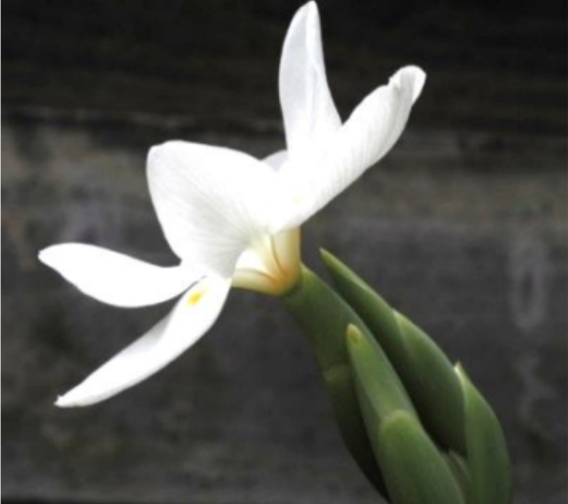
Emerging flower spike, 17th August, image by Sharon Pearson
Now 4 weeks later, spike formed, image by Sharon Pearson
It was planted March 2020 and each year it grew more leaves and I just thought of it as a good contrast plant with grey- green strappy leaves and height about 45cm tall. But, lo and behold early August it looked a bit different….an odd looking leafy spike started to appear. Nearly every morning for the next month I checked on its progress….’I think I’ve got a flower spike’ I said to Jay.
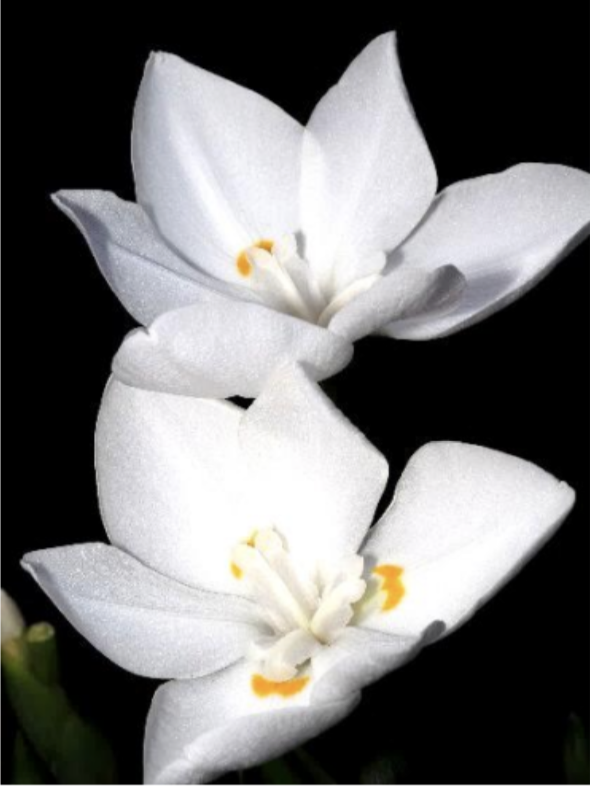
Dietes robinsoniana flower, Sharon Pearson
The flower spike got taller, the buds got fatter and in early September it started to show individual buds and in late September I had my first flower. The Lord Howe Wedding Lily is endemic only to Lord Howe Island. Jay & I did see some when ascending Mount Gower, but it was not in flower. How are the ones at Bodalla doing?, you ask…… Jay is still waiting for his to flower, but his soils are more free-draining than mine and they are in a shadier spot……maybe next year I console him.
Dietes robinsoniana flowers, Sharon Pearson
In my Garden with Jenny John
As the Callistemon brushes fade a scattering of Grevilleas and Anigozanthos flavidus are keeping some bold splashes of colour in the garden as well as supplies of nectar for the lorikeets and honeyeaters. Two Elaeocarpus reticulatus are just beginning to open their bunches of flowers giving the trees a feathery white cloak that dances in the brisk winds we have had lately. Hibbertia scandens is making the most of the support provided by Westringia ‘Wynyabbie Gem’ and the skeleton of a Banksia serrata that upped and died a year ago along with other shrubs of a similar age.
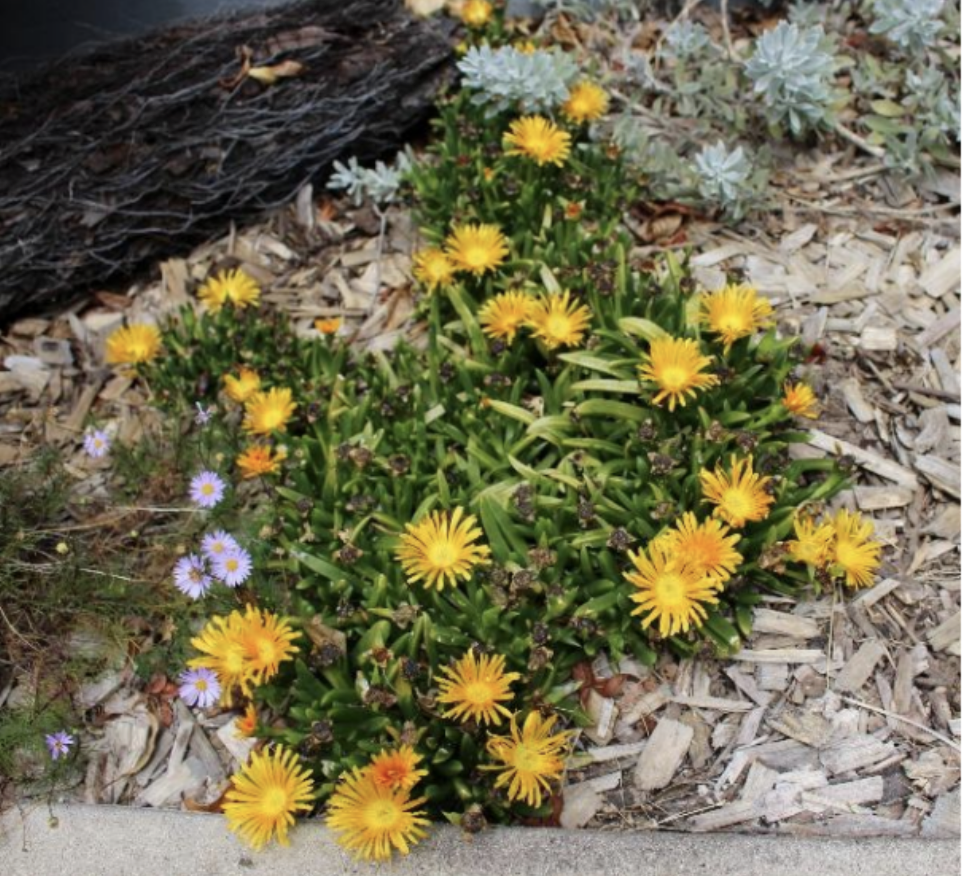
A xDisphyllum ‘Sunburn’ obtained at the Christmas plant swap of two years ago has flourished and extended stems in several directions covered in shiny yellow/orange flowers that open and close as the sunshine comes and goes. It has not liked the dry conditions we have been having recently and I am having to include it in the watering regime which normally just covers the plants in pots along the north facing wall of the house. A more easterly part of the north facing wall is doing better and there Grevillea rhyolitica ‘Deua Flame’ is growing happily and flowering and Calytrix tetragona helps to camouflage the air conditioning unit
( Note: xDisphyllum ‘Sunburn’ is a hybrid succulent, cross between the native Disphyma crassifolium ssp clavellatum, the seed parent, and a South African plant Glottiphyllum longum which provided the pollen. The original plant was sourced from the plant sales at Mt. Annan Botanic Garden)
xDisphyllum ‘Sunburn’, Image by Jenny John
In my Garden Di Clark
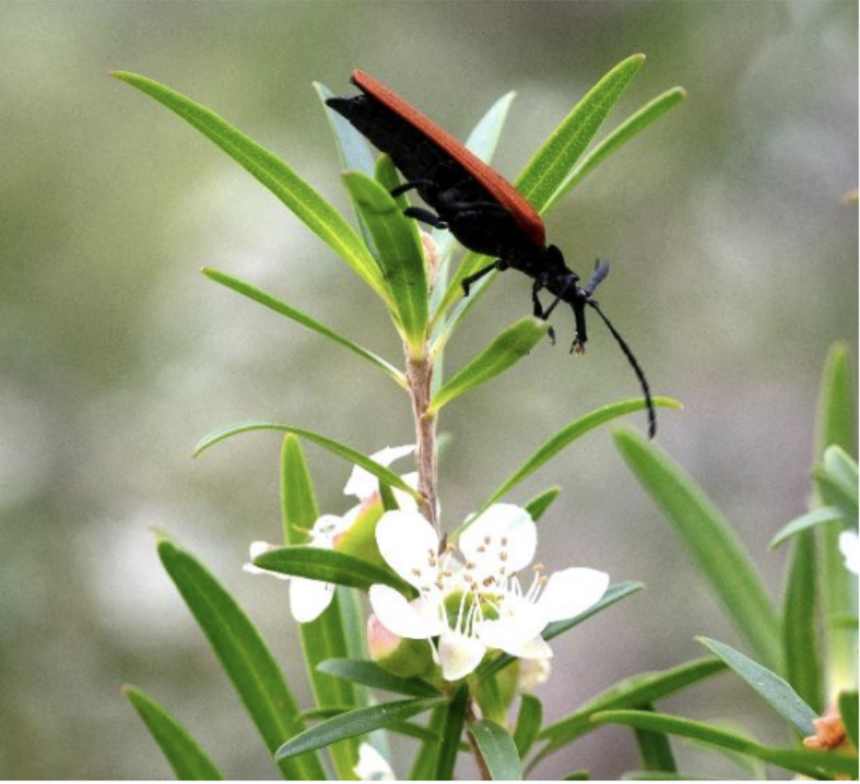
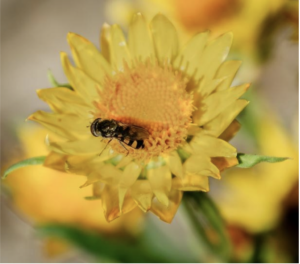
Lately I have been stalking the pollinators in my garden and have discovered that they are not all birds and bees. The first insect I would like to mention is well known to us gardeners as they serve our gardens in two ways. The adult Hover Fly, Melangyna viridiceps is a nectar feeder and plant pollinator and hovers around with the European Honey Bee and our local bees. It has the markings of a wasp or bee, but is actually a fly. The wings are longer that its body and its antennae are short. The larvae of the Hover Fly feed on aphids, so are to be protected and not sprayed with pesticides. There are many species of Hover flies, and verified the name of this species from the very helpful “Insects of South Eastern Australia” by Roger Farrow. They are in the family Syrphidae. The second insect in my garden that I have noticed buzzing around the tea tree Leptospermum polygalifolium and the Lilly Pilly Syzygium smithii is known as a Long Nosed Lycid Beetle, Porrostoma rhipidius. It has beautiful thick black antennae and brown outer wings that form hard protection for the wings within. The long-nosed Lycid Beetle larvae live in leaf litter, under bark or on mouldy wood. The Australian Museum believes that they may feed on moulds and decaying plant material. Although these insects are not eaten by birds as they apparently do not taste very nice, they are contributing in so many ways to plant diversity and a healthy environment.
Lycid Beetle on Leptospermum polygalifolium, image by Di Clark
Hover fly on Xerochrysum bracteatum ,image by Di Clark
In my Garden John Knight
How fortunate are we to be rewarded with such diverse visitors to our gardens. The range of insects which use the plants, or the environment generally, continues to expand with diversity of plantings. Following on from Di’s observations, I note that Prostanthera ‘Poorinda Ballerina’ is also frequented by a range of insects which feed on its bounty. Whilst this visitor, Pieris rapae, Cabbage White Butterfly is not native, it is still welcomed as it visits many different flowers. Prostanthera ‘Poorinda Ballerina’ does not seem to be grown these days, but was very popular 20 or more years ago. There is some confusion over its naming, as it appears to be very similar to the hybrid Prostanthera ‘Poorinda Bride’ which appeared around the same time. The seedling is believed to from P. ‘Poorinda Snow Queen’ which itself was recorded as a cross between P. lasianthos and P. phylicifolia. Poorinda hybrids were widely distributed from the 1960’s, with around 20 different hybrids registered. It is well known that Prostanthera is promiscuous, with seedlings appearing wherever multiple species are grown in close proximity. I can’t claim any success as yet, but with 5 species in the garden, just maybe I will get a worthwhile hybrid of my own.
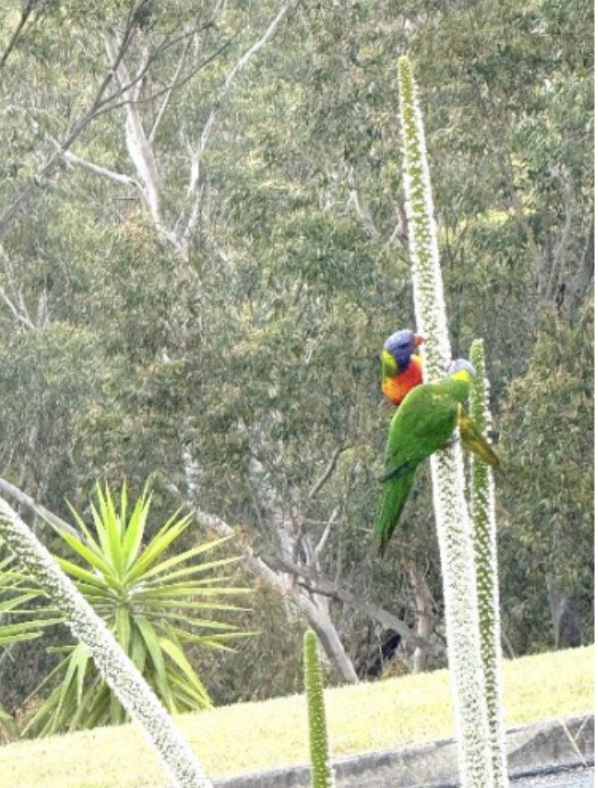
Continuing on the theme of insect visitors, this Xanthorrhoea australis, now over 20 years old (having spent its first 8 years in a pot) has flowered reliably for years, and is a magnet for all manner of insects, including Painted Lady and Imperial Jezabel butterflies, competing with the Cabbage White, Tiger moths, Hoverflies and ants. Birds also are keen for some honey, with wattlebirds attempting to keep others at bay, but having no luck with the aggressive Rainbow Lorikeets, immune to their attacks. Crimson Rosellas also find the plant a tasty source of nourishment, and just recently the plant was visited by some Scarlet Honeyeaters. It is easy to waste an hour or two enjoying the comings and goings.
Xanthorrhoea australis, (birds), image by John Knight
Xanthorrhoea australis, image by John Knight
Some plants flowering now, and suitable for small rockery style gardens or as container plants.
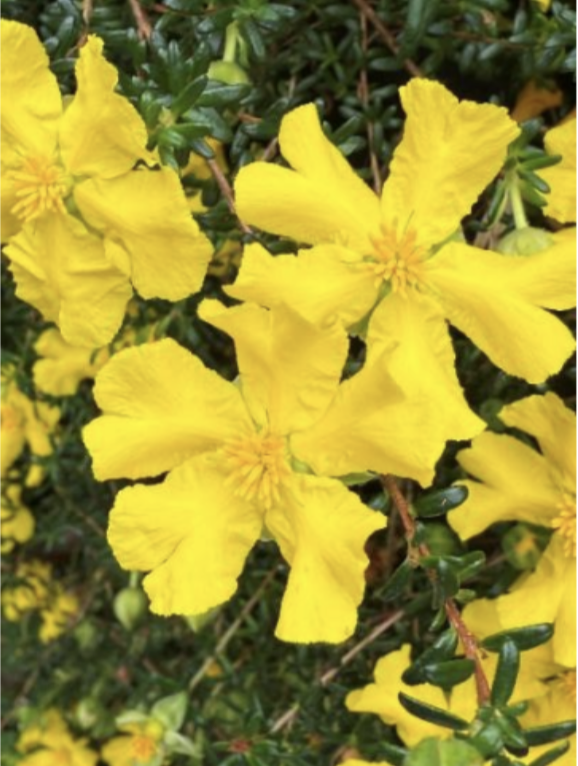
Hibbertia pedunculata, image by John Knight
The prostrate form of Hibbertia pedunculata from Victoria forms a carpet over 1m spread, flowering through spring into autumn. Plants prefer a bit of hot sun protection, and will self-layer on moist ground. Note the notched petals, which are golden rather than yellow.
Each of these are easily propagated from young growth which has not turned woody.
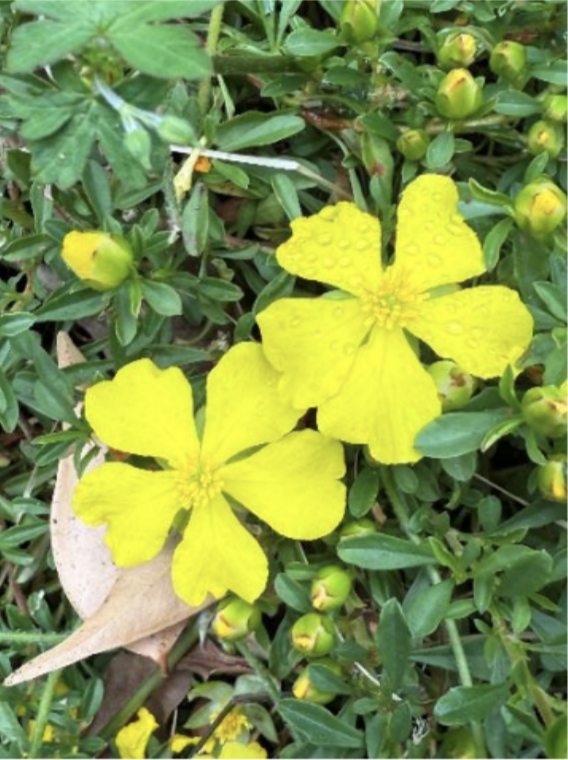
Hibbertia diffusa, image by John Knight
Also prostrate is Hibbertia diffusa, often confused with a low growing form of Hibbertia obtusifolia. This plant is now over 10 years old and suckers lightly but stays flat on the ground. Plants adapt to full sun, but are often found in dappled light in natural habitats.
Scaevola albida ‘Mauve Clusters’, image by John Knight
Scaevola albida ‘Mauve Clusters’ has been a popular garden plant for years, but seems to have lost favour. As a garden plant it grows to about 30- 60cm high with a spread of around 1m. It is a prolific flowerer through spring and summer, and is popular with many types of insect. This has seen a range of different coloured garden seedlings arise, many of which have been sold under various names. Mauve Clusters prefers plenty of sun, and is hardy once suckers have established.