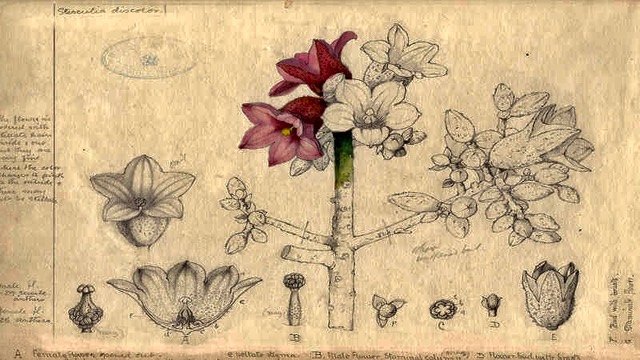
While most people would only go to Sydney’s Royal Botanic Gardens to see flower displays there is another experience awaiting them at the Garden’s Daniel Solander Library. The library shines a light on the literature of the academic interest in plants, their discovery, nomenclature and illustration. Having served for thirty years as the Daniel Solander librarian Miguel Garcia was an ideal raconteur for this revelation.
After a brief explanation of plans showing the development of the Sydney Royal Botanic Gardens we moved into the library where a selection of works on paper were laid out on a long table. It was a pleasant change inside after the hot muggy weather outside. The library’s atmosphere was cool and dry to protect its special collection both from silverfish and the humidity which causes fungus.
We were soon made aware that the library contains a treasure-house of invaluable books about plants written over thousands of years and telling a story of useful remedies for illnesses and developments in science. Each of the beautiful masterpieces on the table would demand a 500 word essay to explain its importance and relevance however, we were there for only a few hours. As anyone who has tried to read a library’s collection the task could easily take a lifetime.
De Materia Medica (1st Century AD)
Miguel introduced us to this daunting educational task by carefully displaying a few illustrations out of each book to show their age, artistic beauty and interest. The earliest books referred to the medicinal benefits of herbs. Pedanius Dioscorides’ De Materia Medica written in the 1 st century AD and an important text for almost 2,000 years had crude woodblock illustrations in the 1550 printed edition on display. This edition had been translated from the Ancient Greek, to Arabic, then Spanish until it received its present Latin text in Antwerp.
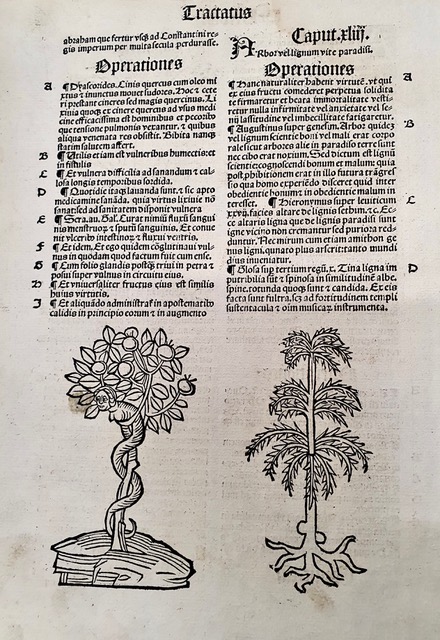
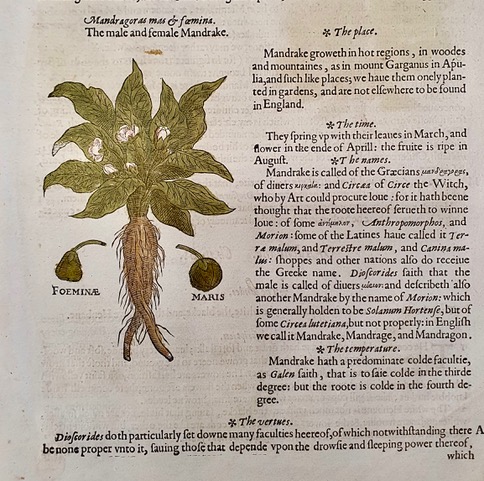
Hortus Sanitatus (1491) and The Herball or Generall historie of Plantes (1636)
There were only two pages of the 15 th century Hortus Sanitatus (Book of Health) that Jacob Meydenbach first published it in Mainz, Germany in 1491. The woodblock prints showed plants that had anthropomorphic renditions of mythical creatures. One displayed the tree of knowledge of good and evil and the other page was the legend of Narcissus with a plant illustration. The repeated reference to folklore resulted in John Gerard’s 1636 The Herball or Generall historie of Plantes maintaining a lasting appeal. Miguel told us about one story in the The Herball: ‘There is a description of the potato plant, which Gerard describes successfully growing in his own garden. His explanations of how the vegetable could be eaten, and its perceived medicinal properties, are followed by a later note by Thomas Johnson, who records that at one point potatoes were banned in Burgundy for fear they were a cause of leprosy’. Some of the etchings such as the male and female Mandrake that is shown as fanciful merely confirms a plant’s folk etymology.
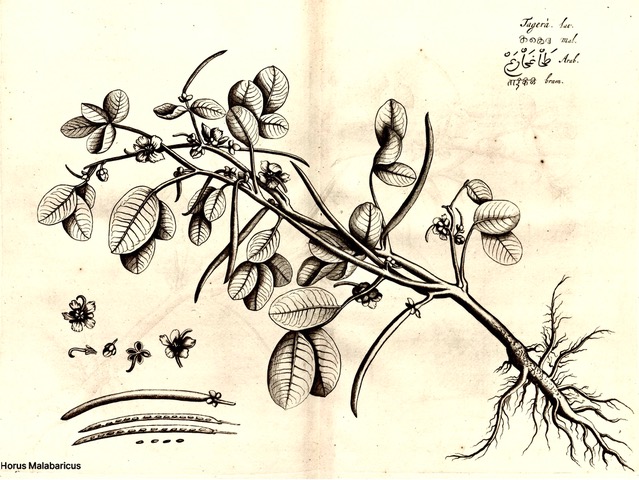
Hortus Malabaricus (1678 – 1693)
For the eminent Swedish botanist Carl Linnaeus, when he was in Amsterdam Hortus Malabaricus was fundamental to his classification of tropical flora. When Miguel showed some of the 17 th century illustrations that had been drawn in India we were impressed by the descriptive accuracy of plants. There were details of the flower and seed pods. Science had finally entered the botanical literature with the publication between 1678 and 1693 of the 12-volume Hortus Malabaricus, an important ecological study of the plants of Malabar which is on India’s west coast. Hendrik van Rheede’s work is a compilation using contributions from academic and amateur botanists, physicians and folk medicine practitioners, engravers and illustrators but it is also an ethnographic study of Malabar society. Containing nearly 6,000 pages, with 794 copperplate engravings of 742 plant species the Hortus Malabaricus is immense if not encyclopaedic. Each entry includes detailed drawings, medicinal uses, and names in Malayalam, Konkani, Arabic, and Latin. This is a rare record of the plants and traditional medical practices of ancient India. It describes the medicinal properties of the flora and the diseases that were treated with the composition and dosage of the medicines as known to the contemporary Ayurvedic physicians such as Itty Achudem of Malabar.
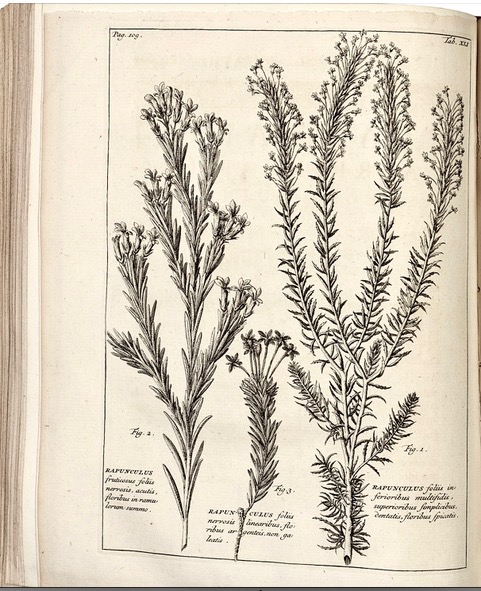
Rariorum Africanarum Plantarum (1738–1739)
Carl Linnaeus was again referenced when Miguel showed us the “Rariorum Africanarum Plantarum (1738–1739)”. This was published by Johannes Burman (1707– 1780) the Professor of Botany at Amsterdam University who collaborated with and employed Linnaeus on several works. Burman was pivotal in Linnaeus acquiring a patron the wealthy Dutch East India company director George Clifford III. Clifford gave Linnaeus an income for three years as well as introductions to British botanists and financed the publication of his books. However, as we noticed in Burman’s Rariorum Africanarum Plantarum (1738–1739) all this was before Linnaeus had published Species Plantarum (1753) with its binomial system of species nomenclature. Burman’s Rariorum Africanarum Plantarum (1738–1739) was interesting in illustrating how in the early 18 th century scientific plant names could have up to five descriptive terms. Before “Species Plantarum”, a plant was referred to as “Plantago foliis ovato-lanceolatis pubescentibus, spica cylindrica, scapo tereti” however based on Linnaeus’s sexual system of classification it was renamed Plantago media. While the book has fine quality engravings they only illustrate leaves and stems without an accurate description of the flower which is essential to defining the plant’s genus.
Bank’s Florilegium (1768–1771)
The artistic result of Cook’s 1768–1771 voyage on the Endeavour was “Bank’s Florilegium” that nobody at the time saw. Of more interest than what became a 200 year print reclamation process is the scientific story. After Amsterdam Linnaeus returned to Sweden where he eventually was ennobled and made Rector of Uppsala University. Daniel Solander (1733 – 1782) was one of Linnaeus’ students and apostles who were sent to distant parts of the world to collect plants and animals. On Linnaeus’s recommendation Solander travelled to England in 1760, where he met Joseph Banks to become his assistant and close friend on Cook’s Endeavour voyage to the South Pacific. Solander was the first university-educated scientist to set foot on Australian soil. After Solander’s work Australian plants were described using the Linnaean system. Unfortunately, because of his untimely death aged 49 due to a heart attack none of his papers have been published.
The artist Sydney Parkinson (1745 – 1771) was an important member of Joseph Banks botanical team. We were shown the Journal of a Voyage to the South Seas, based on Sydney Parkinson’s papers and drawings. It contained a Portrait of Otegoowgoow, son of a chief of the Bay of Islands that was sketched 1769 and engraved in 1773. Parkinson’s original journal had been lost when he died at sea from dysentery and malaria caught in Batavia. It was quite common for foreign sailors to die after landing in Batavia. Parkinson drew sketches of a large number of plants growing along Australia’s east coast. In all he drew at least 1,300 drawings and paintings of specimens collected by Joseph Banks and Daniel Solander on the Cook voyage.
The beautiful Bank’s Florilegium that we saw in the Daniel Solander Library had a 210 year gestation. Upon his return to London in 1771 Banks commissioned five artists to create watercolours of all of Parkinson’s drawings and 18 engravers to create 743 copperplate line engravings from the completed watercolours. However, due to the Florilegium’s tremendous cost and the death of Daniel Solander in 1782 Banks lost interest in the project. Work came to a standstill in 1784. The printing of Bank’s Florilegium was completed in 1980 using the original copperplate engravings. 100 sets were available at a cost of about $100,000 each. Using a 17 th century printing technique each print took between one week to two months to proof. Parts 1 to 15 consists of 337 plates relating to the Australian flora.
Atlas pour servir à la relation du voyage à la Recherche de La Pérouse, 1799 or 1800
It was not only the British that came to Australia in the late 18 th century. The Botanic Gardens library also has a copy of Atlas pour servir à la relation du voyage à la Recherche de La Pérouse, 1799 or 1800 which contains descriptions and illustrations of Tasmania including two of Eucalypts and two of Banksias. Rear-Admiral Bruny D’Entrecasteaux had received command of an expedition with the dual mission of searching for La Perouse who had been missing for two years as well as making inquiries into the natural sciences and commerce of the region.
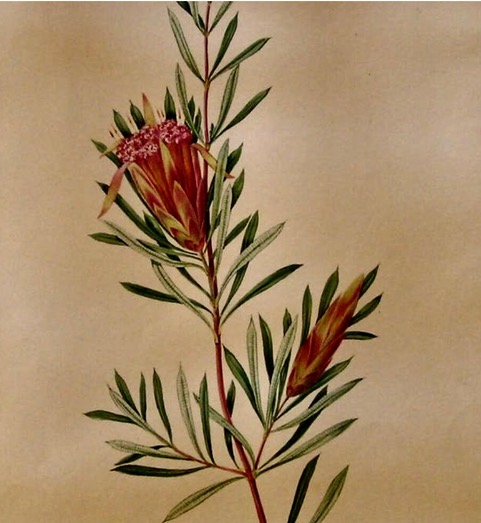
Joseph Lycett (1817)
Joseph Lycett’s name is not known as a botanical artist however a number of botanical paintings that were shown have recently been attributed to him. Lycett (c.1774 – 1828) was a convict artist sent to Australia for forging bank notes and he later made a name for himself through his artistic talents particularly in the Newcastle area where he had been sent in about 1817 as a repeat offender.
On the Origin of Species (1859)
We saw a small commonplace book, like a prayer book sitting on the table. To our surprise its plain grey cover enveloped the original 1st edition, 1st printing of Charles Darwin’s ground-breaking On the Origin of Species (1859). Darwin had corresponded with Charles Moore (1820–1905), the Director of the Botanic Gardens in Sydney, for his assistance with botanical information and specimen collection. Darwin wanted to know about the adaptation of British plants to Australian conditions. Moore provided crucial data for Darwin’s research on plant evolution. As a sign of his appreciation Darwin sent Moore an inscribed copy of On the Origin of Species that is the only presentation copy in Australia.
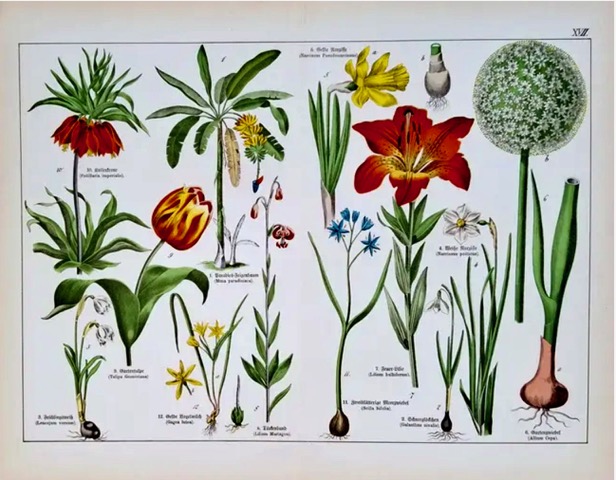
Naturgeschichte des Pflanzenreich in Bildern (1853)
There were two German botany text books on display with beautiful colour illustrations. One was the Naturgeschichte des Pflanzenreich in Bildern (Natural history of the plant kingdom in pictures) by the famous German polymath Dr Gotthilf Heinrich von Schubert, a professor of general natural history in Munich. As an introduction to plants and botany Naturgeschichte des Pflanzenreich was an important text book for botanical education in the 19 th century. It contained 650 true-to-nature illustrations and 52 double-page, hand-coloured lithographs with an index of Latin plant names. Plants were depicted according to botanical classes using the Linnaean system. The book had 77 pages of text showcasing native and exotic plant species with remarkable accuracy. The botanical works were based on drawings from the most outstanding artists of the day with detailed illustrations of leaves, flowers, fruits and roots. The other book was more remarkable for its acquisition than its rarity. This 1930s German high school text book which had the most beautiful coloured-printed illustrations of plants had been purchased from a prison guard in the Changi Japanese prison camp by a Dutch POW who brought the book to Australia to eventually present to the Daniel Solander Library.
South Pacific Fern Album (1889)
One of the publication oddities of the second half of the 19 th century was based on an exceptional interest in ferns. Victorian fern fever or ‘pteridomania’ overtook Britain in the 1850s. While collectors mounted their own albums ready-made albums of pressed and dried ferns were soon on the market. They were sold as ‘scientific souvenirs for those who had either been unsuccessful in their searches or did not care to travel the countryside themselves’. New Zealand fern albums did not occur on a significant commercial scale until the 1870s. On display in the Daniel Solander Library was the South Pacific Fern Album (1889) by Mary Anne Armstrong, J. Twomey and the New Zealand Fern Company that contained the fronds of fern specimens collected throughout New Zealand mounted on 20 pages. Large quantities of these albums were exported to Britain.
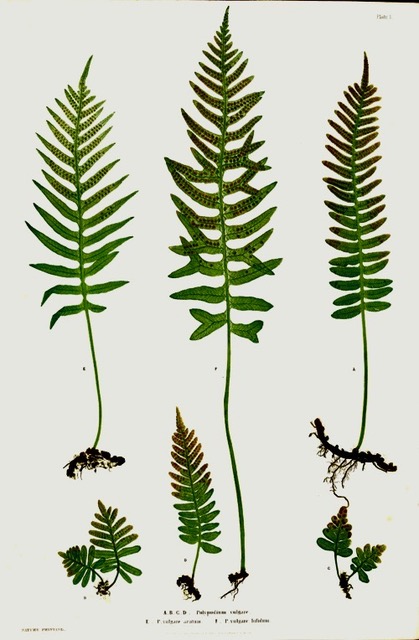
The Ferns of Great Britain and Ireland (1855–1857)
Fern fever financed the development of a new printing technique. The ‘nature- printing’ technique that captured the intricate details of fern specimens was exhibited in The Ferns of Great Britain and Ireland (1855–1857), written by botanist Thomas Moore. The text had a scientific description of all the varieties of ferns found in the British Isles while fern illustrations used a printing process particularly suited to replicating the two-dimensional form of fern fronds. Ferns were impressed upon soft lead plates. These were electroplated to become the printing-plate, the details of the fronds and stem were hand-coloured at this stage. The resulting image was in two colours and provided a highly detailed and realistic depiction of the species. The ‘nature-printing’ technique was briefly in vogue, but did not persist.
Margaret Flockton (1901 – 1927)
We were shown a Margaret Flockton’s illustration of lichen that seemed to jump off the page with its three dimensional rendering. She was obviously a gifted artist and probably Australia’s best known botanical artist. While there were many examples of 20 th century Australian plant illustrators and their illustrations in the library it was difficult to surpass the output of Margaret Flockton (1861 Sussex – 1953 Sydney). When Joseph Maiden, the Director of the Royal Botanic Garden Sydney from 1896 to 1924, established the National Herbarium of NSW in 1901 he surely saw the need for a botanical illustrator. Thus the gifted artist Flockton became the first professional illustrator employed by the Garden from 1901 to 1927. Her drawings, paintingsand lithography were essential to Maiden’s key works such as the “Revision of the Genus Eucalyptus”, “Forest Flora of New South Wales” and his extensive treatment of the Opuntia (prickly pear cactus) genus. During her time at the Gardens, Margaret Flockton produced thousands of black and white and colour sketches, paintings and engravings of plants. Today the Gardens are still finding her work squirrelled away inside the boxes of plant specimens she was illustrating.
Thank you Miguel. I’m finished but there is much more to see in the Daniel Solander Library.