Banksia SG newsletter, no. 33, Summer 2026
Banksia canei, the mountain banksia, is a species surviving in subalpine areas of eastern Vic. and southeastern NSW, and has 4 forms distinct in leaf shape and habit. After the heavy impact of the 2019-20 fires, a restoration project set about re-establishing a self-sustaining population. Seed was collected from genetically compatible populations, and 800 seedlings were planted out. Long-term monitoring will track the populations. A short film is available on Youtube – “ Canei – the Unextinction of Banksia canei”.
Group leaders Kathy and Kevin Collins recently re-located the rare species B. croajingolensis in Croajingalong National Park. A healthy population was found, with all plants appearing to be about the same age (post-fire?). Possible hybrids of B. integrifolia and B. croajingolensis were also located, and these are worthy of further taxonomic investigation.
Member Walter Stanish reports on a weeping form of B. ericifolia found in Sydney bushland. Keven Collins has provided some tips for propagating the form from cuttings.
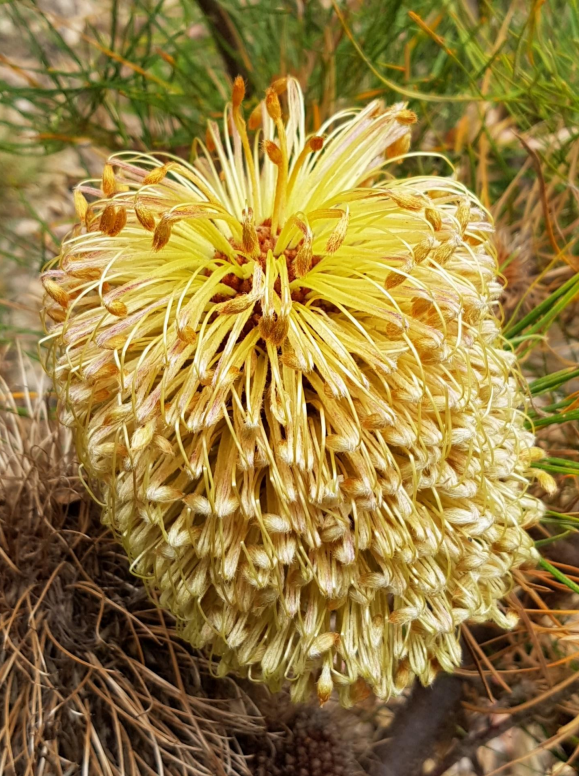
A series of photos is provided of stages and colour variations of B. leptophylla var leptophylla (pictured).
Contact banksia@westnet.com.au
Grevillea SG newsletter, no. 133, Feb 2026
Cranbourne Botanic Gardens, Victoria, has become a home for rare and endangered plants. They now have a complete collection of every Victorian grevillea species and subspecies. Species have been exchanged with the Living Collection on Neil Marriott’s property, and also are being spread to regional botanic gardens.
The newsletter completes the report on the study group tour to WA last September. Species observed in the Southern Cross area included Grevillea oligomera, G. paradoxa, and a natural hybrid between the two, growing close to the parent species.
Numerous showy species were observed near Ravensthorpe, and it was noted that there is a good variety of native plantings in garden beds along the main street of the town. All in all, it was a superb trip covering a lot of territory, with 62+ species of grevillea seen, as well as plenty of other spectacular WA plants.
Mark Abell has checked out the grevilleas to be found between Orange and Denman, NSW. Photos and materials are to be provided to the Hunter Botanic Gardens.
An update is provided on the project to collate a full list of rare and threatened grevilleas. 140 species are now listed. The next steps are to publish the data for each state, and review the Grevillea Living Collection to identify high conservation priority species.
Contact grevilleanews@gmail.com
Acacia SG newsletter, no. 162, March 2026
Acacia siculiformis from southeastern Australia is known as the dagger wattle, from its sharply pointed phyllodes. It is remarkably hardy, growing in the World Garden at Lullingstone Castle in the UK, and has also been successful in East Germany.
A. truncata is native to coastal areas of South West WA, but has been successfully grown in Victoria (the Mandurah variant, with its distinctive foliage).
From a different perspective, A. dealbata seed has been analysed and found to represent a balanced nutritional profile. It is comparable with many widely consumed grains, nuts and seeds.
Three species of acacia have recently been gazetted as threatened. Two, A. atrox, the Myall Creek wattle, and A. pubifolia, the velvet wattle, are from NSW. The other, A. lumholtzii, is from Queensland.
Contact acaciastudygroup@gmail.com
Hakea SG newsletter, no. 90, February 2026
Hakeas of the Sydney/Blue Mountains area are listed in the newsletter, with the notation that they may require some summer watering in cultivation, as the Sydney area does get regular summer rain.
Hakea bakeriana has bright green foliage and deep pink flowers. H. constablei is a lovely shrub with terete leaves and vivid white axillary flowers. H. dactyloides, dohertyi, gibbosa, laevipes ssp laevipes, propinqua, pachyphylla, salicifolia, and teretifolia are other species briefly described.
Species from Tasmania would also seem to be in need of summer watering, but in SG leader Paul Kennedy’s garden at Elliminyt, Vic., they have survived without such watering being applied. This includes H. epiglottis and H. megadenia. H. lissosperma (Tas. and Vic.) has also proved very hardy.
Contact hakeaholic@gmail.com
Grafting SG newsletter, no. 6, March 2026
Updates are provided on members’ experience grafting the waratah Telopea speciossisima, including a successful graft onto Alloxylon flammeum stock. A new rootstock for this Telopea is potentially valuable to the horticultural industry, as it is a long stemmed variety.
In reporting on his grafting trials, member John Elton advises that the “mummy graft” technique has good potential for problematic hairy species, as it avoids retained moisture which can cause fungal problems. On several species trialled, buds appeared quicker when a mummy graft was used. The best scions for mummy grafting are those that have hardened off.
Brendon Plaza has been doing experimental grafting, with Eremaea, Beaufortia, Regelia and Phymatocarpus doing quite well up to this point on Melaleuca linariifolia rootstock. However Callistemon may be a more suitable rootstock.
Contact graftingstudygroup@gmail.com
Fern SG newsletter, no. 161, March 2026
A “ferny” excursion to Victoria last November included Sherbrooke Rainforest Walk in Dandenong Ranges National Park, which yielded some impressive ferns. Ascending the Mt Oberon Walk at Wilson’s Promontory initially seemed an “un-fern-like” environment, but eventually 19 species revealed themselves. Back off the car park, 27 species were seen in Rainforest gullies. At Tarra-Bulga National Park, 27 species were observed including filmy ferns.
Contact ANPSAferns@bigpond.com
Australian Plants for Containers SG newsletter, no. 47, March 2026
Hibiscus geranioides is one of the Walcotts’ best pot plants in Canberra, flourishing after 11 years in a pot. It has delicate pink trumpet flowers.
The paper daisy Bracteantha “Elite Citrine” is flowering well for Anne Campbell of Adelaide. It likes full sun and hates wet feet.
Maureen Mallard of Canberra recommends Crowea exalata “Gininderra Falls” and Tetratheca thymifolia. Eremophila “Carmine Star” has also done well for her.
Ros Walcott presents a roundup of the Eremophilas she has in pots. E. cuneifolia, foliolissima, and glandulifera “Lipstick Pink” get honorable mentions.
Robyn Tyson of Victoria comments of her container garden started in 2021, she has only had a few casualties. She has flowered Eucalyptus orbifolia, and other successes include Epacris which don’t thrive planted in soil.
Contact roswalcott5@gmail.com or benwalcott5@gmail.com
Isopogon & Petrophile SG newsletter, no. 38, March 2026
Isopogon “Musk Sticks” is a new release in nurseries, with the study group having participated in its development. It is a natural hybrid of I. divergens and I. gardneri.
I. buxifolius is now classified as endangered as there are just a few roadside populations within a restricted area. A trip to Denmark, WA, found a new population of about 40 plants, however nearly overwhelmed by thick vegetation.
New populations of I. pallidus have been found near Collie, WA, extending its known range by about 100km.
Nillumbik Nursery of Diamond Creek, Vic. has posted a video to Facebook giving an overview of the range of Isopogon cultivars available in nurseries. They are all spectacular pink forms. They like excellent drainage and as little water as possible in summer.
I.asper is impressive in photos. It has conspicuous floral bracts which are brightly colored and appear like petals.
Petrophile canescens is a species which is found inland in NSW, while extending to the coast in Queensland. It is remarkably adaptable and tolerates extreme humidity.
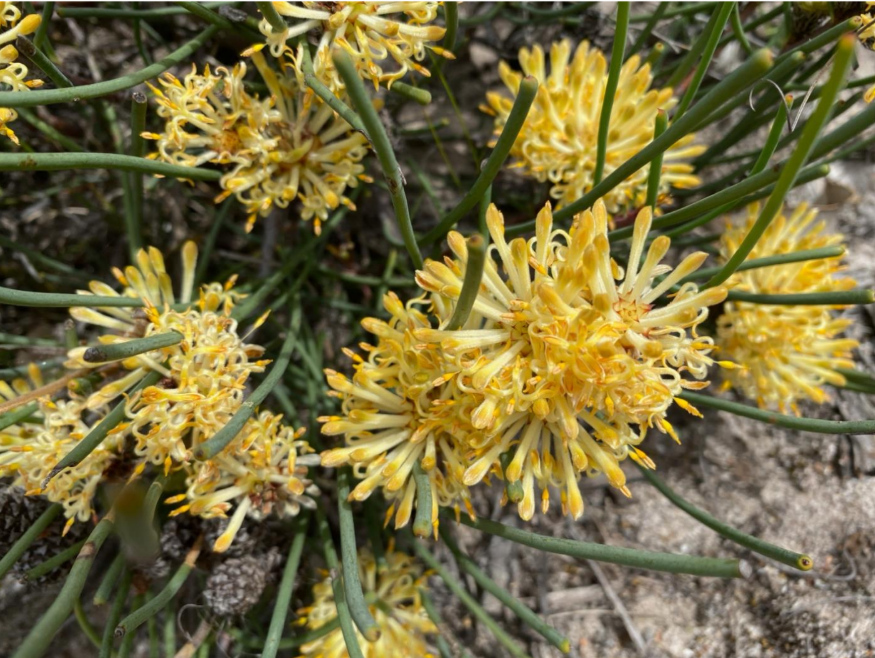
Petrophile media (pictured) from the SW of WA is little known in cultivation. It is a small plant with large yellow terminal flower heads.
Contact isopetstudygroup@gmail.com
Eremophila SG newsletter, no. 150, April 2026
Eremophila galeata is a WA eremophila commonly known as turpentine bush, which has large single flowers of cream-red-pinkish grey. It is not widely grown, but prefers full sun and seems to be quite drought hardy. It needs to be propagated by grafting, as it is difficult to strike cuttings.
Pioneer in Eremophila studies, Ken Warnes, has been awarded an OAM. He has been a major facilitator of the introduction and cultivation of species Eremophila.
Steve Cathcart writes of growing Eremophila in Gundagai, NSW, a place that is always pretty dry. Eremophila means “desert-loving” of course, but Myoporum insulare, the stock plant for most grafted specimens, is not! With limited availability of watering, Steve has lost many newly planted grafts this season. He has had success with preparing grafts however, and has 40-50 Eremophilas in pots ready to try again. And his potted collection has done well, with good quality potting mix and consistent water.
The national biennial conference coming up in August in Alice Springs has the theme “Amazing Arid Australia”. Several presentations will be relevant to Eremophila. Lyndal Thorburn’s will focus on the activities of the study group, while Mel Perkins will discuss a research project to investigate Eremophila seed biology. Rachael Fowler will present insights into the evolutionary history of Eremophila and its close relatives.
A NSW subgroup of the study group is being trialed, with the initial meeting held at Earlwood, Sydney on April 18th. The subgroup will include cutting exchange, grafting demonstrations, and general discussion. [The April meeting was a success and more are planned]
Contact lthorburn(at)viria.com.au
Eucalyptus SG newsletter, no. 78, Autumn 2026
Lerps are shell-like covers produced by psyllids, small insects which live on eucalypt leaves. They are a valuable source of food for native birds, and are a key part of local ecosystems.
Dr Richard Noske has become “hooked” on the Eucalyptus of Karawatha Forest, Queenlsand, and conducts monthly surveys of flowering trees and birds, recording buds, flowers and fruits of 16 eucalypt species and other flowering trees. Each species has a distinctive flowering season. 9 species of honeyeater, and 2 species of lorikeet feed on floral nectar in Karawatha.
Grey gums may appear vivid orange at some times of the year, reports Dean Nicolle of Currency Creek Arboretum, SA. Bark shedding is responsible and the timing may vary.
National Eucalypt Day was held on 23rd March. Sold-out tours, community festivals, and educational events formed part of the program, and enthusiasm was felt right across the country. 2026 Eucalypt of the Year was Corymbia calophylla (Marri)
Contact nutsaboutgums@outlook.com
Fern Study Group newsletter, no. 162, May 2026
Tony Clarke’s collection of ferns (gathered over 46 years) was recently visited at his place near Newcastle. Some photos are presented of the highlights of his collection.
A group of Sydney members visited Happy Valley (near Mt. Wilson) in March.
Recently posted to Youtube are several videos documenting a search for Australian Platycerium species by visiting Japanese experts.
Peter Bostock provides a tabulation of ferns where the name differs between NSW accepted names, and Queensland Herbarium usage.
Contact ANPSAferns@bigpond.com
Garden Design SG newsletter, no. 133, May 2026
The newsletter theme is “Design and Garden Focal Points”. Plants with dramatic visual character can be focal points, as can inviting seating and sculptural containers nestled amongst foliage. Corners and pathway intersections are prime spots for adding focal points, and wooden barriers, supports, and other simple structures can frame a view. Water elements such as fountains can attract eyes and ears. A specimen tree can be the focus of a lawn, a terrace, or within a garden bed, surrounded by lower-growing plants. Some examples are given from Victorian gardens.
Lawrie Smith presents an outline for planning the composition of plant communities – dominant species, plant layering, and plant density.
A Melbourne subgroup of the study group met in April, guided by Bev Hansen. Bev has published a book, “Bev Hansen – Very Warrandyte” which includes illustrations of Bev’s designs and gardens.
Contact gdsg@anpsa.org.au