
Australian Plants for Containers SG newsletter, no. 46, October 2025
Gail Ritchie Knight of Sutton, NSW, reports that her best successes with container plants have been in self-watering pots. The pots help her plants deal with the exposure to the elements in her garden situation. Boronia denticulata is her favourite container plant, growing to 1mx1m. Correa “Barossa Gold” is another star.
Heavy winter frosts have taken a toll on the Walcotts’ Canberra garden. This has included plants that have survived previous winters. Accurate description on frost hardiness in important for plant labels – “frost tolerant” is distinct from “frost hardiness”.
On the plus side for container culture, Kangaroo paws (Anigozanthos), are noted to perform better in pots than in the ground. Better drainage in pots is what makes the difference.
Garden Design SG newsletter, no. 131, October 2025
Group leader Lawrie Smith shares plans for an impending move to a smaller garden. He is going back to first principles to apply optimal planning and design, and details some of the steps involved. Some plantings which have proved successful previously will be re-used eg. a grove of Leptospermum brachyandrum and L. madidum sheltering an understorey of ferns.
An enquiry is posed – is mass planting logical? A list of potential benefits is provided, including ‘visual impact’. Plants should be well-suited to local conditions and appropriately spaced. Horticulturist Todd Layt provides tips for better results with large area planting, including species suggestions.
Mackay Botanic Gardens has had tremendous success with mass plantings of paper daisies. Maya Harris provides an account of the regular process of propagation and planting meadows of Xerochrysum bracteatum from seed collected on-site.
Contact : gdsg@anpsa.org.au
Isopogon & Petrophile SG newsletter, no. 37, October 2025
Members share successes and failures in propagating and growing Isopogons and Petrophiles. Germination successes include Isopogon ceratophyllus, which is being propagated as part of a new project in Horsham, Vic. (Conserving Wimmera Rarity)
Considering the propagation of Isopogons and Petrophiles in the wild, weevils have been identified as pollinating I. anethifolius. Hoverflies (Syrphidae) are very active pollinators of flowering plants worldwide, and have been recorded as collecting pollen from a Petrophile linearis potted specimen.
Seed dispersal mechanisms using the wind, include parachute structures (hairs) and papery wings. Examples of both are found in Isopogons and Petrophiles.
Isopogons and Petrophiles occur on offshore islands around Australia. A tabulation is presented of species occurrence, indicating that they are the same species as found on nearby mainland. The data collected present an opportunity to track how Australia’s island flora may be changing over time.
Species profiled in the newsletter include the recently named Isopogon panduratus (from the SW of WA), now distinguished from I. pruinosus, and Petrophile prostrata which has a prostrate habit with partly covered flat stems giving rise to straight, erect, terete leaves. The large terminal flower heads sit flat on the ground.
Contact : isopetstudygroup@gmail.com
Acacia SG newsletter, no. 161, October 2025
The newsletter reviews wattles with flower colours differing from the usual yellow/cream. Acacia leprosa “Scarlet Blaze” has been referred to in previous newsletters, while A. purpureopetala is the only Australian species with mauve/pink flowers. There is a pink flowered form of A. terminalis, called “Pink Sunshine”, which was intended to be released to the public; sadly this release never happened.
In exciting news, a “Queensland Wattle Association” has been formed. It has a website and a Facebook page, and seeks to encourage wattle tree planting by the distribution of wattle seed packs.
A new species has been described – A. yinnetharra from the Gascoyne River area of WA. Described as a ‘truly superb looking Acacia’, it is a small tree with terete phyllodes and pendulous branchlets.
A recent study has focused on A. lauta, the Tara wattle, from the Brigalow belt of Queensland. Ecological, genetic and propagation knowledge is being collected in the light of upcoming railway development in the area.
Meanwhile in NSW, a new book “Weddin Wattles” has been published recently, describing the 33 species of wattle from the Weddin Shire in the Central West.
Contact : acaciastudygroup@gmail.com
Fern SG newsletter, no. 160, October 2025
Fern study group members visited Maiala, Mount Glorious in Qld. In June 2025. Fern observations began in the carpark and included ferns on hoop pine trunks and other climbing epiphytes. Tree ferns and Blechnum neohollandicum appeared where there was a break in the canopy. 32 species were logged on the visit.
Centre Road at D’Aguilar National Park, Qld. Was visited in August. A search for Crepidomanes saxifragoides was unsuccessful. The extent of lantana overgrowth was dismaying, but 21 species of ferns were recorded. A September visit to the Cream Track, Upper Tallebudgera Valley yielded some Dicksonia tree ferns (D. youngiae) and numerous other ferns ; however others are to be sought on future trips.
Sydney chapter members visited Ferndale Park in Chatswood in April and July, only visiting the rainforest area as ferns do not belong with eucalypt-dominated vegetation. Little Digger Track in Roseville was visited in September. There is a relatively pristine rainforest area from Little Falls to Babbage Falls and downstream.
The newsletter includes fern photos from a trip to Kinabulu Park in the Malaysian part of the island of Borneo.
Contact : ANPSAferns@bigpond.com
Eucalyptus SG newsletter, no. 77, November 2025
The group has a new leader in Brian Rau, replacing Warwick Varley.
Eucalypts are vulnerable to climate change, but a species from southern Tasmania, Eucalyptus risdonii, is expanding its range because it is well-adapted to warmer, drier conditions. It is unusual in retaining its blue-grey baby foliage for its whole life, giving it ornamental qualities.
Well-known eucalypt expert Dean Nicolle, has had a ‘Eucalypt trail’ named after him. It runs along a former rail corridor near Blyth, S.A., and features more than 2000 Australian plant species, including 300 varieties of eucalypt. They were planted by artist Ian Roberts and his local assistants.
They also removed the detritus from the rail freight industry.
Can a eucalyptus tree grow indoors? A recent study offers 7 key insights.
Contact : sheryl.backhouse@bigpond.com
Grevillea SG newsletter, no.132, November 2025
A field trip to Western Australia in September located a number of grevilleas including some rare ones eg Grevillea gillingarra, currently only known from 3 plants. G. hakeoides ssp. stenophylla and G. leptopoda were among the attractive species photographed in flower. Not all plants identified were in good condition, with some overrun by weeds. It was concluded that the WA roadside flora is in decline.
In a separate article, it was reported that the midwest of WA is hosting somewhat of a recovery for G. batrachioides, with the help of seedling translocation. The species is commonly known as the Mt Lesueur grevillea.
Bruce Malcolm from Narrabri, NSW reports on some very attractive grevilleas that have self-seeded in his garden. Expert opinion is that they are G. alpina x lanigera crosses and have horticultural potential.
Mark Abell tackles the issue of what is happening with plant names. Combining previous taxonomic work with recent insights from DNA analysis has produced a mixed bag of results, including the highlighting of some anomalies. While changes to familiar names are annoying, understanding how and why is helpful. Links to further information on this topic are provided.
Contact : grevilleanews@gmail.com
Hakea SG newsletter, no. 89, November 2025
Group leader Paul Kennedy completed a trip to Queensland in July. The gulf country is not home to hakeas, but Hakea lorea appeared in some hilly country halfway back to Cairns. In the Cooktown area, H. pedunculata was inspected, growing next to mangroves. This is a species that would probably be difficult to grow outside the tropics. On the Atherton tablelands, H. persiehana and H. plurinervia were sought out. H. plurinervia can be grown on its own roots in southern climes, and should be brought into cultivation. H. arborescens was seen in bushland approaching the tablelands.
Back home in Elliminyt, Vic., the winter flowering of hakeas was coming to an end, with H. fraseri covered in flowers. A few more species such as H. florida were expected to flower around Christmas.
Ian Evans writes about grafting hakeas, a way to get northern species to grow in southern gardens,
Initial attempts with H. salicifolia as rootstock and using saddle grafts yielded good success. He has continued to use H. salicifolia and H. drupacea seedlings as rootstock, noting that most species seem to be compatible with H. drupacea. Ian currently uses 20mm Jiffy Preforma plugs. He has a long list of successes to report and is working with Paul to bring all currently recognised hakea species into cultivation. He also reports a number of failures, possibly due to poor scion material.
Contact : hakeaholic@gmail.com
Grafting SG newsletter, no. 5, December 2025
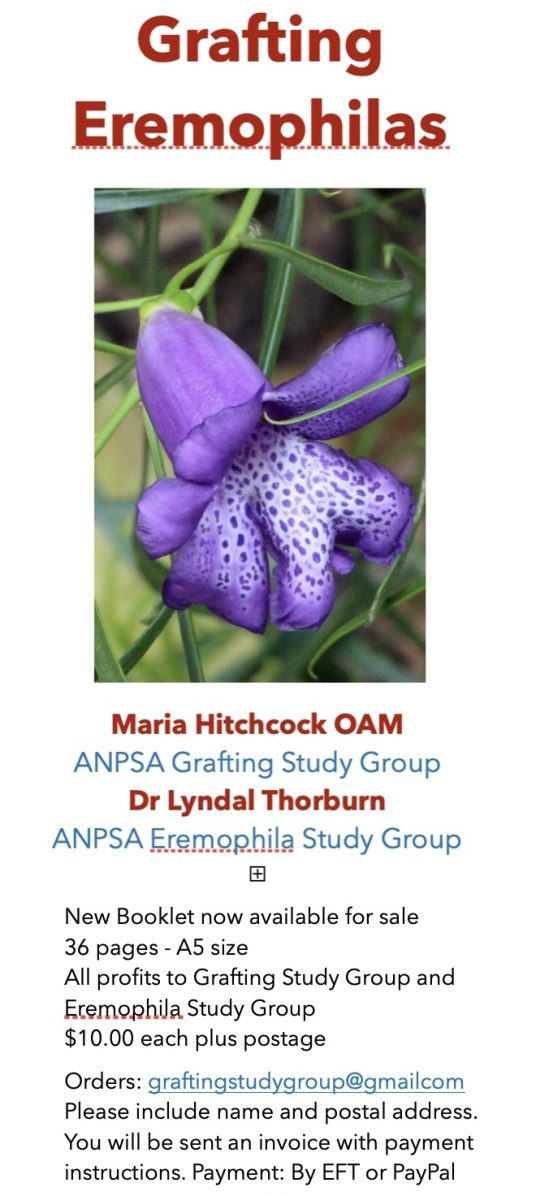
The group has now published a “Grafting Eremophila” booklet. A publicity poster is provided. The newsletter mentions a useful grafting tape and provides a link to a video comparing different types of tape, as well as other relevant videos.
Brendon Plaza reports on his grafting activities with Darwinia and Correa rootstocks, as well as attempts with Telopea on Alloxylon flammeum. He also does Banksia cotyledon grafts. Brendon mentions condensation leading to mould as a problem. It is hard to strike the right balance.
Maria Hitchcock is working with Telopea on the premise that T. speciosissima needs an intergraft on another Telopea species. She is also trying T. speciosissima x truncata on Lomatia silaifolia cuttings. Detailed photos of her method are provided.
Correa SG newsletter, no.71, December 2025
Correa lawrenciana, the Tree Correa, grows well as an attractive dense screening plant (to 4m). Good for boundary plantings.
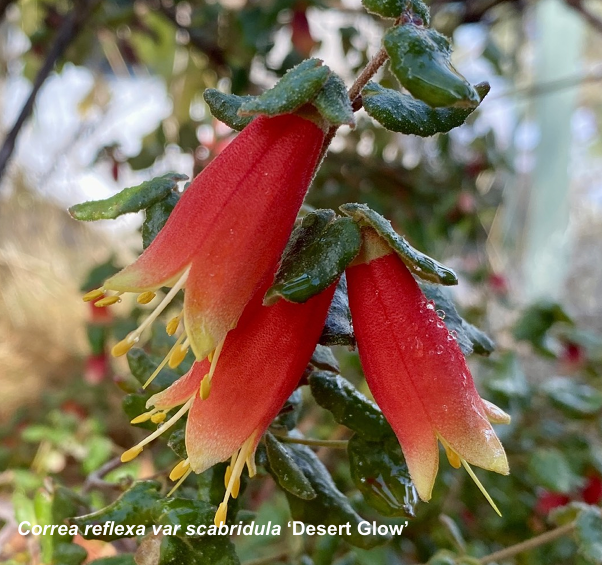
In Black Range, Vic., C. glabra forms have proved hardy in a long dry spell. C. reflexa var. angustifolia, a Grampians endemic, has survived better than C. reflexa var. reflexa. C. reflexa var. scabridula is a beautiful large flowered form from the Little Desert. Neil Marriott has registered it as “Desert Glow” (refer photo).
Meanwhile in the Warrnambool. Vic. Area, a local form of C. reflexa has been given the name “Granny’s Grave”. Propagation efforts and local plantings are helping to preserve it.
Miriam Ford reports on her success in developing a garden on a windy, ancient sand dune in Wonthaggi, Vic. She has had help with the landscaping, and front and back gardens have a different character. Many bags of Neutrog products have been added to improve nutrition and water-holding capacity, as well as cardboard and tree mulch, with a sprinkling of worm castings. She has many correas, including C. “Inglewood Gold”, and C. pulchella varieties such as “Gwen’s Blush” and “Ring a Ding Ding”. Correa “OMG” and “Prolific” are also favourites.
Contact: dlhandscombe@bigpond.com