
Grevillea SG newsletter, no.131, June 2025

In news from WA, grevilleas have suffered a bit less than many other bush plants from the seven-month drought. However following-up reported sites of a number of species has found reduced populations of species such as Grevillea pinifolia and G. squiresiae. In some cases road grading is responsible. There will be a check made next year for possible regeneration.
Brian Weir presents part 2 of his Travellers Guide to Grevilleas in Victoria (species M-W).
John Elton reports from Coolangatta, NSW, that grevilleas grafted onto G. robusta, G. “Carrington Cross” and G. “Bronze Rambler” have survived wet conditions well. Some grey-leaved grevilleas have shown signs of fungal infection, and older specimens of plants from in and around the Sydney basin, have mostly died. Tropical hybrids have survived the wet, but not necessarily the wind that followed.
Meanwhile the Hunter Botanic Gardens suffered a “mini-cyclone” that damaged or blew over more than 100 mature trees. Volunteers have engaged in clean-up work, and replanting of the Grevillea garden has begun.
Contact grevilleanews@gmail.com
Hakea SG newsletter, no.88, June 2025
A study group meeting at a property in the Darling Ranges, WA, allowed members to inspect a large number of Hakeas, irrigated by bore water. With a little help, owners Bob and Judy Howard will soon have all WA hakea species growing. In the following two days, properties at Bullsbrook and further north were visited, including probably the most northerly location of Hakea myrtoides. In the Calingiri area, the only known location of H. chromatropa was visited, in its vulnerable roadside location.
Ian Evans from Bendigo has been successfully grafting hakeas onto H. drupacea. There are a few species however that will only take on H.salicifolia.
Contact: hakeaholic@gmail.com
Grafting SG newsletter, no.3, June 2025
The group has prepared and has for sale a booklet “Grafting Grevilleas : a Guide for the Home Propagator”. The cover features a photo of Grevillea longistyla (pictured).There are also several videos posted to Youtube. The channel is “Grafting Study Group”.
Ian Evans supplies a list of suggested materials for a grafting workshop. Some are commonly available and others can be sourced through Amazon. Elastoplast and Savlon for cut fingers are recommended!
Grafting Eremophila youngii onto E. montanum is illustrated. Aftercare of grafts is important – a cool semi-shaded and sheltered position.
Dave Handscombe (Vic) reports using grafting to propagate some tropical grevillea hybrids, which are otherwise difficult to propagate. Spectacular examples are G. “Canning Cumquat” and G. “Elowen”.
Contact: graftingstudygroup@gmail.com
Acacia SG newsletter, no.160, June 2025
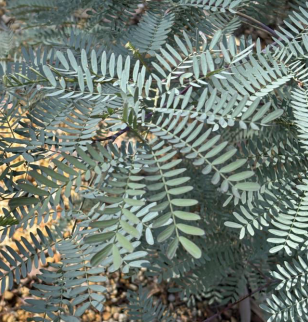
Ros Walcott of Canberra reports two specimens of Acacia blayana thriving in her garden. It is a critically endangered tree native to Wadbilliga National Park on the NSW south coast. It was first described in 1990. Its main feature in the garden is extremely beautiful bipinnate silver foliage (pictured).
A. courtii (Three Brothers wattle), a native of the Brother mountains south-east of Port Macquarie, NSW, has recently been moved from the Vulnerable to the Endangered category of native plants. The reason being the restricted distribution of this species, its decline in habitat, and climatic and bushfire vulnerability factors.
An article by Dr Kit Prendergast presents the results of thousands of hours collecting information about acacia pollinators. A database has been compiled which can be accessed online. An article by Dr Rod Griffin focuses on what we do, and do not know about what pollinates temperate acacias, and suggests some “citizen science” projects.
Contact: acaciastudygroup@gmail.com