
Eremophila SG newsletter, no. 151, June 2026
Eremophila debilis is a low-growing native which forms a ground-covering mat. It’s from semi-arid to arid regions, and requires full sun and freely draining soils. Methods of propagation from cuttings and seed are described.
A recent study revealed that smoke water did not improve the germination rate of E. longifolia seeds, which was a low 7–8% (in soil). However, the genus contains such diversity that the results can’t necessarily be extrapolated to other species.
The study group is sharing the revenue from the recently published Grafting Eremophilas booklet with the Grafting Study Group.
A NSW subgroup has met with a view to re-forming. Issues relating to Eremophilas in cultivation and in the nursery trade were discussed, and grafting techniques were demonstrated. The Queensland subgroup met to discuss causes of Eremophila mortality, including humidity, drought, frost and pests. Meanwhile in South Australia, the subgroup discussed Eremophilas in the rejuvenation plantings at the Adelaide Botanic Gardens.
Contact: lthorburn[at]viria.com.au
Garden Design SG newsletter, no. 134, July 2026
Lawrie Smith presents an account of his involvement with the Sensory Garden at the Gold Coast Botanic Garden. Sound, smell, taste, sight and touch were all aspects which were considered when evaluating plants.
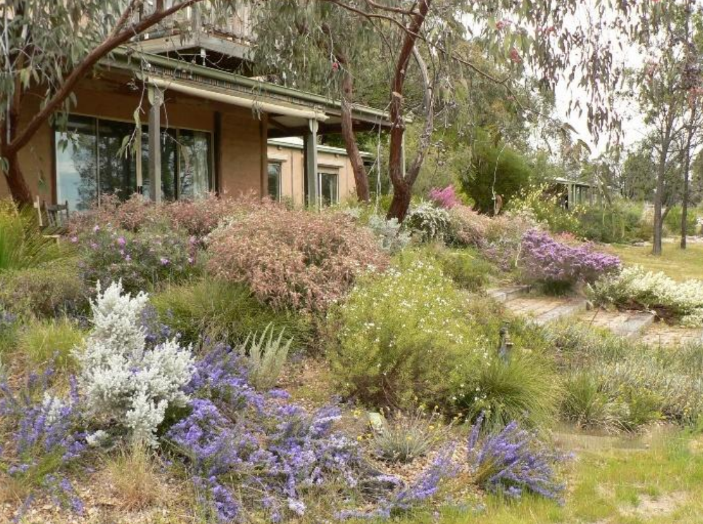
The study group has been in existence for 33 years. The group publishes a newsletter, and Queensland members meet bimonthly to visit residential gardens and parklands to analyse the landscape design and observe plants in detail. In the newsletters, members have commented over the years what the study group, and garden design generally, means to them. Photos are published, eg the attached photo of Neil Marriott’s garden in the Grampians, Vic. Current leader Lawrie Smith is seeking a replacement leader who will help the GDSG continue to grow and expand its influence.
In Melbourne, the Gardens for Wildlife volunteer program has spread rapidly. As part of her participation, Janette Wilson of Seaford, Vic. is exploring how wild gardens and designed gardens can co-exist and enhance each other. Her photos illustrate how different elements such as plant selection, water, rocks, mulch and logs can contribute.
‘Contemporary Garden Design’ is the planned theme for the next newsletter,
Contact gdsg@anpsa.org.au
Grevillea SG newsletter, no. 163, June 2026
Peter Olde advised a recent meeting that in the forthcoming Grevillea revision, all Grevilleas with entire leaves, and most with toothbrush racemes, will stay in Grevillea. Most tropical Grevilleas will come out of Grevillea; however, most garden-cultivated species will still be Grevillea. The study group will likely be renamed the Grevillea and Allied Genera Study Group.
On the topic of ‘preservation by cultivation’, Neil Marriott observes that planting to conserve WA species in danger of being wiped out is an important priority for the group, as the WA government does not intervene to protect them.
Grevillea parallela and G. striata are similar, but some morphological features can assist in identifying them. These are outlined in an article by P. Olde.
A photo gallery for Grevillea species is being established on the ANPSA website, and further photos are sought for missing species. Another project involves photographing seeds and follicles. Some tips for seed collection are provided.
Contact: grevilleanews@gmail.com
Acacia SG newsletter, no. 163, July 2026
Several commercial ventures receive a mention in the newsletter. Footeside Farm in South Australia grows and markets wattle seeds and other native foods. A small business in Rylstone, NSW, is selling natural home and body products, including a popular moisturising cream containing a fragrance extracted from the sunshine wattle, Acacia terminalis. A body scrub includes ground seeds from A. mearnsii.
Acacia have some penetration into the cut flower market, with A. aphylla, A. baileyana, A. cultriformis and A. dealbatabeing named. Further recommendations are sought.
Unusually coloured acacias continue to receive interest, with several members reporting their experience with A. leprosa‘Scarlet Blaze’, A. leprosa ‘Just Peachy’ and A. terminalis ‘Pink Sunshine’, as well as A. ‘Twilight Glow’, a hybrid of A. howittii × A. leprosa. ‘Twilight Glow’ has mustard-pink ball flowers with yellow stamens.
Several small WA acacias are described in the newsletter. A. moirii subsp. moirii is pictured, with quite large and bright yellow ball flowers on a small plant. It’s virtually gone now from the south Stirlings location where seed was collected, due to clearing and road verge degradation. A. squamata is a great little plant from the southwest of WA. It is a low-growing, sometimes trailing shrub.
Contact: acaciastudygroup@gmail.com SG newsletter summaries Jun-Sep…
Australian Pea Flower SG newsletter, no. 8, July 2026
The features found on plant surfaces can be crucial in distinguishing species. These include hairs, textures and the presence of trichomes, including hairs, bristles, scales, spines or other hair-like outgrowths. The term for the hairy covering of plants is indumentum, which has a range of environmental functions such as water and temperature regulation.
The lead article of the newsletter provides a comprehensive account of the range of plant surfaces encountered, with examples drawn from the native peas. This will extend the vocabulary of all native plant fans!
Several members have supplied articles documenting the multi-day ‘Pea prowl’ in 2025 through the Grampians, Victoria. The pea species encountered are named, with broader descriptions of vegetation communities and mention of other notable species observed.
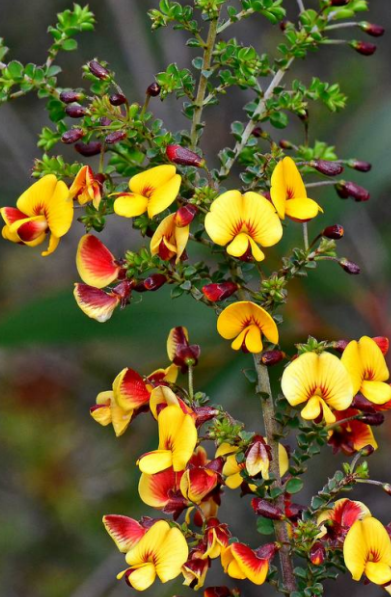
Endemic species observed included Pultenaea patellifolia, the Mount Byron bush-pea, at Black Range State Park, and Dillwynia oreodoxa, another Grampians endemic, on the Splitters Falls walk, while Hovea rosmarinifolia at Wartook Lookout was delicate and beautiful.
Besides the bushwalks at a number of locations, the Wartook Gardens and the Grampians/Gariwerd Endemic Botanic Gardens were visited by the Pea Study Group members.
On another pea quest, group leader Shirley McLaran visited the New England region of NSW and the adjacent region of Queensland. Locations visited included Boonoo Boonoo National Park and the Torrington State Conservation Area. The Washpool and Gibraltar Range National Parks were also explored.
The highlight was locating Dillwynia rupestris, a Gibraltar Range endemic, in flower, while Mirbelia speciosa was also at its peak flowering.
Members are reminded that they can join a related Facebook group for discussions and photo sharing. Search for ‘pea flower study group’ and request to join.
Contact: fabpeamail@gmail.com
Grafting SG newsletter, no. 8, September 2026
Robert Grundy writes of his experience grafting Eremaea and other Myrtaceae. He has been able to establish five grafted species of Eremaea in his garden, with others looking good to plant out. Compatible rootstocks are being sought for other species. Success with Beaufortia, Kunzea and Melaleuca is also reported.
Brendan Plaza is having considerable success with approach grafting Grevilleas, and has developed his own technique. It has potential for Waratah and Alloxylon also.
John Elton talks about Eremophila standards. Why grow them? What understock? What height? And what is the best technique? One observation is that lifting the plants off the ground on short standards improves air movement and somewhat reduces humidity.
Eremophila waitii has maybe the greatest potential to look great as a standard; however, any compact-growing Eremophila is worth a go.
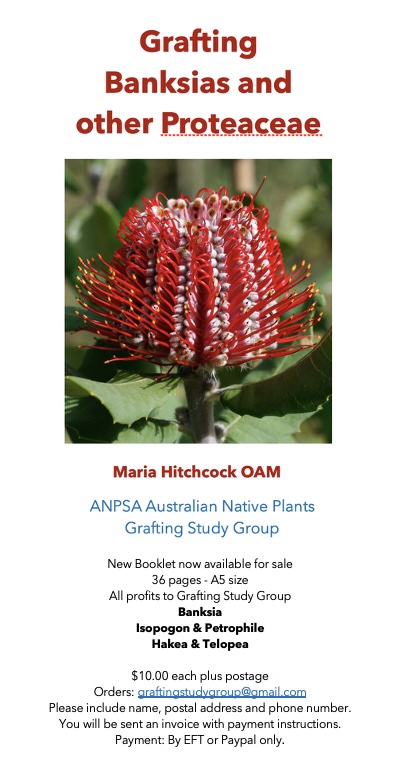
The study group has recently published a third booklet on grafting. It is Grafting Banksia and other Proteaceae.
Contact: graftingstudygroup@gmail.com
Eucalyptus SG newsletter, no. 79, Winter 2026
The visually striking newsletter’s new title is The Scribbly Gum, and it features an article by Malcolm French addressing the question of whether all gum trees are Eucalypts.
First Corymbia was separated, and now Blakella is to be split off, the latter being our ghost gums. The writer thinks there is a case for putting all eucalyptus back in one robust genus, Eucalyptus.
Ian Roberts discusses the performance of his Eucalypt plantation on Scobie Road, Clare Valley, South Australia, over 20 years. He has to report losses of higher rainfall species, and the better performance of local and WA species. He has a high soil pH (8.5), which some of the more spectacular species do not like, but he keeps trying!
The study group is to run an excursion to the Barkly Arboretum of study group leader Bryan Rau, on 3–4 October. The arboretum grows more than 115 species.
‘Gum Glimpses’ is a gallery of snapshots and observations submitted by members, which rounds off the newsletter. Shots of the striking new eucalypt species from Cape York Peninsula are included, Eucalyptus sp. ‘Bottlecamp’, with stunning orange flowers.
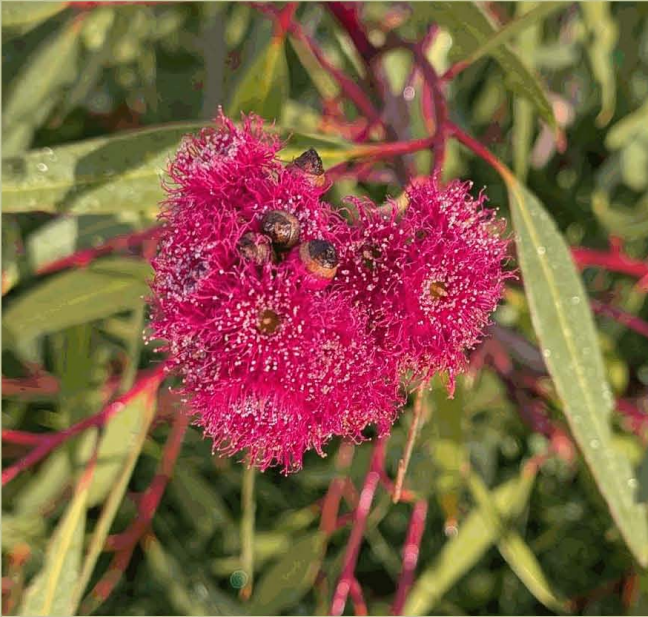
Meanwhile, an attractive photo of Eucalyptus lansdowneana flowers heads up the newsletter.
Contact: nutsaboutgums@outlook.com