
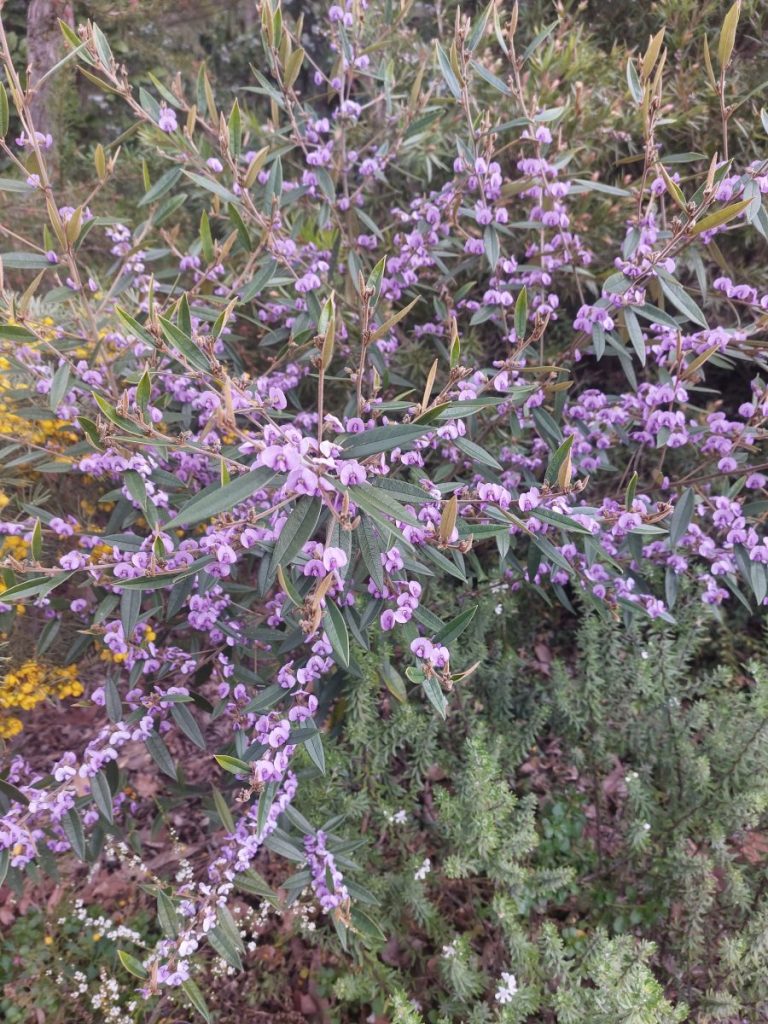
I have had this plant growing in my garden for years with no maintenance except a prune after flowering. It is inconspicuous in my garden and I really only notice them after decent winter rain, as they typically grow around Sydney along creek lines and banks in moist-dry and wet sclerophyll forests. It is a medium shrub to 3 metres tall, usually with a narrow spread.
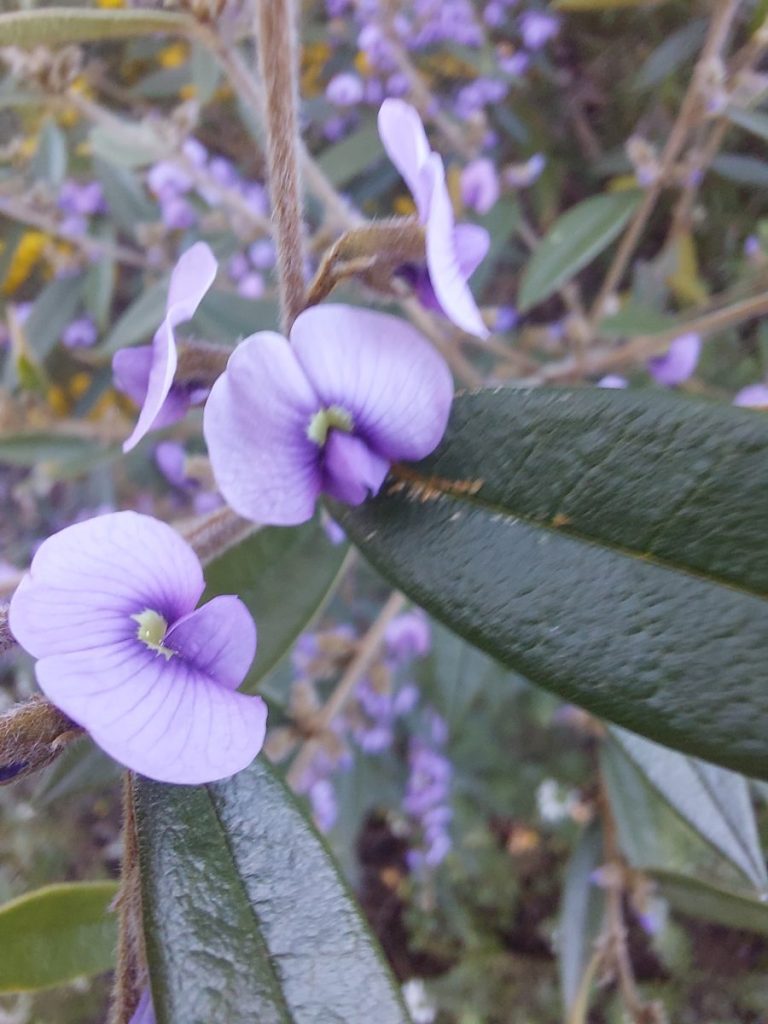
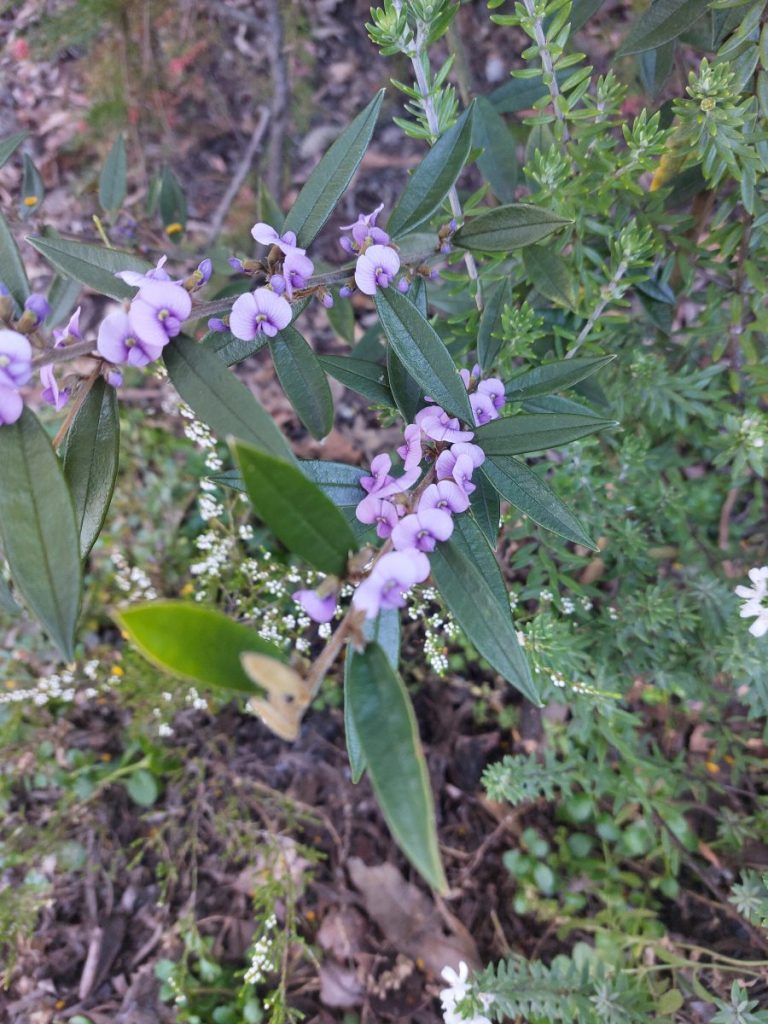
Flowers are pea-shaped with 5 petals in a fixed arrangement; the main back petal is called the “standard”, two lateral petals called “wings” and two fused petals at the bottom called the “keel”. The flowers occur in leaf axils, either solitary or in groups of 3, blue-mauve in colour and fade to whitish colour.
The seeds are contained in a pod, approximately 15 mm long and seeds are about 3 mm long. New plants are easily grown from seed that needs to be soaked in hot water, to soften the hard seed coat, before sowing. Cuttings of hardened, current season’s growth strike readily as well.
Well worth growing for the attractive flower colour alone. Try a few in your garden.
-
Habitat & Range – Hovea longifolia, commonly called the Rusty Pods, is found in coastal and near-coastal areas of New South Wales and southern Queensland, typically in moist, sheltered gullies and along creek lines in sclerophyll forests.
-
Growth Habit – It is an upright shrub that can grow up to about 3 metres tall, often with a narrow, slender form, making it well-suited to natural-style gardens.
-
Leaves – The leaves are long and narrow (hence longifolia), dark green on the upper surface and paler beneath, with a velvety or rusty-brown underside that gives the species its common name.
-
Flowers – Like other members of the pea family, it produces purple to mauve pea-flowers, usually in late winter to spring. The blooms are often noticed after periods of good rain.
-
Pods & Propagation – The plant produces small brown pods that contain hard-coated seeds. Propagation is usually from seed (which benefits from hot-water treatment) or from cuttings, though cuttings can be more difficult to strike.