
On this website you will read that APS (NSW) is a member of The Nature Conservation Council, which represents over 200 community organisations and is a leading advocate for nature in NSW. Most NCC groups are small with APS (NSW) being one of the largest.
The 2025 Nature Conservation Council of NSW Annual Conference was special. It celebrated its 70 anniversary and included speakers who were past firebrands for nature and conservation. The very capable NCC chair Carolyn Loton mentioned some of this year’s great environmental successes such as the declaration of the Great Koala National Park and the NSW parliament’s repeal of John Barilaro’s Kosciuszko Wild Horse Heritage Act 2018. The NCC’s focus on the future will be the protection of Australia’s north-west shelf from the effects of gas extraction, the saving of NSW old growth forests, control of land clearing, maintenance of water quality and the protection of coastal wet lands. An issue close to the hearts of APS Blue Mountains group was a motion passed objecting to the construction of three glamping camps along the ridge line of the Gardens of Stone National Park.
Invited politicians gave many compliments. Penny Sharpe MLC, Minister for Environment, Heritage, Energy, and Climate Change, congratulated the NCC for its 70 years of campaigning that has brought great change to the government’s perception of the value of the natural environment and heritage. She also congratulated her government for creating the Great Koala National Park. This will have existing national parks combined with 176,000 hectares of state forests to create a network of protected areas encompassing over 475,000 hectares from Kempsey to Grafton and inland to Ebor. We were to hear more about this later from Dailan Pugh.
The ever enthusiastic Sue Higginson MLC, Greens Spokesperson for the Environment and Climate Change, gave another impassioned inspirational speech for the environment. James Griffin MP, Shadow Minister for Energy, Climate Change and Environment, also spoke of his support for NCC policies and of the importance of an opposition to keep the Labour government on its toes. Penny Sharpe had already reminded us that environment decisions were ultimately made by the government’s Cabinet.
After lunch legendary protester Meredith Burgmann AM, former President of the NSW Legislative Council, delivered a most entertaining description of her political activism. Besides remembering some of Meredith’s antics during the late 1960s and 1970s that started with the anti-Vietnam War demonstrations she is also remembered as the longest serving woman member of the NSW Legislative Council. She recounted how her environmental activism began with the fight for Kelly’s Bush in Hunters Hill. This resulted in the world’s first Green Ban, imposed by the Builders Labourers’ Federation in 1971. At this time during the anti-apartheid demonstrations Meredith was also imprisoned for running onto the Sydney Cricket Ground during the Springboks tour in 1971. The Kelly’s Bush campaign brought Meredith into contact with Bob Pringle whose brand of unionism advocated that workers had the right to insist that their labour couldn’t be used in harmful ways. Up to that time this worker’s ethic of do no harm was reserved for medical practitioners. Eventually after many green bans and clashes with the law The Rocks, Woolloomooloo, Centennial Park and Moore Park, the Glebe Estate and the Pitt Street Uniting Church were saved from demolition and development. Harry Seidler wanted to rip down the beautiful Queen Victoria Building. “It is an architectural monstrosity, a wasteful, stupid building,” Seidler said. The violent fight to save Victoria Street in King’s Cross from high rises in the early 1970s led to the disappearance (and suspected murder) of Juanita Nielsen. Meredith reminded us that before the green ban campaigns there was no legislation or Land and Environment court to protect nature and our built heritage.
While Meredith was concerned about the city Dailan Pugh OAM was a forest campaigner, artist and co-founder of the North East Forest Alliance (NEFA). Dailan depicted the Terania Creek protest against the Forestry Commission’s plans to clear fell the rainforest in 1979. This was his first encounter with environmental activism. Letter writing, ABC documentaries, legal action and the obstruction of forestry operations by lying in front of bulldozers resulted in Neville Wran, then New South Wales premier, making the historic ‘rainforest decision’ in October 1982. Terania Creek is now part of the World Heritage-listed Nightcap National Park, which would be further expanded with subsequent campaigns. The lessons from the Terania Creek protests were used in stopping the Franklin River Dam in Tasmania, the forest wars at Eden on the NSW Far South Coast and even the anti-coal seam gas (CSG) movement that culminated in the blockade at Bentley in Northern NSW where it took 900 police to break up the protest.
Since 1979 Dailan has been involved in actions from old-growth forest blockades to detailed ecological surveys and political advocacy. His persistence and vision helped to protect over 1 million hectares of forest across the North Coast. Following the first North Washpool blockade in 1989 Dailan co-founded the North East Forest Alliance (NEFA) to protect rainforest, old growth forest, wilderness and threatened species. In 1990 a second blockade of North Washpool and a court case stopped logging of mapped rainforest on public lands. In 1990 NEFA forced the NSW Government to establish moratoria over some 180,000 ha of old growth forest at the Chaelundi State Forest, which borders the Guy Fawkes River National Park north-west of Dorrigo until Environmental Impact Studies were prepared. 230 people were arrested in this struggle. As a result of a series of cases brought before the NSW Land and Environment Court between 1989 and 1991 Guy Fawkes River National Park increased in size and Chaelundi National Park was established in January 1997. The success of this campaign depended upon a landmark decision in which the interpretation of section 99 of the National Parks and Wildlife Act, 1974 (NSW), which stated that it was an offence to “take or kill any endangered fauna”. This section was subsequently used to protect other old growth forests. This led to NSW’s first threatened species legislation – the Endangered Fauna (Interim Protection) Act 1991 which focused on threatened species outside of national parks. Eventually the NEFA were instrumental in increasing the area of national parks and other conservation reserves in north-east NSW from 968,335ha in 1989 to 2,033,227ha in 2011. This is an increase of 1,064,892 ha or 110%. The creation of the Great Koala National Park which links many of these past victories with new National Park areas that were State Forests is indeed a great victory for nature.
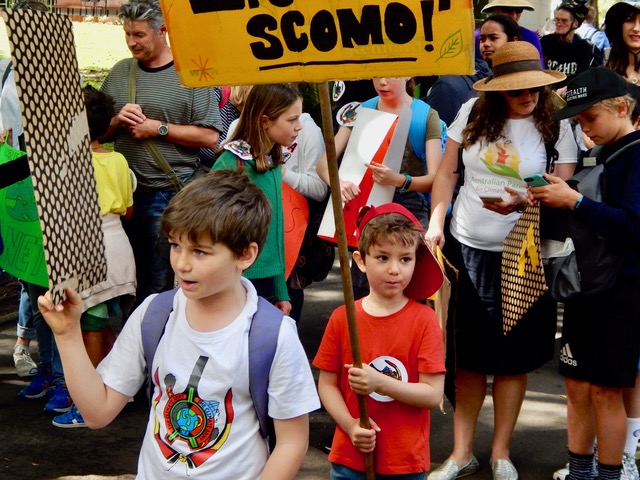
Without strong determined leadership the above-mentioned environmental campaigns would not have been successful. The last speaker was Cate Faehrmann MLC, Greens Member of the NSW Legislative Council. For many years Cate was the Executive Director of the Nature Conservation Council of NSW, where she launched Walk Against Warming rallies in 2005 that brought 140,000 people onto the streets for climate action 2008. The movement for climate action grew so that on Friday 20 September 2019 I attended a massive School Strike Against Warming event in the Domain. This followed from the “Fridays for Future” movement inspired by Greta Thunberg. These protests required the NCC’s planning, strategic and logistical support.