This article was originally published in the Blue Mountains 2025 Summer Edition Newsletter.
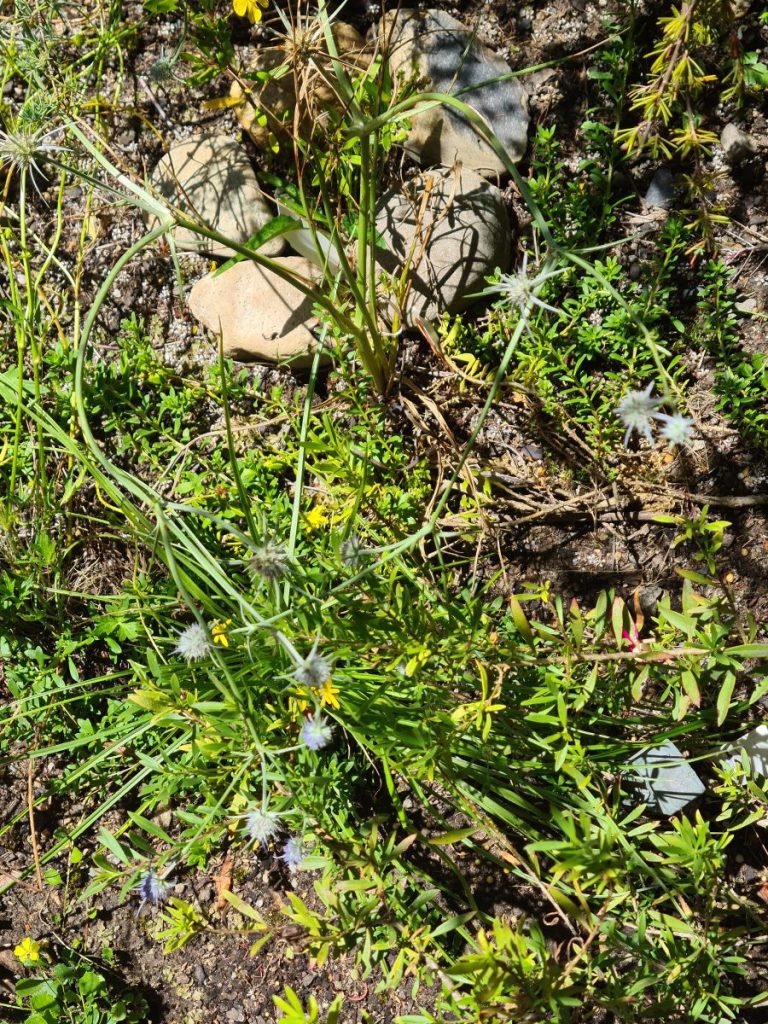
Eryngium ovinum with common name The Blue Devil plant.
It is a fascinating perennial herb native to Australia I now have in our garden. See my photos.
It might not be preferred due to its prickly and somewhat weedy-looking nature but the blue-purple colour is certainly interesting.The Blue Devil could make an eye-catching addition to a cottage garden or rockery.
I came across it in the Canberra Arboretum as an understorey plant in their native STEP garden.
In case of interest or you want to visit their website has:
“In contrast to the monocultural forests at the Arboretum, the Southern Tablelands Ecosystems Park (Forest 20) grows 16 different species of eucalypt trees, shrubs, herbs and grasses typically found in the Southern Tablelands region of New South Wales and the ACT. Planted in 2009 and 2010, the Park includes trees and plants of the critically endangered ‘Yellow Box/Red Gum Grassy Woodland’ ecosystem. Trees are arranged in bands representative of their natural position in the landscape, and are complemented by the Central Garden display of native understorey species typical of the forests, woodlands, grasslands and ephemeral wetlands of the local region. Understorey species are located close to the eucalypt species they commonly grow near in their natural habitat. This design enables visitors to learn about tree and understorey associations and further develop their understanding of the natural environments of the Southern Tablelands.”
I found it for sale at Cool Country Natives in Pialligo, Canberra. It came with an identification label and a threatened species label.

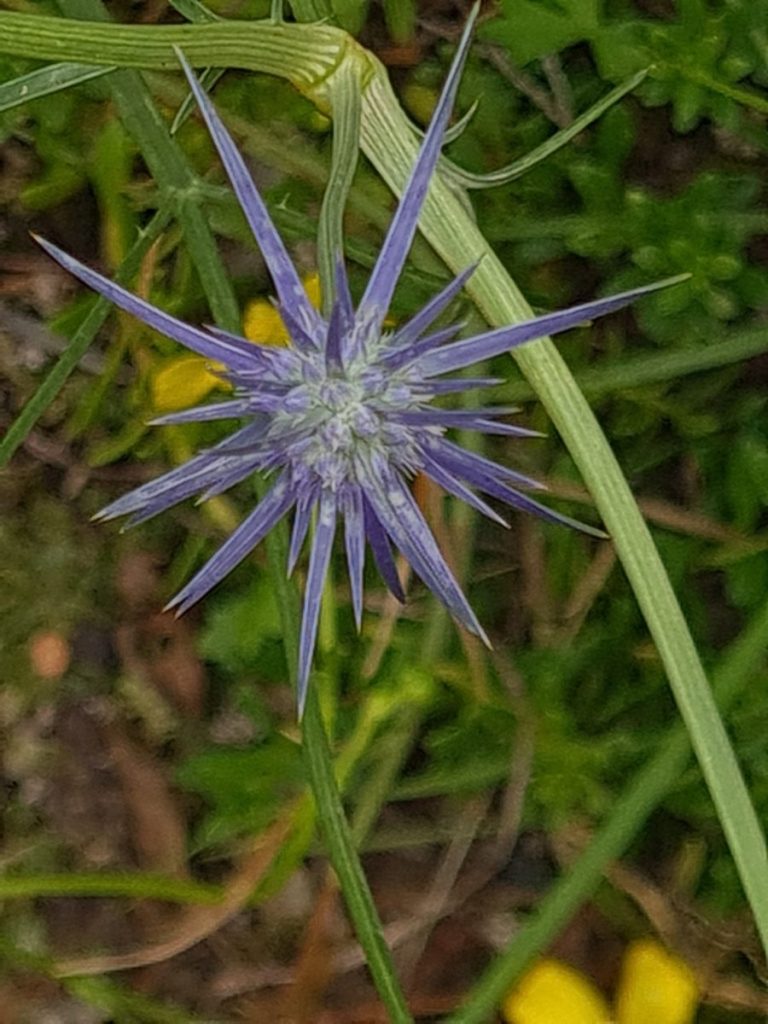
Appearance: This plant typically grows to about 60 cm tall and forms clumps of spiky, metallic blue to purple foliage. Its leaves are reminiscent of a thistle, adding to its unique look.
Flowering: It produces bright blue, spiky flower heads in summer, which are quite striking.
Habitat: It’s commonly found in temperate woodlands and grasslands across New South Wales, Victoria, South Australia, and Western Australia.
Growth Conditions: It prefers well-drained soils and sunny positions. It’s frost hardy and relatively low-maintenance.
Uses: The Blue Devil plant can be used in rockeries, open beds, or as cut flowers for fresh or dried arrangements.
The stems and bracts are a metallic blue and, together with its ‘spiky’ look, give rise to its common name, Blue Devil.
Extremely spiky. A perennial herb that dies down in winter but re-emerges with blue metallic flowers in summer.
Australian National Botanic Gardens has this distribution map.
The Blue Devil plant (Eryngium ovinum) is widely distributed across temperate regions of Australia. Here’s a summary of its distribution:
• New South Wales (NSW): Common in the tablelands and western slopes, extending to the south-western plains around Deniliquin.
• Victoria: Found around the western parts, south from Albury, and generally through the northern central areas and south-west of the state.
• South Australia (SA): Grows in separate patches, north of Mt Gambier, around Adelaide, and further north around Burra, Clare, and Saddleworth.
• Queensland: Present west of Warwick and Toowoomba.
• Tasmania: Seen around the Hobart area and further north-east near Pontypool.
• Australian Capital Territory (ACT): Naturally grows around Canberra.
• Prefers: Well-drained soils and a sunny position. It can tolerate medium frosts and works well in rocky, open beds or as a feature in sunny garden spots.
Ecological Role
• Pollinator Friendly: The plant attracts bees and other beneficial insects, playing a role in supporting local pollinator communities.
• Drought Tolerant: Its hardy nature makes it a valuable plant for gardens in arid or semi-arid climates.
Gardening Tips
• Care: It’s relatively low-maintenance, needing minimal watering once established and regular pruning to remove dead foliage.
• Propagate: Easily grown from seed planted in well-drained soil during summer.
The Blue Devil plant’s combination of resilience, striking appearance, and ecological benefits makes it a fantastic addition to both natural and formal garden settings.