
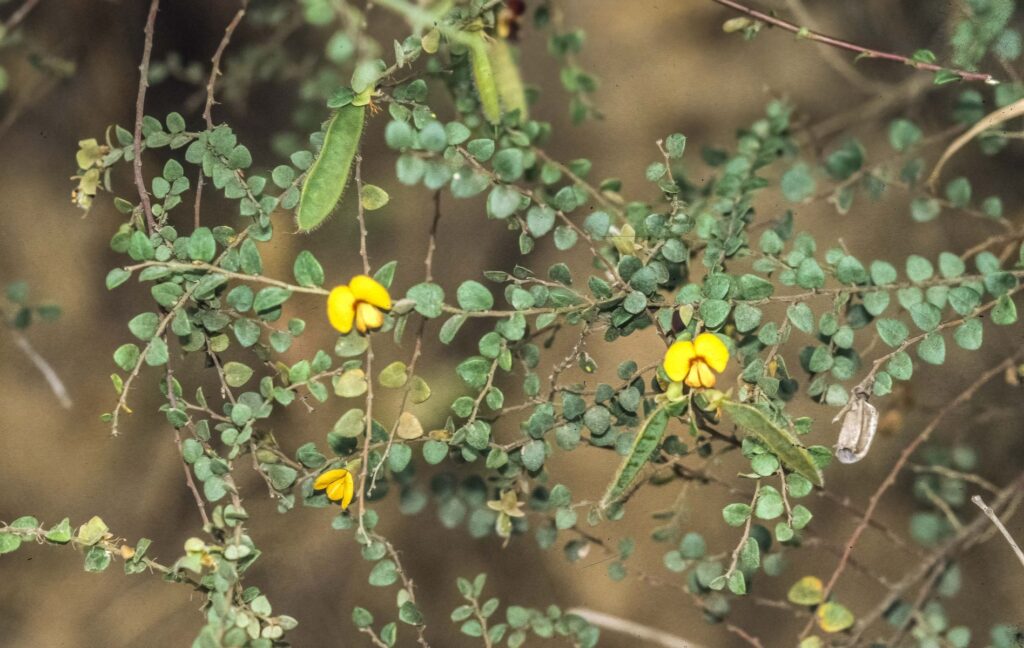
Bossiaea neoanglica is one of those quietly rewarding plants that rewards the attentive bushwalker — a low-growing, spreading shrub of dry sclerophyll woodland that catches the eye in flower but is easily overlooked at other times. Despite being endemic to NSW and Queensland, it remains little known in cultivation, and even less written about. For members exploring the native flora of the New England and central coast regions, it is worth getting acquainted with.
Distribution and Habitat
The natural distribution of Bossiaea neoanglica is genuinely interesting. In NSW it occurs in two broadly disjunct patches: one on the central coast running roughly between Campbelltown, Lake Burragorang and Bundanoon in the Southern Highlands; and a second further north, scattered across the area west of Gloucester, through the northern tablelands around Armidale and east of Glen Innes, reaching the Queensland border at Jennings. It extends into Queensland, though records there are scattered. Throughout its range it grows in dry sclerophyll woodland and forest on sandy soils, often in fire-prone country.
Identification
Bossiaea neoanglica is a prostrate to low-lying shrub reaching around 50 cm in height. Its leaves are arranged alternately, ovate to roughly round, up to 8 mm long and 7 mm wide, dull green to blue-green on the upper surface with minute raised tubercules, and paler and hairy beneath.
The flowers are the real drawcard. Like all members of the pea family (Fabaceae), they are papilionate in structure — five petals arranged in the classic configuration of a standard, two wings, and a fused keel enclosing the reproductive parts. In this species the flowers are borne singly in leaf axils and are up to 9 mm long. The standard petal is a striking combination of dark red on the outside and bright yellow inside with red markings, while the wings and keel are dark red with brown markings. The fruit is an oblong pod to 25 mm long.
The genus Bossiaea itself is worth understanding. Some species carry normal simple leaves, while others have leaves so reduced that the stems have become flattened photosynthetic structures called cladodes. B. neoanglica belongs to the leafy group, with small stipules present as is typical across the pea family.
In the Garden
Bossiaea species as a group are not widely cultivated, which is something of a mystery given how attractive they are in flower. Species like B. heterophylla, B. walkeri and B. scolopendria can stop you in your tracks when seen in full bloom in the bush. B. neoanglica is no exception.
Cultivation information for this species specifically is limited, but the general requirements of the genus provide a reasonable guide. A sunny position with well-drained sandy soil suits it well. Plants are reportedly straightforward to grow once established, and the main challenge is simply sourcing them — check with native plant nurseries or online tubestock suppliers, as seed is not always readily available.
Propagation
Seed propagation requires pre-treatment to break dormancy. The hard seed coat needs to be softened by soaking in boiled water for 12 hours, after which the swollen seeds can be sown into a mix of three parts coarse sand to one part peat moss or equivalent. Cuttings are an alternative and strike reasonably well from firm current-season growth, which may be the more reliable path given the variable availability of seed.
A Little Taxonomy and History
The genus Bossiaea comprises at least 50 species, all endemic to Australia and found across every state. NSW currently recognises 30 species. The genus was named by French botanist Etienne Pierre Ventenat in honour of Joseph Hugues Boissieu de la Martinière, a physician and plant collector who sailed with the ill-fated La Perouse expedition of 1785 and disappeared when the ships were lost in the Solomon Islands. The species epithet neoanglica derives from the Greek and Latin for “New England,” reflecting the region where the species was likely first collected.
This species is not currently considered threatened with extinction in the wild.
Further Reading