
This article was originally published in the Blue Mountains 2025 Summer Edition Newsletter.
Teresa gets in a diverse range of plants from numerous outlets. This is another interesting one.
I purchased it and it is a fascinating plant native to Queensland. It is found in the top half of Queensland near the coast and occurs in Cape York Peninsula and Northeast Queensland as far south as Rockhampton.
Grow it as you would an African Violet. It thrives in well-drained soil, light shade to heavy shade, and requires regular watering to keep the soil moist but not waterlogged.
This is Australia’s answer to the African Violet to which it is closely related. See my photos of my plant.
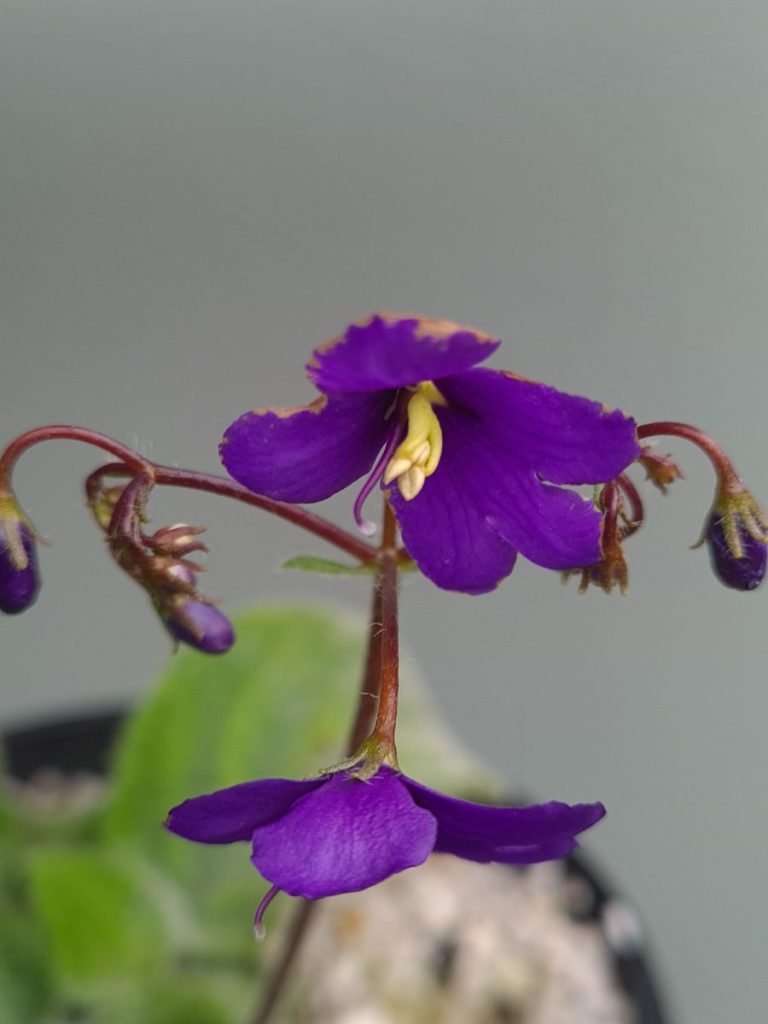
It has fleshy, ovate leaves that can absorb moisture efficiently, adapting well to humid surroundings. The plant produces small, purple flowers.
Rock Violet is typically found growing along creek beds, on moist banks, and moss-covered rocks in rainforests, open forests, vine forests, and gallery forests.
It is considered a “resurrection plant” because of its ability to withstand virtually total water loss. Detached leaves can survive desiccation and recover fully when watered again.
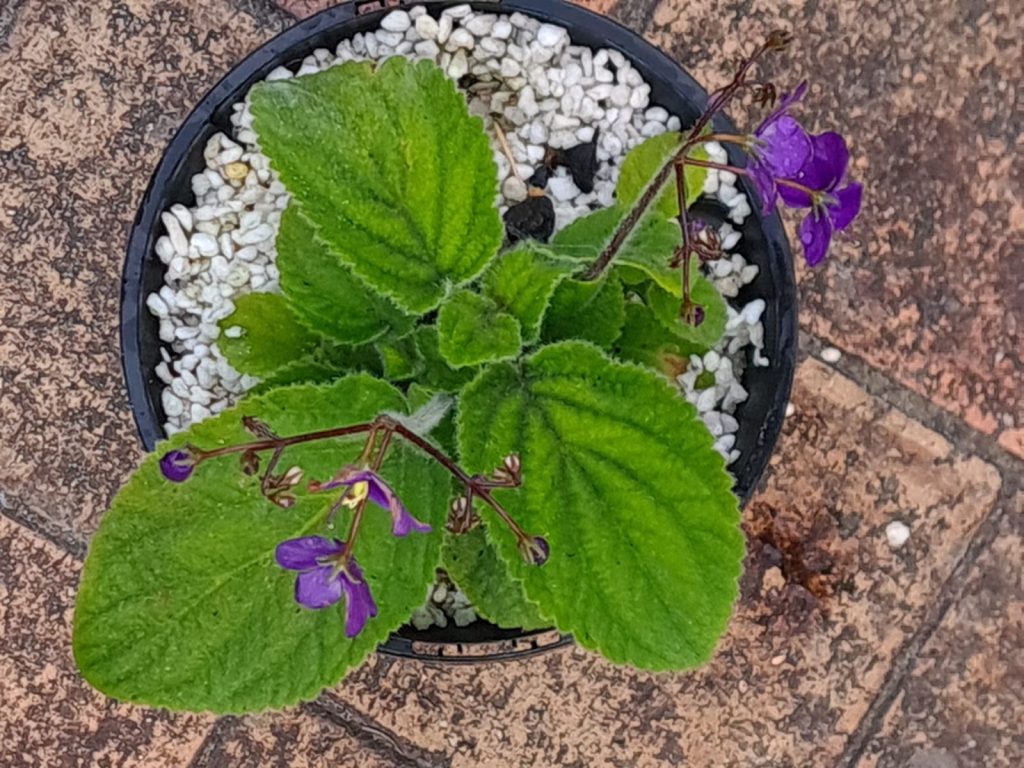
You can look up Boea. It does not have an etymology and if curious you will see it could be a corruption of the surname Beau for which it was apparently named. Once you have it in the right location the only maintenance required is the removal of any dead or dying flowers and foliage.
The term “hygroscopica” comes from the Greek words “hygro,” meaning “moisture,” and “scopos,” meaning “to see” or “to observe.” In the context of Boea hygroscopica, it refers to the plant’s ability to absorb moisture from its environment. Thus, the name highlights its fascinating characteristic of resilience to dehydration and its remarkable capacity to revive upon rehydration.
Cultivation
-
Location: When planting in your garden, choose a location that mimics its natural rocky habitat. It thrives in well-drained soil and partial shade, which helps protect it from harsh sunlight.
-
Soil: Use a coarse, well-draining potting mix if planting in pots. Adding perlite or sand can improve soil drainage.
-
Watering: Water the plant thoroughly but allow the soil to dry out between waterings. Its remarkable ability to revive after dehydration means it can handle periods of dryness well.
-
Propagation: It can be propagated by seed or leaf cuttings. If using leaf cuttings, place them in a moist, well-drained medium until they root.
Ecological Significance
• Erosion Control: The Rock Violet’s preference for rocky crevices and its root system help stabilize soil in its natural habitat, reducing erosion.
• Habitat for Insects: It provides a micro-habitat for various insects and small invertebrates that live in the crevices and under the plant.
• Indicator of Environmental Health: The presence of Boea hygroscopica can indicate a healthy, undisturbed natural environment. Its survival and revival capability make it a resilient plant in varying conditions.
Extra Care Tips
• Avoid Overwatering: Overwatering can cause root rot, especially in confined environments like pots.
• Mimic Natural Conditions: Try to replicate its natural rocky and slightly shady environment as closely as possible for the best growth results.
From Wikipedia, the free encyclopedia –
Boea is a genus of plants in the family Gesneriaceae, with species originating from Australia, China, India, Malaysia, Myanmar, Philippines, Polynesia, Solomon Islands, Thailand, Papua New Guinea, Indonesia, Nepal, Bhutan, Cambodia, Vietnam and Laos.
Boea hygroscopica (known as Rock Violet) is one of 15 species of flowering plant of the Boea genus in the gesneriad family. It is considered a ‘resurrection plant’ because of its ability to withstand virtually total water loss. Detached leaves of B. hygroscopica can withstand desiccation by increasing the small amount of constitutive glutathione by up to 50 times.
Gesneriaceae, the gesneriad family, is a family of flowering plants consisting of about 152 genera and ca. 3,540 species in the tropics and subtropics of the Old World (almost all Didymocarpoideae) and the New World (most Gesnerioideae), with a very small number extending to temperate areas. Many species have colourful and showy flowers and are cultivated as ornamental plants.
Etymology
The family name is based on the genus Gesneria, which honours Swiss naturalist and humanist Conrad Gessner.