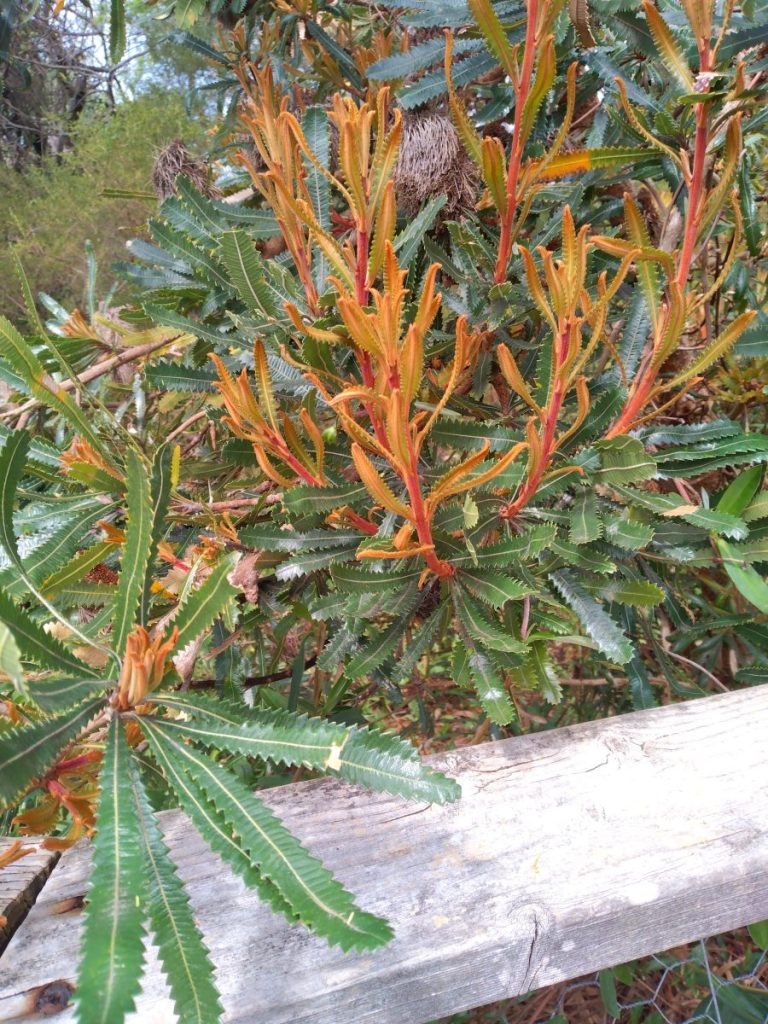
Banksia aemula (Harbour Georges River Group)
In October 2025, the HGR group undertook a walking tour of the Randwick Environment Park, described under the Randwick Council website – Randwick Environment Park comprises 13 hectares of parkland, bushland and wetland. The bushland and wetland provides valuable habitat for native birds, lizards, frogs and mammals. More than 90 species of indigenous plants have been identified in the park. The Park contains 3.6 hectares of Eastern Suburbs Banksia Scrub, a critically endangered ecological community, and is also home to the endangered Sunshine Wattle. The park, originally part of the Randwick Army Barracks, opened in 2010, and is cared for using our Randwick Environment Park Plan of Management.
One of the plant highlights of the walk was the Banksia aemula. Reported to be a relatively easy plant to grow in the right spot and on the right soil – sandy and free draining. It does not grow as big as other banksia and is considered more versatile but is harder to source.The full notes to their walk are p4 October 25 HGR Newsletter
In the garden: Bursaria spinosa
An easy and useful plant for gardens. Although thorny and sometimes difficult to maintain, it can be grown in out-of-the-way areas or used as a barrier plant. Very hardy once established and highly recommended for attracting small native birds.
Blackthorn is ecologically significant, providing secure nesting sites for small birds.
Author’s note: Bursaria spinosa has regenerated vigorously in cold-climate gardens following the removal of grazing stock. Local clumps often show many old nests. The flowers provide nectar and attract insects such as Blue Flower Wasps (Scolia sp), whose larvae help control Scarab Beetles — a factor in eucalypt decline on the Northern Tablelands. The species is also crucial to the Bathurst Copper Butterfly (Paralucia spinifera), serving as its principal food plant; restoration work is underway to support its survival.
The plant may self-seed, can be pruned to maintain density and height, and may cause skin irritation due to sharp thorns. Handling prunings can be difficult. Occasionally affected by sooty mould and scale.
Plant in full sun with room to spread, away from traffic areas. Found naturally on clay, alluvium, and sandstone soils — generally thrives in most gardens once established.
The referenced photo shows a Spotted Flower Chafer Beetle seeking nectar.
By Warren and Gloria Sheather. Editing and additional text by Dan Clarke.
Burrendong conservation project
Burrendong Botanic Garden & Arboretum (BBGA) has announced the launch of its Living Collections Plan 2026+, marking a significant step in the institution’s long-standing role in native plant conservation. The new plan sets out a renewed vision for the future, with a major rejuvenation program beginning in 2026.
Located on 164 hectares overlooking Lake Burrendong in central western NSW, BBGA was established in 1964 following more than three decades of advocacy by local farmer and founder George Althofer, with support from his brother Peter and Peter’s wife Hazel. Althofer is regarded as a pivotal figure in the promotion of native plants in Australian horticulture.
Entirely devoted to Australian flora, BBGA holds legacy collections including Eucalyptus, Prostanthera, and drylands species, and is now extending its focus to the conservation and display of regional flora. Planned works include upgrades to the iconic Fern Gully and collaboration with Wiradjuri traditional owners to acknowledge cultural plant connections across Country.
BBGA’s core mission is to preserve an inspirational collection of Australian plants, particularly those of the inland slopes and plains of temperate eastern Australia, for conservation, education and recreation.
The Living Collections Plan 2026+ will be launched on:
Thursday 12 February 2026
9 for 9.30 am
95 Tara Rd, Mumbil
RSVP by 6 February to:
projects@burrendongarboretum.org