
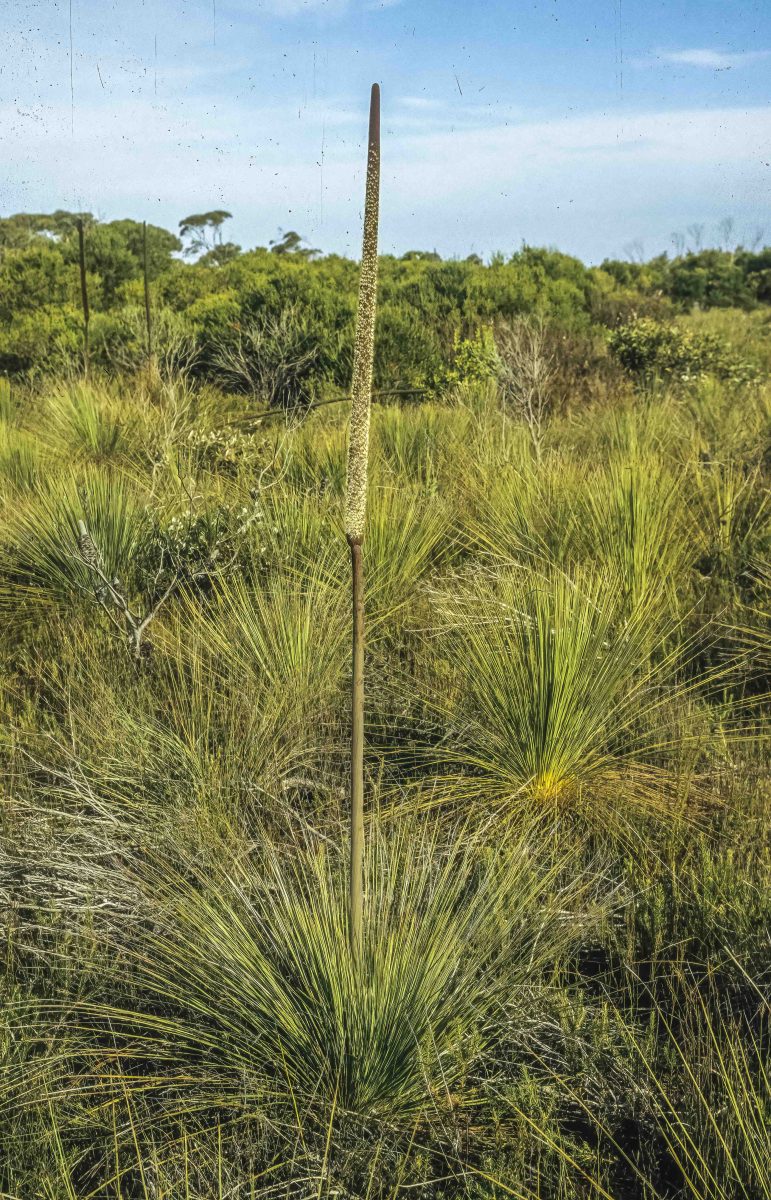
Xanthorrhoea media is a grass tree, with the trunk either absent or reported to 0.5 m tall (this author wonders if they might reach 1.0 metres in some cases).
This species occurs only in the greater Sydney-based area, as far north as Aberdeen / Muswellbrook in the Hunter Valley, as far west as Kandos and as far south as around Berrima in the southern highlands. It is often found on sandy and sandstone environments in heathland, shrubland and dry sclerophyll forest and woodland, often on higher and drier ground.
Xanthorrhoea spp. are known for their conspicuous and unique habit, consisting of a clump of long linear leaves at ground-level from a thick basal stem, or emerging from a broad trunk (which can be 20 to 30 cm across); with leaves often arching over towards the ground. They were once in their own family but are now thought to be closely related to genera such as Stypandra, Dianella and Aloe.
In this species, leaves are very narrow, to 3 mm wide and mid to dark green, up to around 1 m long, with a rhombic cross-section (important for identification). Many leaves will be produced in a clumping fashion. Leaves often have slightly sharp edges and have a very firm texture.
Xanthorrhoea spp. produce many flowers are on large “spike”. The spike consists of a flowering section – the spike and the non-flowering basal scape. The overall length of the structure and the ratio of the spike to scape aids in identification. Each flower is small (about 10-15 mm across) consisting of 6 linear tepals (3 petals and sepals) radiating in a star-like structure, often bisexual with 6 longer stamens surrounding one carpel; always cream to white to yellow in colour. In between the flowers are many clustered bracts.
In this species, the scape can be up to 2 m tall (about 10-15 mm in diameter), with the spike often to about 1 m long or shorter; about 30 mm in diameter. Mass flowering events can often be observed within 2 years after bushfire.
The fruit is a capsule; hard and woody, which might be obtuse or pointed with capsules merging into each other along the spike. In this species, they are each around 10-20 mm across and woody, producing several seeds.
Grass Trees are used in gardens and highly desired by some. They can grow well but are known to suffer from diseases and dieback – sometimes with a fast demise which can cause some gardeners distress, especially if they were expensive to source. Often, nurseries will sell the more popular and preferred species such as Xanthorrhoea glauca and X. johnsonii – both species that occur naturally in NSW with large trunks. The Sydney-based species are not cultivated as often.
Grass trees make excellent additions to may gardens; for their architectural form and the attraction of the flowers to native insects. Flowering plants in the bush can excrete a lot of nectar and, at times, the flowering spike can be a virtual apartment block of a variety of insects, foraging on nectar and pollen. Plants are generally slow growing.
They are useful for adding form and texture as well as habitat resource to any garden.
Ther are best planted in a sunny spot with reliable drainage. Monitor for pest and diseases as well as dieback. They are reported to be susceptible to Phytophthora.
Propagation from seed is reliable and not overly difficult. However, it can be a slow process. It can take several years to obtain a flowering and mature plant from seed.
Xanthorrhoea is a genus of about 30 species – endemic to Australia and occurring in all states. NSW currently has 13 species, with hybrids observed in the field.
Xanthorrhoea can regenerate rapidly after fire with the inner buds of the trunk generally insulated. Leaves reshoot very quickly from buds on the trunk / or underground stem.
These plants had strong indigenous uses – stems (scapes) were used to light fires; with stems also used to carry fire from place to place. Stems were also used for weapons in some instances. Flowers can be used to make a sweetened drink.
Native bees such as Carpenter Bees will use the flower spikes for hives.
Xanthorrhoea – from Greek – Xanthos (ξανθός) – meaning “golden” or “yellow” and -rheo (ῥέω) – meaning “to flow” or “to stream” – referring to the yellow sap of some species.
media – Latin “middle” – referring to this species having characteristics that are intermediate between the extremes shown in other species.
This species is not considered to be at risk of extinction in the wild.
NSW Flora Online (PlantNET) – Xanthorrhoea media profile page https://plantnet.rbgsyd.nsw.gov.au/cgi-bin/NSWfl.pl?page=nswfl&lvl=sp&name=Xanthorrhoea~media
Wikipedia – Xanthorrhoea media profile page https://en.wikipedia.org/wiki/Xanthorrhoea_media
Grass Trees – its uses and abuses by Phil Watson for the Australian Native Plants Society Australia: https://anpsa.org.au/APOL33/mar04-5.html
Wrigley, J.W. & Fagg, M.I. (2001). Australian Native Plants – Propagation, cultivation and use in landscaping. 4th edition. New Holland Publishers, Pty. Ltd. Australia.