
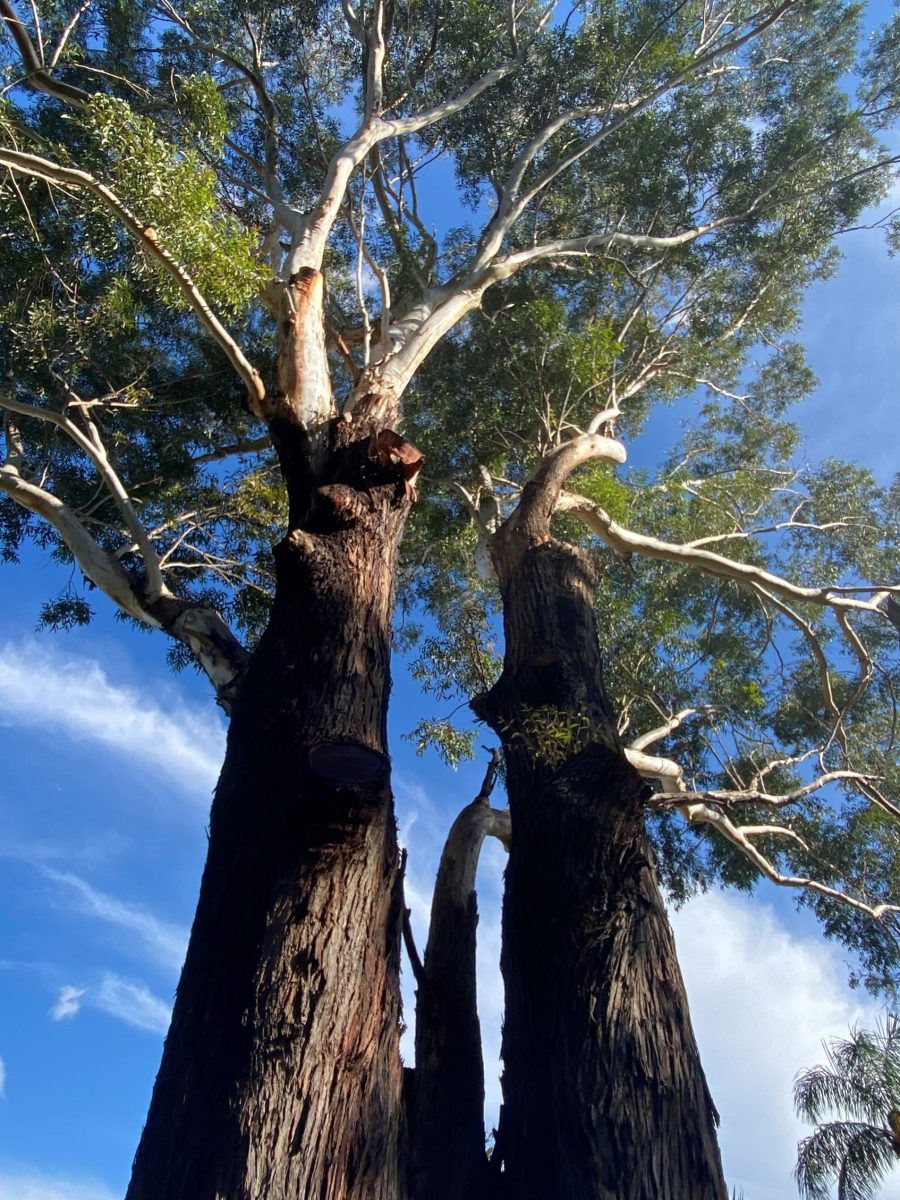
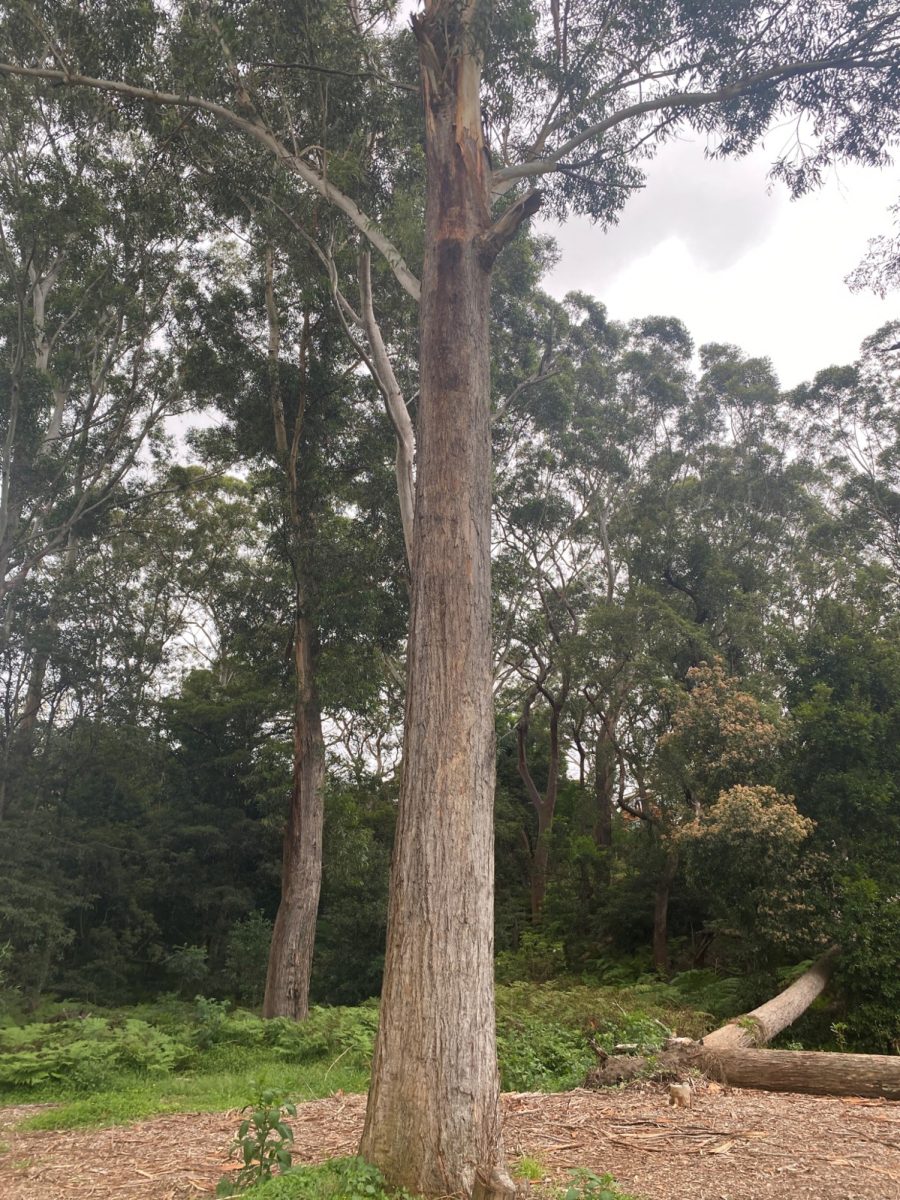
A tree reaching potentially reaching 70 m tall (often seen at 30-35 m) – without a lignotuber.
It has a basal trunk of coarsely-somewhat messy dark brown to black fibrous bark – with upper smooth creamy limbs – sometimes with scribbles.
It is a NSW-Qld species, growing down south beyond Eden – very close to the Victorian border, northwards along the coast – inland to around Blackheath-longitude and Armidale, extending into Queensland, as far north as Fraser Island. There are some very large specimens around Sydney – esepcially on the enriched Ashfield Shale and Narrabeen Sediments (i.e., suburbs such as Gordon and Pymble, as well as the Royal National Park).
They form part of dry and wet sclerophyll forests and woodlands and can be found on sandstone and shale environments. They are a common tree in coastal NSW forests.
Eucalyptus spp. have simple and usually alternate adult leaves with juvenile leaves starting off opposite to alternate (disjunct). In this species, the juvenile foliage / coppicing growth is opposite-sessile for many paris and then alternate, mid-green to purple-green above and with almost grey-silver or pale green colouring underneath. Juvenile leaves are also very silky in texture.
The adult leaves are disjunct, lanceolate to falcate, to 20 cm long and to about 3.5 cm wide, concolorous to discolorous, generally mid green. The canopy appears very green in the sunlight (no hint of blue).
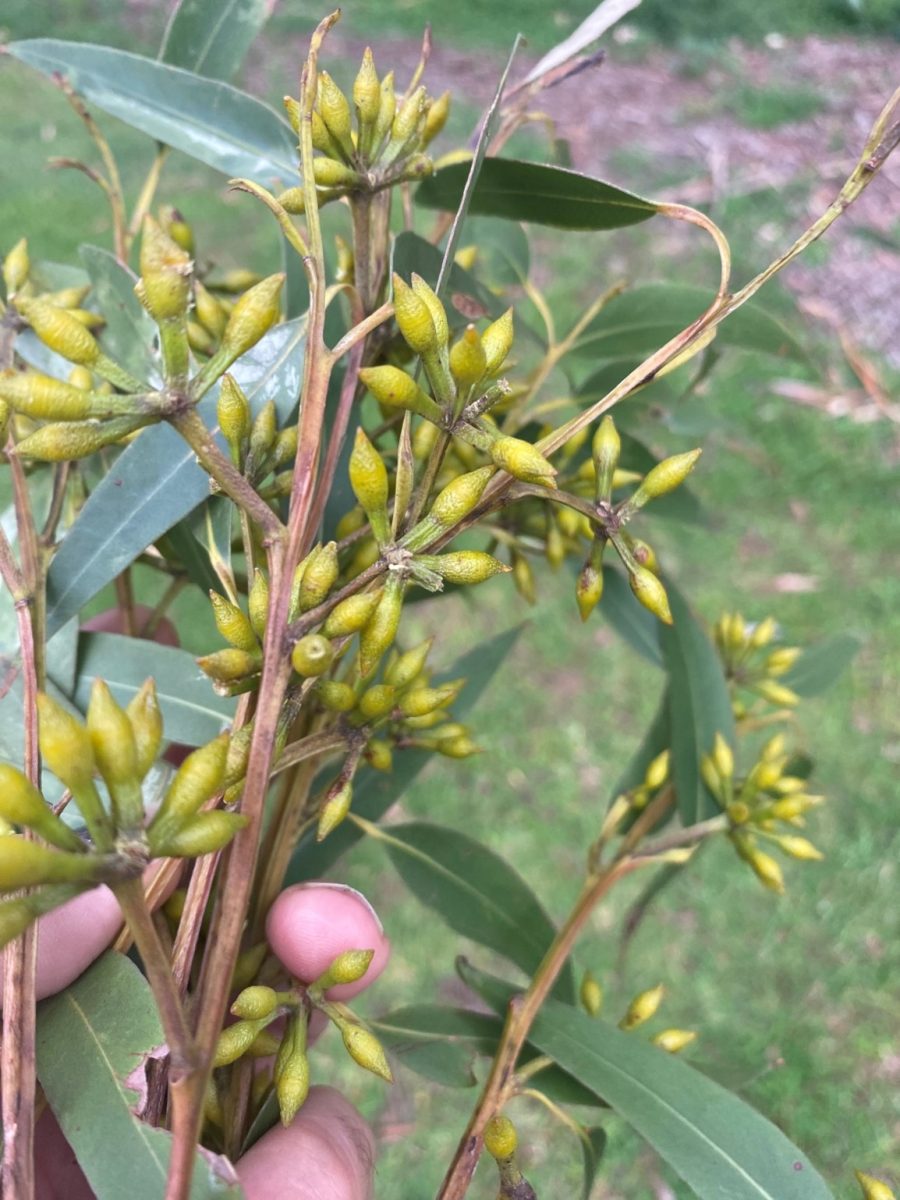
The primary inflorescence of “eucalypts” (Angophora / Corymbia / Eucalyptus) is an umbellaster (an umbel-like cluster of flowers). In the flowers of Corymbia and Eucalyptus, the petals and sepals are fused into the distinctive calyptra / operculum (bud cap) which is shed when the flower opens (in some species, 2 bud caps (opercula) are shed). The flowers are conspicuously staminate – where many stamens are basically taking over the role of the petals, all surrounding one central carpel. In this species, the flower buds are arranged in leaf axils in groups (umbellasters) of 7 to 15, in leaf axils or in compound sprays. Mature buds are ovoid to diamond-shaped, to 10 mm long and 5 mm wide, yellow to creamy in colour with a conical to beaked operculum / calyptra and with the calyptra scar absent (hence one bud cap per flower only). Flowers are white, occurring mainly in spring to summer.
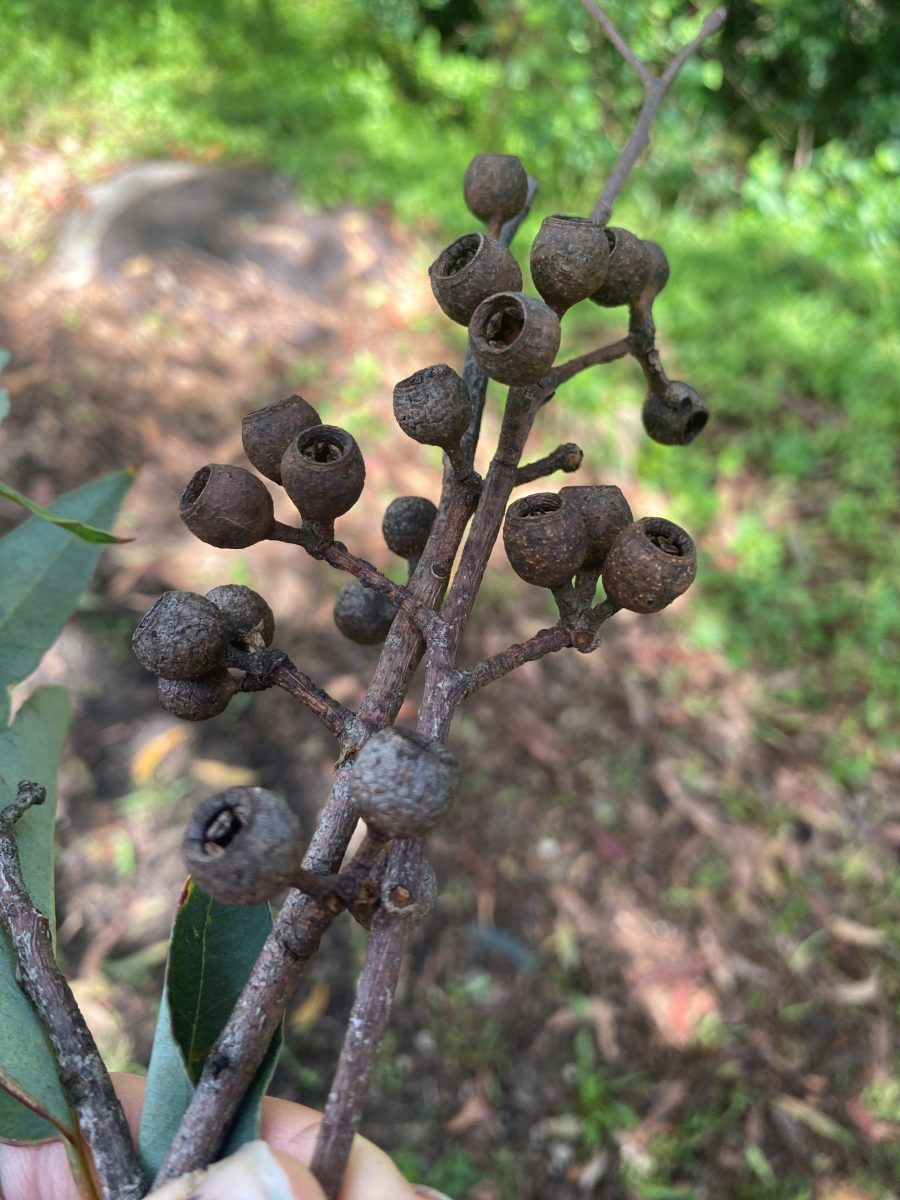
Eucalyptus produce a capsule (gum-nut) which house valves which open to release the seed. The fruits (capsules) of some boxes have a cylindrical to urceolate shape. In this species, the capsules are cup-shaped to hemispherical / globose – strongly resembling a broad brandy glass, to 11 mm long and 13 mm broad – hence the larger size aids in identification. The disc is typically level to descending, with 4 valves usually enclosed or rim-level.
This is likely not a tree that would likely be planted in a small urban garden. Usually, this species would be admired as remnant trees in any neighbourhood or suburb (i.e., Sutherland Shire). They can form large trees and are known to drop branches. However, they create much habitat by means of hollows and resource for fauna.
They are a nice tree in a park setting or larger garden and have a nice overall form. They also have robust root systems. They also produce flower buds and fruit in large numbers. Rarely do they suffer form dieback.
May be sueful for regeneration projects or in a larger landscape.
Propagate from seed.
This species can regenerate from epicormic shoots as well as the seed bank. It does not possess a lignotuber.
The timber has been used extensively for floorboards and furniture.
It is well-known that Eucalyptus is a large and diverse genus. Between 700 and 950 known species are reported, occurring as far north as The Philippines, as well as Indonesia, New Guinea, Timor and Australia. Only 16 species reportedly occur outside Australia. They occur in all Australian states. NSW currently has about 250 species. (See this website for some detailed information: https://apps.lucidcentral.org/euclid/text/intro/learn.htm).
Eucalyptus – from Greek, eu, “well” or “true” and calyptus, referring to the calyptra (καλύπτρo) or operculum, which is a bud cap or covering which covers the developing flowers. The calyptra is a fusion of petals and/or sepals and is shed when the flower opens, leaving a flower with many stamens (staminate) surrounding one female part (carpel).
pilularis – Latin – pilular – referring basically to “pill” or “globule” or “pellets” – capturing the rounded fruits of this species.
This species is not considered to be at risk of extinction in the wild.
NSW Flora Online (PlantNET) – Eucalyptus piluaris profile page https://plantnet.rbgsyd.nsw.gov.au/cgi-bin/NSWfl.pl?page=nswfl&lvl=sp&name=Eucalyptus~pilularis
EUCLID – Eucalypts of Australia – Centre for Australian National Biodiversity Research – Eucalyptus pilularis profile page https://apps.lucidcentral.org/euclid/text/entities/eucalyptus_pilularis.htm
Arcane Botanica YouTube Channel (Dan Clarke) – Eucalyptus pilularis video https://www.youtube.com/watch?v=B-RKNbfB3p8
Arcane Botanica YouTube Channel (Dan Clarke) – Eucalypt Theory Video https://www.youtube.com/watch?v=m89bALPO4uc