

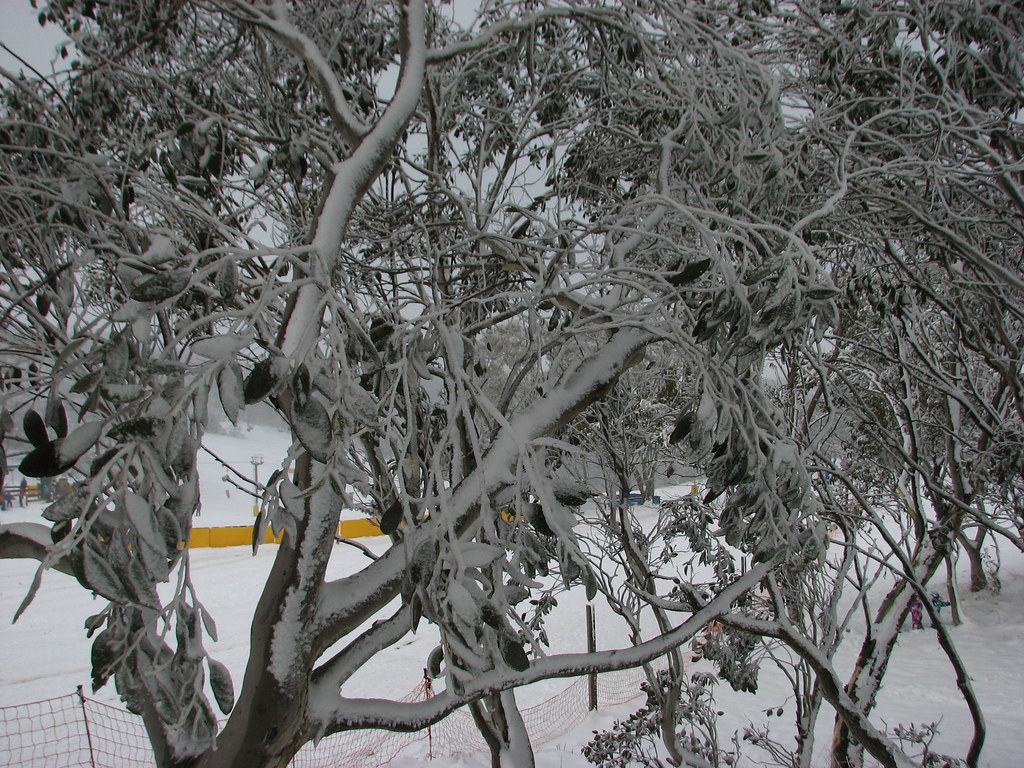
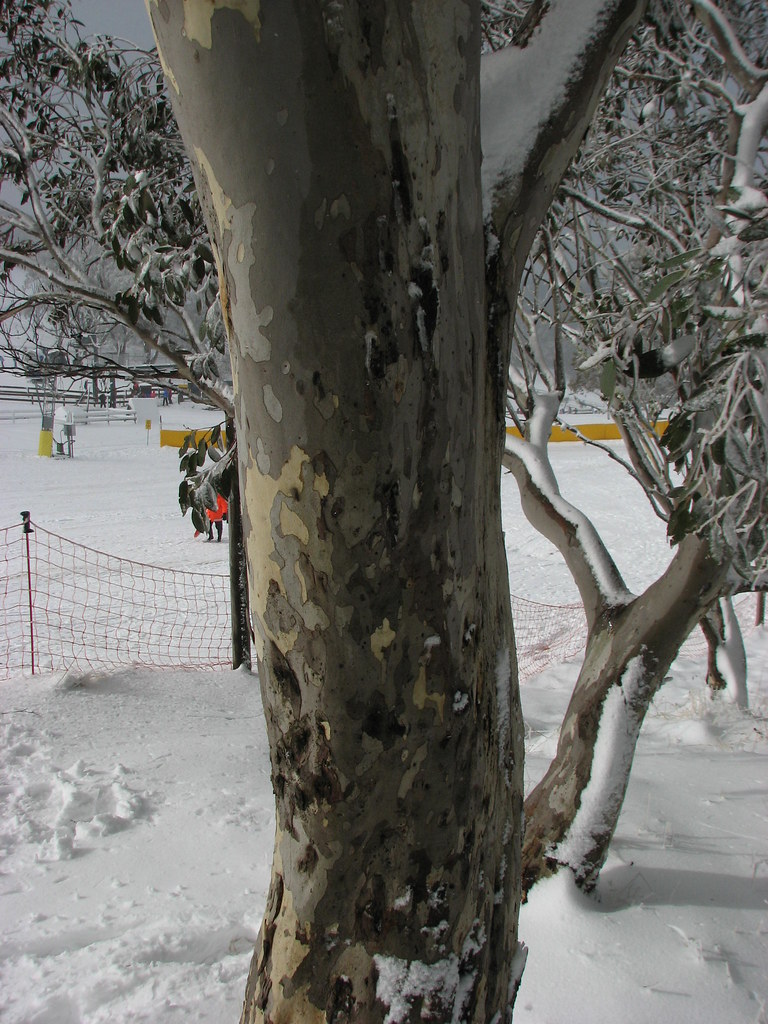
A tree reaching 30 metres tall with a canopy spread to 5 or 10 metres. They can be found at a wide range of sizes in their habitats – sometimes forming a mallee; forming a lignotuber.
The bark is mostly smooth – mostly white with shades of cream / grey and yellow – sometimes with scribbles and looking much like a scribbly gum (which it can be found growing with in some locations).
It can be found commonly in NSW, scattered over all of the tablelands regions and virtually contained to those regions of NSW, from border to border. In Victoria, it spreads through most of the eastern half (absent in the far east) to the south-west. It extends in South Australia to Mt Gambier. It is common through the central parts of Tasmania. It only just gets into Queensland around the Stanthorpe region.
Snow Gum, as the name implies, is typically found in colder areas where snow might fall each year or every now and then. Usually on cold flats and above creeklines in “frost-hollows” as well as mountainous areas with higer snow fall. Outside of Kosciuszko, it occurs in the Southern Highlands, Orange and Oberon, to name just a few locations. It forms part of dry sclerophyll woodlands – on a range of soils.
Eucalyptus spp. have simple and usually alternate adult leaves with juvenile leaves starting off opposite to alternate (disjunct). In this species, the juvenile foliage / coppicing growth is alternate, blue-green to glaucous, to 17 cm long and 9 cm wide, broad-lanceolate to ovate or elliptical.
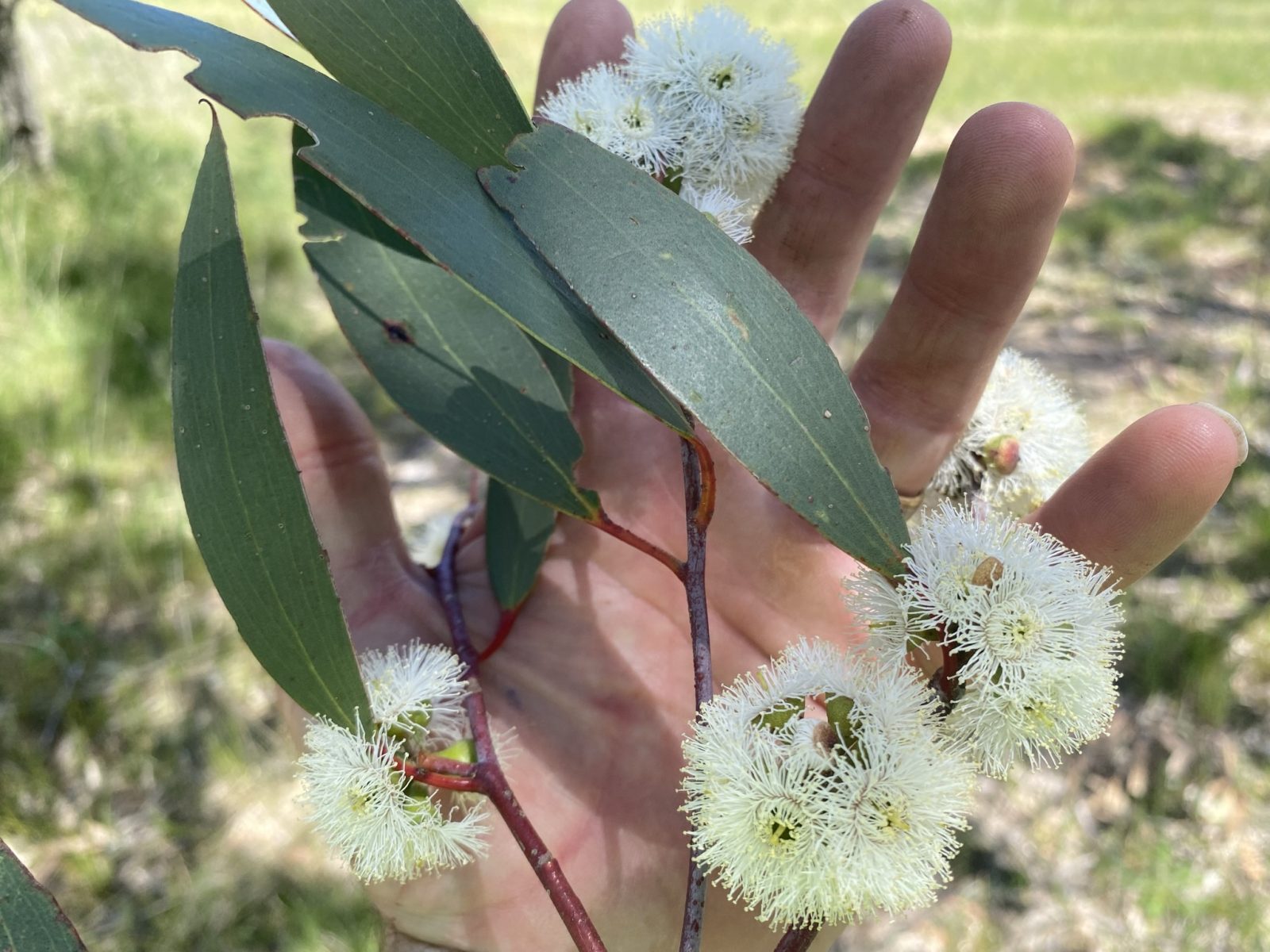
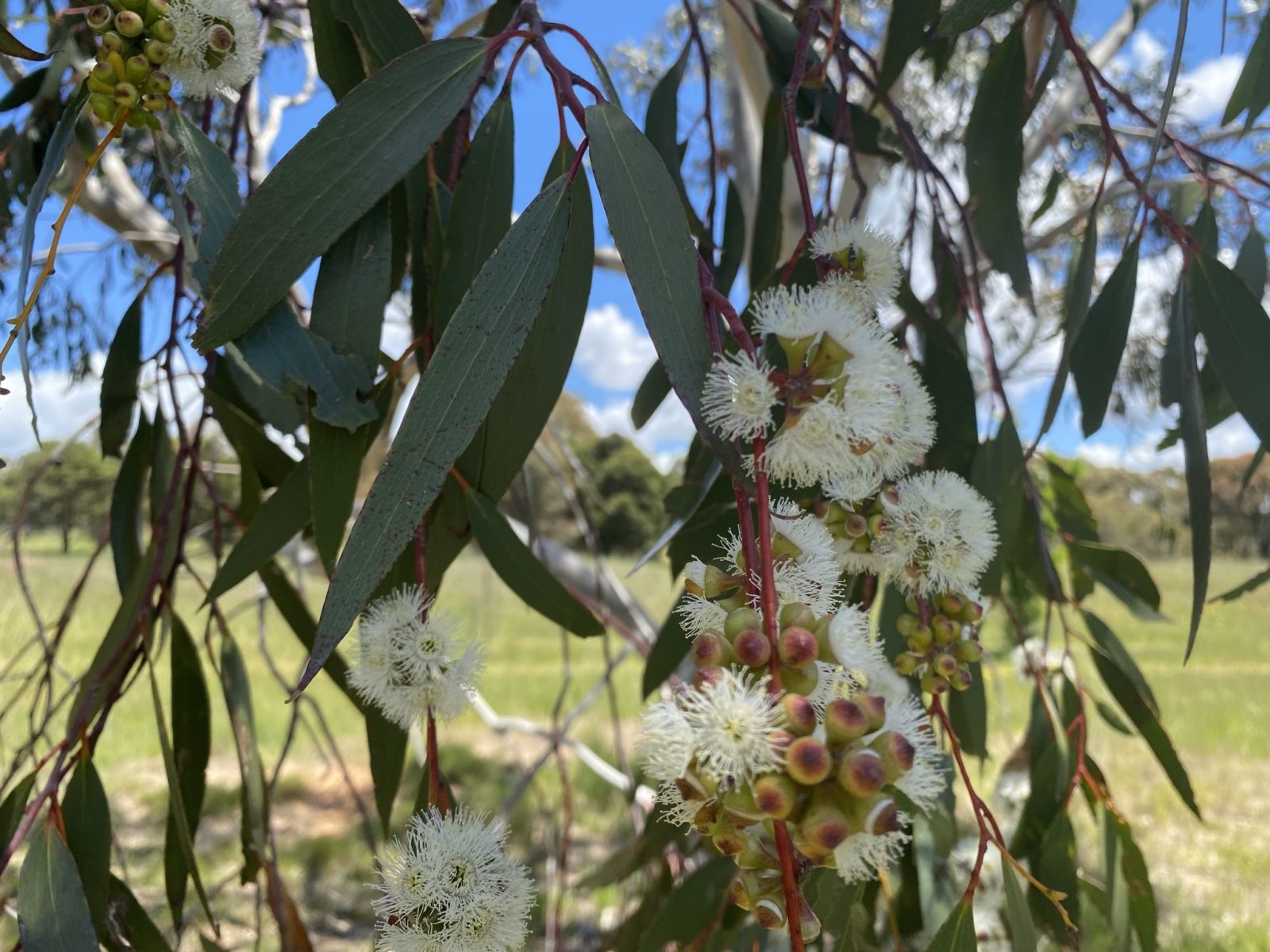
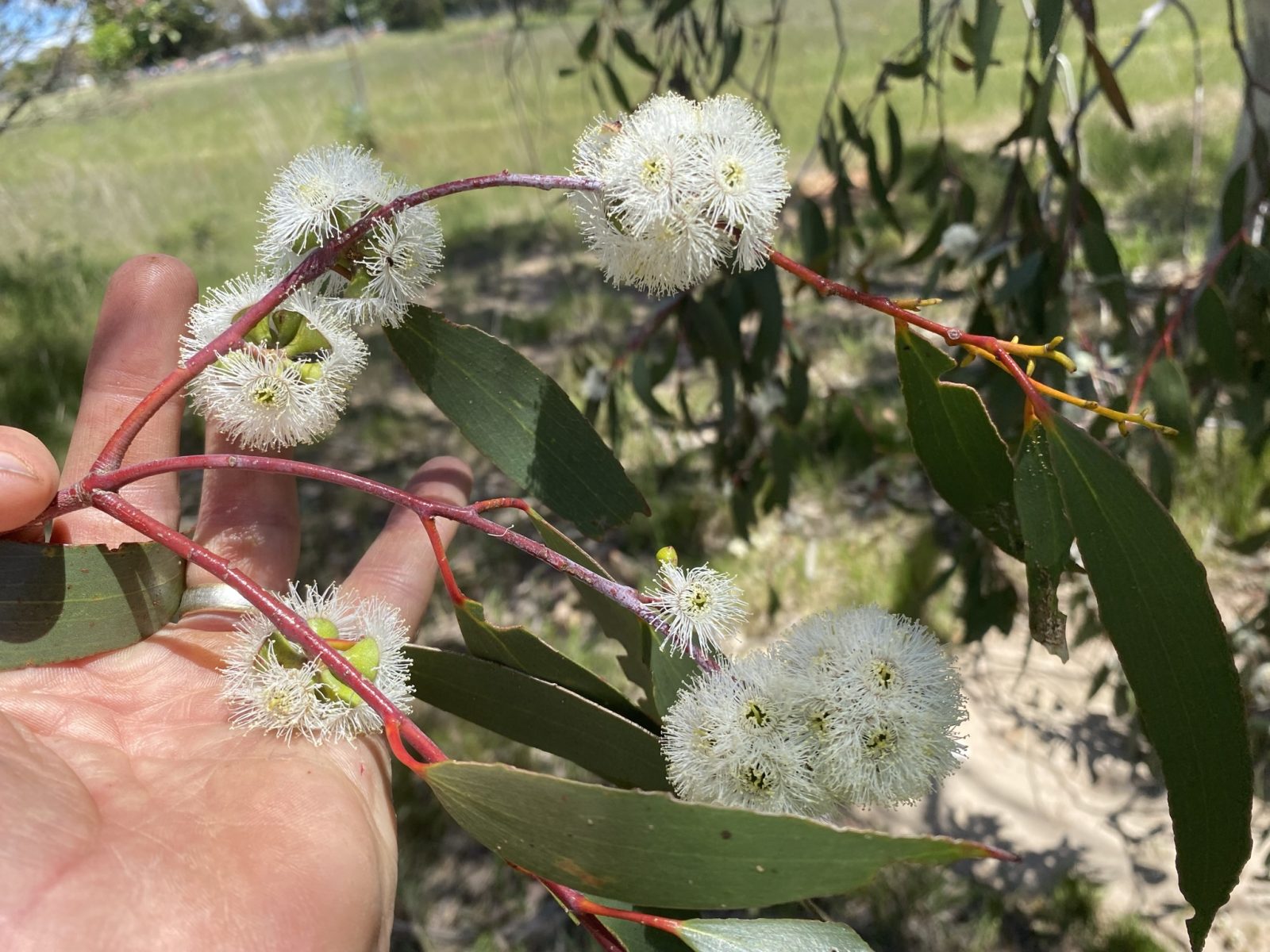
The adult leaves are disjunct, elliptic to lanceolate to falcate, to 20 cm long and to about 5 cm wide, mostly green and concolorous; very thick in texture and with very conspicuous / strong venation which aids enromously in the identification.
The primary inflorescence of “eucalypts” (Angophora / Corymbia / Eucalyptus) is an umbellaster (an umbel-like cluster of flowers). In the flowers of Corymbia and Eucalyptus, the petals and sepals are fused into the distinctive calyptra / operculum (bud cap) which is shed when the flower opens (in some species, 2 bud caps (opercula) are shed). The flowers are conspicuously staminate – where many stamens are basically taking over the role of the petals, all surrounding one central carpel. In this species, the flower buds are arranged in leaf axils in groups (umbellasters) of 9 to 15 (sometimes to 19). Mature buds are obovoid to 8 mm long and 5 mm wide with a rounded to conical operculum / calyptra – and lacking a calyptra scar (hence only one bud cap per flower). Flowering has been observed in most months of the year.
Eucalyptus produce a capsule (gum-nut) which house valves which open to release the seed. The fruits (capsules) of some boxes have a cylindrical to urceolate shape. In this species, the capsules are obconical to hemispherical, with the disc level of slightly descending, with 3 to 4 valves, near rim level or enclosed, to about 13 mm long by 11 mm wide.
This tree is an easy one to grow although probably best in an inland and colder environment. Planted trees are commonly seen, by this author, on farms around locations such as Goulburn and Berrima. In a garden , they are often not a large tree and so may be suited to some situations.
The strongly veined and often large leaves are a nice feature as are the bright white flowers. The white trunk is also appealing.
Can be planted on a range of soils. High humidity may be detrimental as well as too much coastal heat.
Can also be pruned to be a mallee. It would be a nice feature in the right setting.
Propagate from seed.
This species can regenerate from fire from lignotubers and epicormic shoots as well as the seed bank.
This species is part of a complex of similar species, some of which are recognised at the species or subspecies level including Eucalyptus gregsoniana, E. niphophila and E. lacrimans.
It is well-known that Eucalyptus is a large and diverse genus. Between 700 and 950 known species are reported, occurring as far north as The Philippines, as well as Indonesia, New Guinea, Timor and Australia. Only 16 species reportedly occur outside Australia. They occur in all Australian states. NSW currently has about 250 species. (See this website for some detailed information: https://apps.lucidcentral.org/euclid/text/intro/learn.htm).
Eucalyptus – from Greek, eu, “well” or “true” and calyptus, referring to the calyptra (καλύπτρo) or operculum, which is a bud cap or covering which covers the developing flowers. The calyptra is a fusion of petals and/or sepals and is shed when the flower opens, leaving a flower with many stamens (staminate) surrounding one female part (carpel).
pauciflora – from Latin paucus – meaning “little” or “few” and –florus meaning “flowers” – this is a rather obscure allusion as this species can flower nicely and heavily; therefore the botanical name is considered very inappropriate.
This species is not considered to be at risk of extinction in the wild.
NSW Flora Online (PlantNET) – Eucalyptus pauciflora profile page https://plantnet.rbgsyd.nsw.gov.au/cgi-bin/NSWfl.pl?page=nswfl&lvl=sp&name=Eucalyptus~pauciflora
EUCLID – Eucalypts of Australia – Centre for Australian National Biodiversity Research – Eucalyptus pauciflora profile page https://apps.lucidcentral.org/euclid/text/entities/eucalyptus_pauciflora_subsp._pauciflora.htm
Arcane Botanica YouTube Channel (Dan Clarke) – Eucalyptus pauciflora video https://www.youtube.com/watch?v=LqOo8lypDFw
Arcane Botanica YouTube Channel (Dan Clarke) – Eucalypt Theory Video https://www.youtube.com/watch?v=m89bALPO4uc