
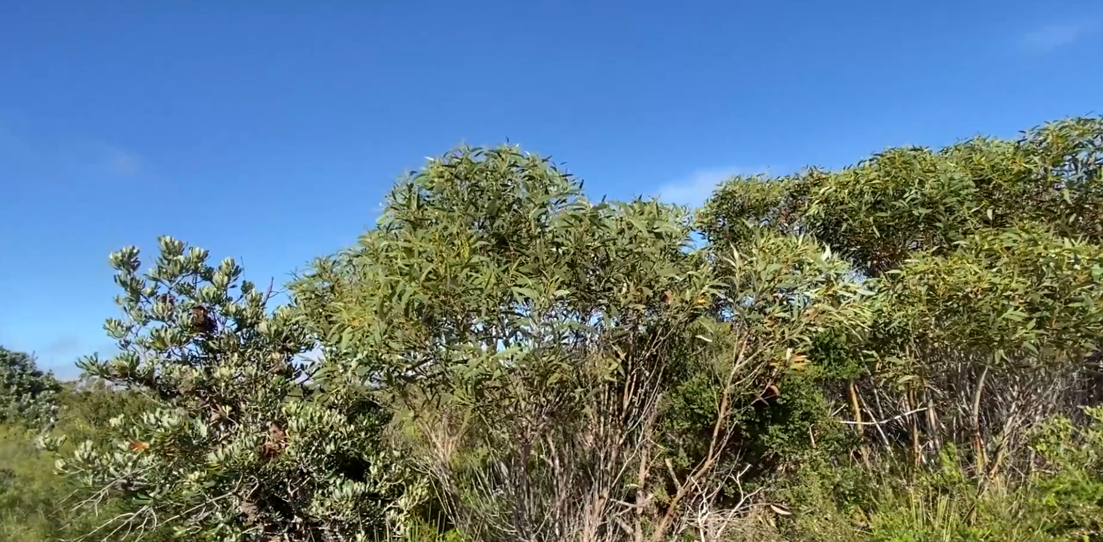
A tree or mallee to 7 m tall, with a lignotuber, often with many thin stems in a clump.
It is a NSW species, with a small geographic range, occurring as far north as Berowra, south through Sydney to about Helensburgh, then with a little disjunction to around Robertson then down to Jervis Bay and Ulladulla and to the west around Nerriga and towards Braidwood. Some botanists treat this to be the same species as Eucalyptus burgessiana – which occurs in the Blue Mountains area – bounded by roughly Springwood, Bilpin, Wentworth Falls and Blackheath.
It is typically found on shallow sandy soils and sandstone outcrops often in mallee shrublands and dry sclerophyll woodlands as well as heathlands.
Eucalyptus spp. have simple and usually alternate adult leaves with juvenile leaves are broadly lanceolate, to 15 cm long and 5 cm wide, concolorous, glossy and bright green.
The adult leaves are disjunct, narrowly lanceolate to falcate, to 13 cm long and to about 2.5 cm wide, mostly green and concolorous; with a thickish texture and no obvious reticulate venation.
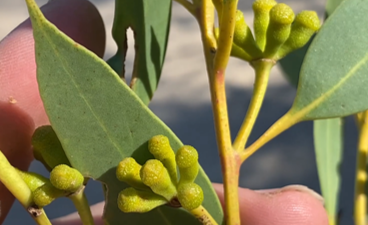
The primary inflorescence of “eucalypts” (Angophora / Corymbia / Eucalyptus) is an umbellaster (an umbel-like cluster of flowers). In the flowers of Corymbia and Eucalyptus, the petals and sepals are fused into the distinctive calyptra / operculum (bud cap) which is shed when the flower opens (in some species, 2 bud caps (opercula) are shed). The flowers are conspicuously staminate – where many stamens are basically taking over the role of the petals, all surrounding one central carpel. In this species, the flower buds are arranged in leaf axils in simple groups (umbellasters) of 7 to 11. Mature buds are obovoid to 11 mm long and 6 mm wide with a rounded to conical-apiculate operculum / calyptra, lacking a calyptra scar (hence one bud cap per flower only). Flowering has been observed from May to December with flowers bright white.
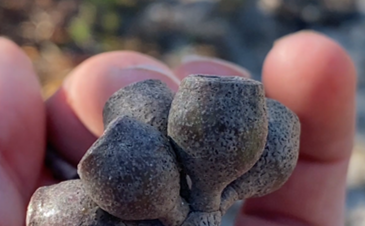
Eucalyptus produce a capsule (gum-nut) which house valves which open to release the seed. The fruits (capsules) of some boxes have a cylindrical to urceolate shape. In this species, the capsules are barrel-shaped to cup-shaped to slightly urceolate, with the disc descending, with 3 to 4 enclosed valves, to about 12 mm long by 13 mm wide.
This species is not known to be cultivated widely which is a shame as it is a very nice species and would be of great benefit to many gardens.
It is not known here if it is difficult to grow or simply has not been tried. It is a very attractive flowering plant and the mallee habit means it stays small. Usually the stems/trunks are only up to 5 cm across in many plants.
Check with local nurseries for availability. The natural habitat of this species may mean it is difficult to establish in “nicer” habitats such as gardens.
Propagate from seed.
This species can regenerate from fire from lignotubers and epicormic shoots as well as the seed bank.
It is well-known that Eucalyptus is a large and diverse genus. Between 700 and 950 known species are reported, occurring as far north as The Philippines, as well as Indonesia, New Guinea, Timor and Australia. Only 16 species reportedly occur outside Australia. They occur in all Australian states. NSW currently has about 250 species. (See this website for some detailed information: https://apps.lucidcentral.org/euclid/text/intro/learn.htm).
Eucalyptus – from Greek, eu, “well” or “true” and calyptus, referring to the calyptra (καλύπτρo) or operculum, which is a bud cap or covering which covers the developing flowers. The calyptra is a fusion of petals and/or sepals and is shed when the flower opens, leaving a flower with many stamens (staminate) surrounding one female part (carpel).
obstans – from Latin meaning “standing in the way” or “hindering or obstructing” – referring to the thick barriers sometimes formed by this species.
This species is not considered to be at risk of extinction in the wild.
NSW Flora Online (PlantNET) – Eucalyptus obstans profile page https://plantnet.rbgsyd.nsw.gov.au/cgi-bin/NSWfl.pl?page=nswfl&lvl=sp&name=Eucalyptus~obstans
EUCLID – Eucalypts of Australia – Centre for Australian National Biodiversity Research – Eucalyptus burgessiana profile page https://apps.lucidcentral.org/euclid/text/entities/eucalyptus_burgessiana.htm
Arcane Botanica YouTube Channel (Dan Clarke) – Eucalyptus obstans/burgessiana video https://www.youtube.com/watch?v=jDW8lmq5WgA
Arcane Botanica YouTube Channel (Dan Clarke) – Eucalypt Theory Video https://www.youtube.com/watch?v=m89bALPO4uc