
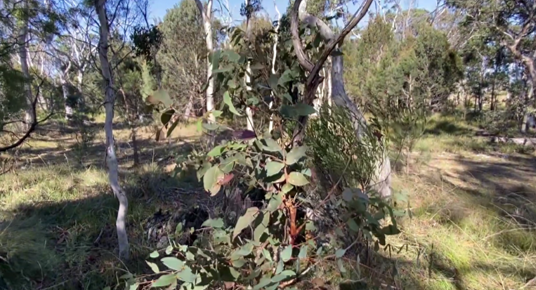
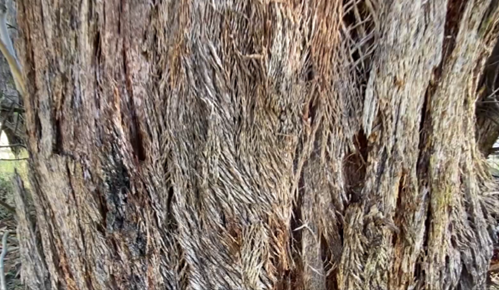
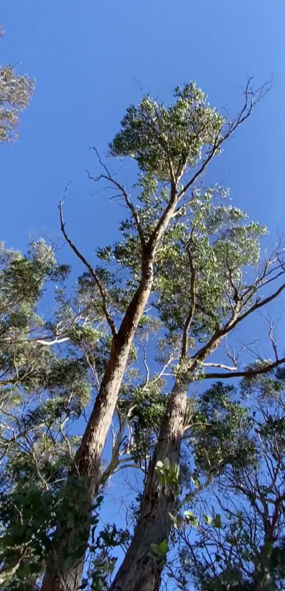
A tree reaching around 20 m tall, often found smaller in many habitats – possessing a lignotuber. The bark is a fine fibrous bark that can be mashed into sawdust in the hands, extending up much of the trunk and lower branches with ultimate branches smooth.
It is a NSW-Victorian species, growing as far north and north west as around the Nundle to Walcha area (a disjunct northern patch) – then found from north-east and north-west of Kandos – extending to Molong, southwards through the tablelands mainly, out to Holbrook and Albury. It then extends through much of eastern Victoria and into the west of the State to around Halls Gap.
They form part of dry sclerophyll forests, often on higher poorer soils including sands and rocky soils, often on the highest points in the landscape.
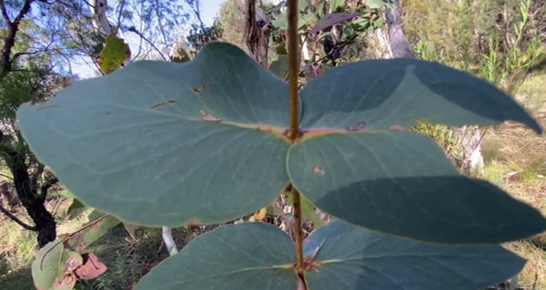
Eucalyptus spp. have simple and usually alternate adult leaves with juvenile leaves starting off opposite to alternate (disjunct). In this species, the juvenile foliage / coppicing growth is very distinctive and useful for identification – broad-ovate and with squared-off bases (truncate) and sessile (without a petiole) clasping the stem – in opposite pairs and smelling very strongly of peppermint; blue-green in colour. This is a species where a glance at the juvenile leaves helps enormously.
The adult leaves are disjunct, broadly-lanceolate to lanceolate to falcate, to 15 cm long and to about 4.5 cm wide, concolorous, glossy or not glossy green to blue-green.
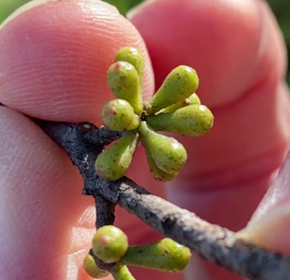
The primary inflorescence of “eucalypts” (Angophora / Corymbia / Eucalyptus) is an umbellaster (an umbel-like cluster of flowers). In the flowers of Corymbia and Eucalyptus, the petals and sepals are fused into the distinctive calyptra / operculum (bud cap) which is shed when the flower opens (in some species, 2 bud caps (opercula) are shed). The flowers are conspicuously staminate – where many stamens are basically taking over the role of the petals, all surrounding one central carpel. In this species, the flower buds are arranged in leaf axils in groups (umbellasters) of at least 11 to 20 or more, in leaf axils or in compound sprays. Mature buds are ovoid to diamond-shaped, to 6 mm long and 4 mm wide, yellow to green in colour with a rounded to conical operculum / calyptra and with the calyptra scar absent (hence one bud cap per flower only). Flowers are white, occurring mainly in spring to summer.
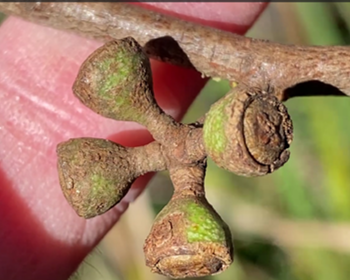
Eucalyptus produce a capsule (gum-nut) which house valves which open to release the seed. The fruits (capsules) of some boxes have a cylindrical to urceolate shape. In this species, the capsules are cup-shaped to hemispherical / globose or obconical – to 7 mm long and 8 mm wide. The disc is typically slightly raised to slightly descending, with 3 or 4 valves, usually enclosed or rim-level.
This tree is common on farms in rural NSW and seems to be a hardy species on higher rocky areas and lower sandy soils. It does not grow overly large and so may be a useful species in gardens where smaller eucalypts can be used (in a similar fashion to some scribbly gums).
It is likely hardy once established and could be shaped into a mallee if desired. Plants in the field often appear sickly (from field experience in the southern highlands) – so perhaps not the most appealing gum. But the juvenile leaves are attractive and many flowers can be produced. Useful for habitat recreation and enhancement.
Check with local nurseries for availability.
Propagate from seed.
This species can regenerate from epicormic shoots as well as the seed bank, as well as the lignotuber.
This species has been used for oil extraction.
It is well-known that Eucalyptus is a large and diverse genus. Between 700 and 950 known species are reported, occurring as far north as The Philippines, as well as Indonesia, New Guinea, Timor and Australia. Only 16 species reportedly occur outside Australia. They occur in all Australian states. NSW currently has about 250 species. (See this website for some detailed information: https://apps.lucidcentral.org/euclid/text/intro/learn.htm).
Eucalyptus – from Greek, eu, “well” or “true” and calyptus, referring to the calyptra (καλύπτρo) or operculum, which is a bud cap or covering which covers the developing flowers. The calyptra is a fusion of petals and/or sepals and is shed when the flower opens, leaving a flower with many stamens (staminate) surrounding one female part (carpel).
dives – Latin – dives – meaing “rich” – referring to the rich oil content of the leaves (very strong peppermint smell).
This species is not considered to be at risk of extinction in the wild.
NSW Flora Online (PlantNET) – Eucalyptus dives profile page https://plantnet.rbgsyd.nsw.gov.au/cgi-bin/NSWfl.pl?page=nswfl&lvl=sp&name=Eucalyptus~dives
EUCLID – Eucalypts of Australia – Centre for Australian National Biodiversity Research – Eucalyptus dives profile page https://apps.lucidcentral.org/euclid/text/entities/eucalyptus_dives.htm
Arcane Botanica YouTube Channel (Dan Clarke) – Eucalyptus dives video https://www.youtube.com/watch?v=ZgwfjHeEcvk
Arcane Botanica YouTube Channel (Dan Clarke) – Eucalypt Theory Video https://www.youtube.com/watch?v=m89bALPO4uc