
Family: Proteaceae
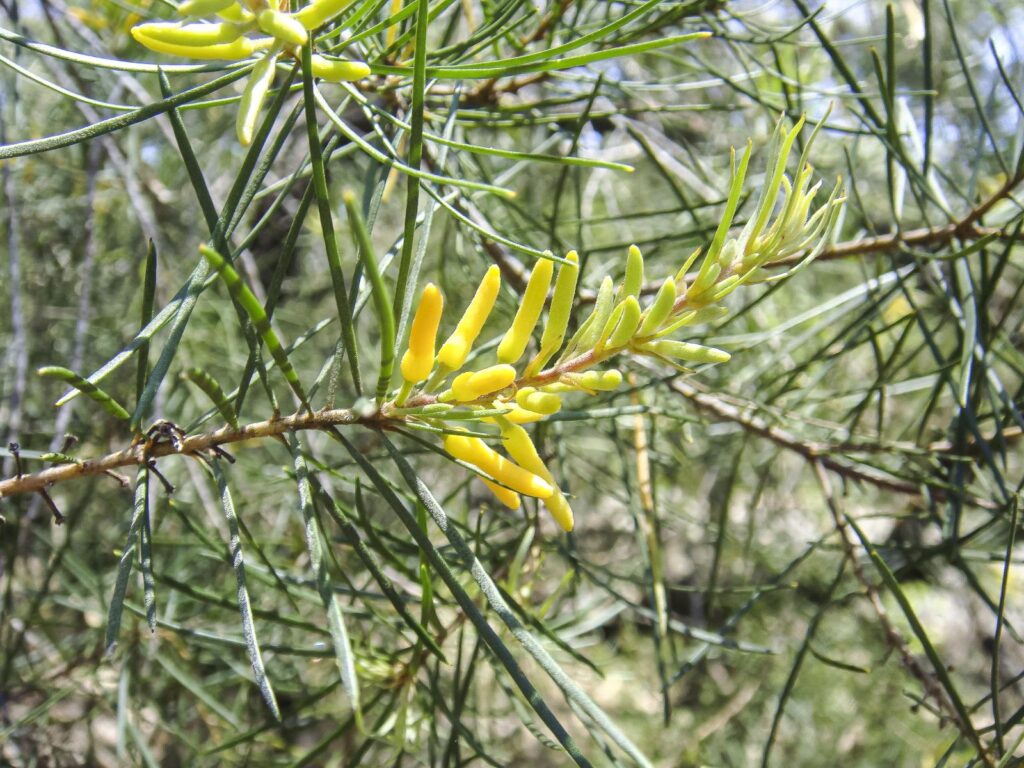
Persoonia linearis (Narrow-leaved Geebung) is a common shrub of the NSW coast and tablelands, growing to 5 metres tall by 1 to 2 metres wide. Its range extends from the Macleay River in the north, through the southern tablelands and south coast, and into Victoria. It typically grows in dry sclerophyll forests and woodlands on ridges and mid-slopes, in sandstone soils as well as conglomerates and other soil landscapes.
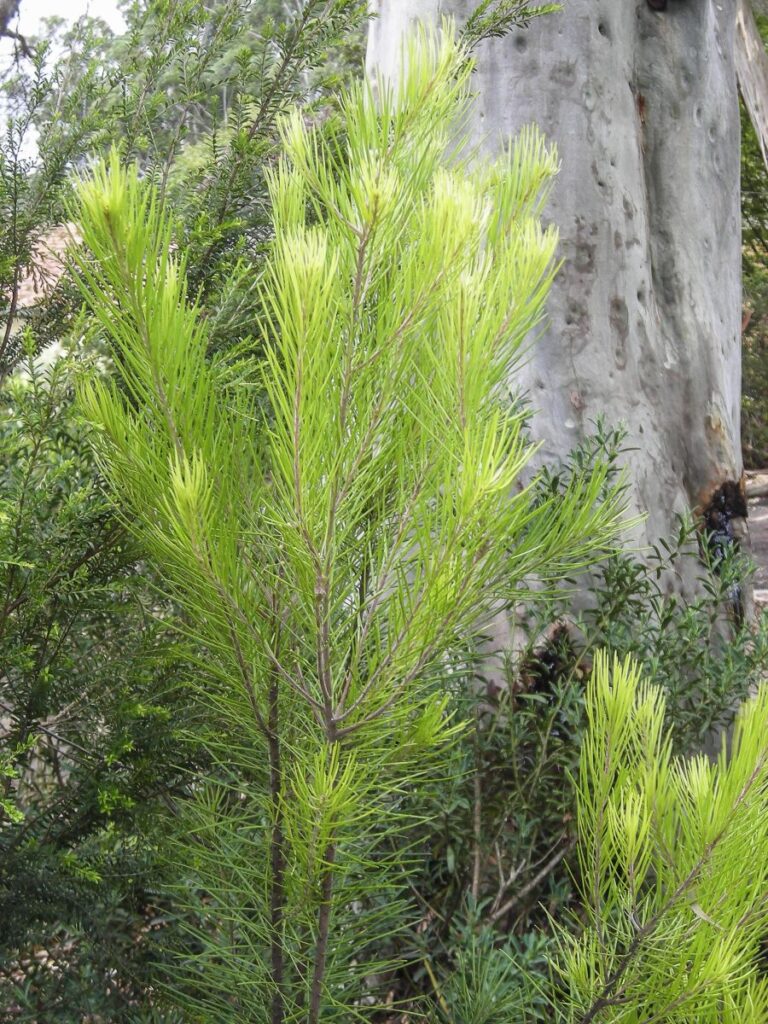
One of its most distinctive features is its bark — flaky and papery, dark grey to black on the outer surface and red-pink below, with an almost crepe-paper texture. New growth is hairy.
Identification
The leaves are linear in shape, up to 9 cm long and nearly 1 cm wide, with slightly down-rolled margins. Leaf width can vary considerably between populations, ranging from 1 mm to 8 mm.
Flowers are yellow, up to 15 mm long, more or less fused at the base and sparsely to densely hairy. Like all persoonias, the flower structure is characterised by four tepals at the base, four stamens rising above, and one carpel. This species flowers from December to May.
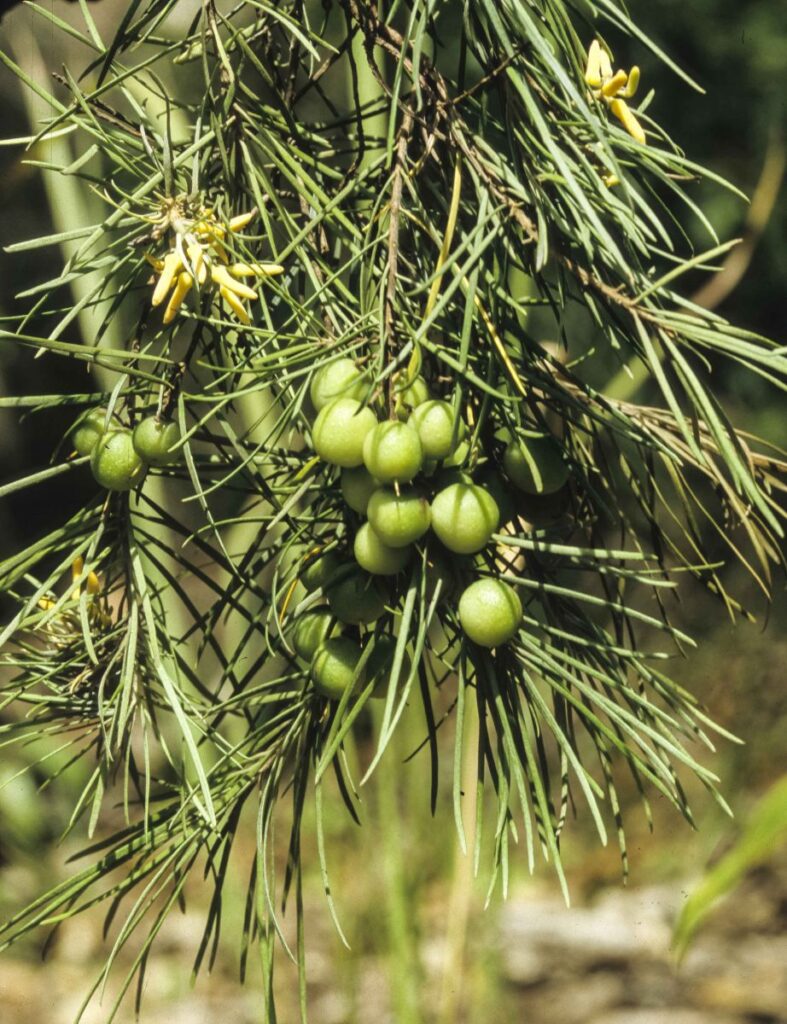
The fruit are smooth, fleshy drupes — green and roughly round, measuring up to 1.5 cm in diameter. Mature drupes may develop purple blotches and contain one or two seeds within a woody stone.
In the garden
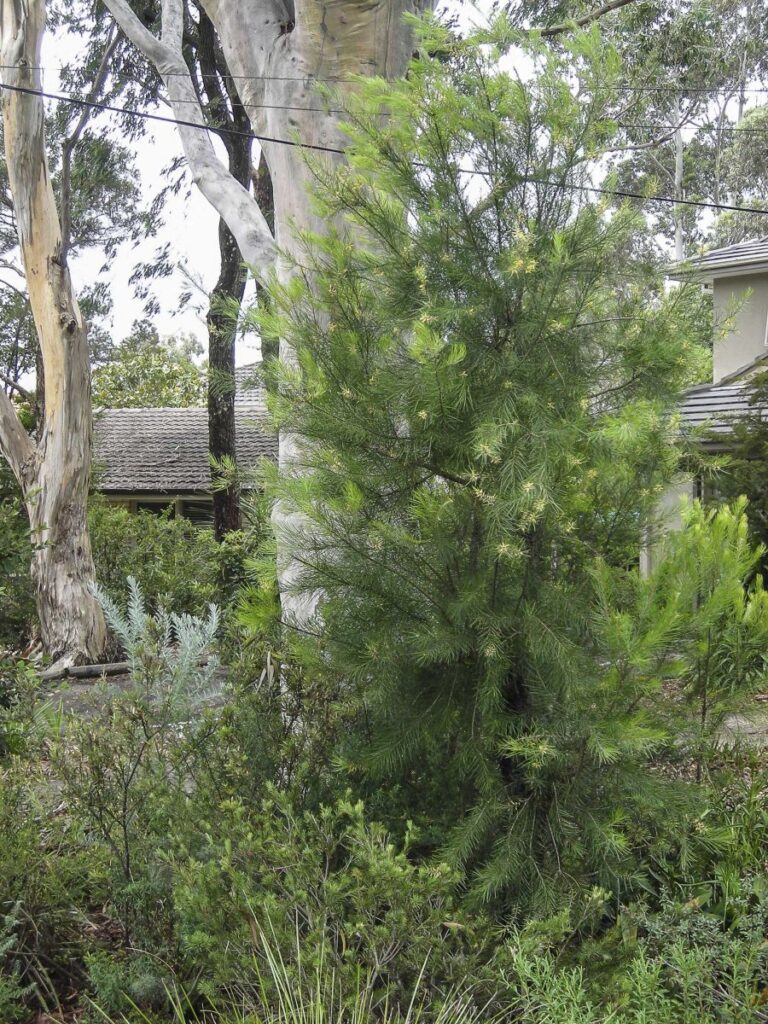
Persoonia linearis is a useful and attractive garden plant with a naturally good form. Its red flaky bark is a standout feature, and the plant is both hardy and long-lived once established. It does not require additional watering during dry spells and can persist for decades in a suitable position.
The author has been growing his own plant since the 1990s in a Sydney suburban garden, where it established naturally from a seed that arrived in a delivery of local sandstone-derived leaf litter — landing in exactly the right spot.
Plants may be difficult to source in nurseries, but tubestock is worth seeking out when available.
Propagation
Propagation of Persoonia linearis is generally difficult from both seed and cuttings. Seed needs to be scarified and sown as soon as it is fresh. Working with persoonia seed has attracted many amateur attempts, often with considerable frustration.
One approach involves clipping the outer fruit coating (the exocarp) to open it up, then placing the seed in a solution containing the plant propagation hormone gibberellic acid (GA) for several hours to days to trigger germination.
Another technique, developed through practice at Sutherland Shire Bushcare, involves placing fruits in a bag with potting mix and storing in a glasshouse or propagation shed for 12 months, then cleaning and sanding the fruits before sowing. Germination typically takes a further six months after sowing.
Propagation of Persoonia species is becoming more common in specialist nurseries as knowledge and techniques improve.
Persoonia is a genus of around 100 species, all endemic to Australia and occurring in all states and territories. NSW currently recognises around 51 species, some of which are complex with many subspecies, and some of which are threatened with extinction.
The genus was named in honour of Christiaan Hendrik Persoon (1761-1836), a South African botanist and mycologist best known for his work describing mushroom species. The genus was formally named by English botanist James Edward Smith (1759-1828), founder of the Linnean Society. The species epithet linearis is Latin for narrow or linear leaves.
Persoonia linearis hybridises occasionally with a number of related species including P. chamaepeuce, P. lanceolata, P. levis, P. pinifolia, P. sericea and several subspecies of P. mollis. After fire, this species can regenerate vegetatively from basal trunk areas.
This species is not considered to be at risk of extinction in the wild.
Cultural Significance and Edible Fruit
The fruit of Persoonia linearis can be eaten raw or cooked. It has a sweet fibrous pulp attached to one large seed — succulent but astringent, with a taste described as something like sweet cotton wool. The fruit is relished by First Nations Peoples of Australia.
The common name Geebung is derived from the Dharug language word geebung, while the Wiradjuri term was jibbong.
Taxonomy and Hybridisation
Persoonia is a genus of around 100 species, all endemic to Australia and occurring in all states and territories. NSW currently recognises around 51 species, some of which are complex with many subspecies, and some of which are threatened with extinction.
The genus was named in honour of Christiaan Hendrik Persoon (1761-1836), a South African botanist and mycologist best known for his work describing mushroom species. The genus was formally named by English botanist James Edward Smith (1759-1828), founder of the Linnean Society. The species epithet linearis is Latin for narrow or linear leaves.
Persoonia linearis hybridises occasionally with a number of related species including P. chamaepeuce, P. lanceolata, P. levis, P. pinifolia, P. sericea and several subspecies of P. mollis. After fire, this species can regenerate vegetatively from basal trunk areas.
This species is not considered to be at risk of extinction in the wild.
Further Reading
Wrigley, J.W. and Fagg, M.I. (2001). Australian Native Plants: Propagation, cultivation and use in landscaping. 4th edition. New Holland Publishers, Australia.