
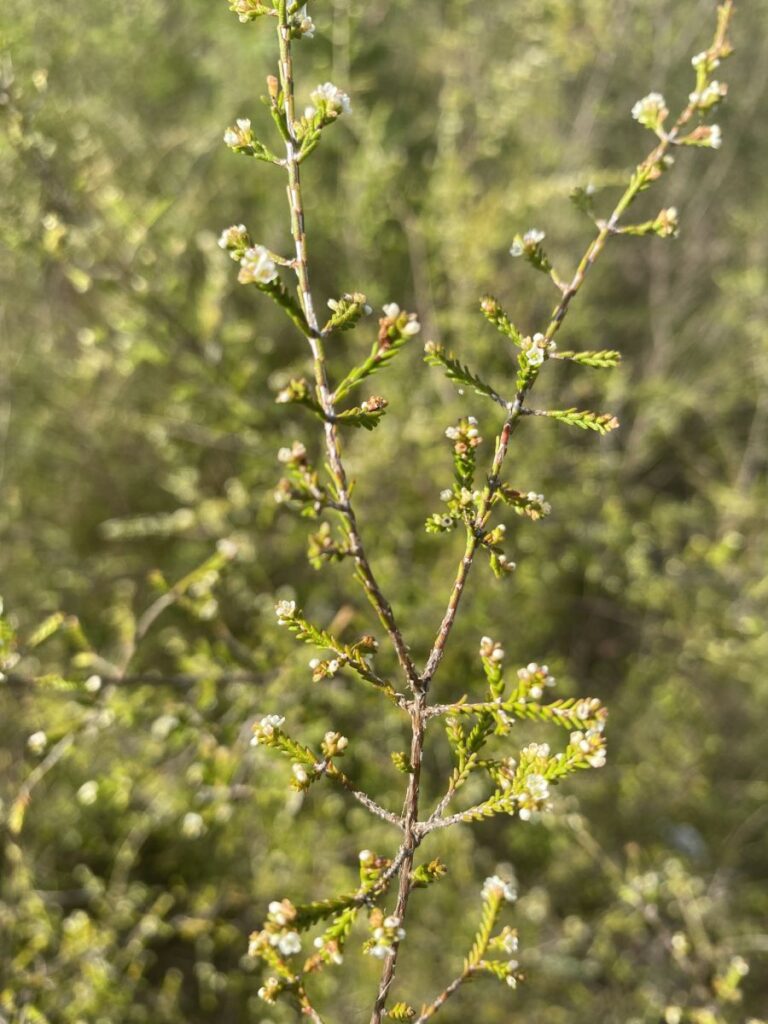
Micromyrtus minutiflora occupies a precarious position in the NSW flora — a slender, quietly beautiful shrub with a natural range so restricted it fits within a rough triangle between Richmond, Penrith and Riverstone in western Sydney. Listed as Endangered under NSW legislation and Vulnerable under Commonwealth law, it is one of those species that reminds us how much of our native flora exists on a knife’s edge, hemmed in by urban expansion and the ongoing loss of the ecological communities it depends on.
Distribution and Habitat
The natural distribution of Micromyrtus minutiflora is among the most restricted of any plant in NSW. It grows exclusively within a small area of western Sydney, in some of the region’s best-known endangered ecological communities: Cooks River Castlereagh Ironbark Forest, Castlereagh Scribbly Gum Woodland, and Shale/Gravel Transition Forest, as well as modified remnants of these communities. The substrate is tertiary alluvium and consolidated river sediments, ranging from sandy to clayey-alluvial soils, in full sun.
The fact that this species occurs within communities that are themselves listed as endangered gives some sense of the cumulative conservation pressure bearing down on this part of western Sydney’s flora.
Identification
Micromyrtus minutiflora is a slender spreading shrub reaching up to 2.5 metres in height, typically with a narrow spread of around 1 metre. It produces a few to many narrow arching stems and may spread by suckering. The overall habit is elegant rather than dense.
The leaves are small and narrow as is characteristic of the genus, oblong to ovate, up to 4 mm long and just 1 mm wide, with hairy margins and oil glands visible under magnification. They are produced in the decussate arrangement typical of Micromyrtus — each successive pair of leaves rotated 90 degrees relative to the last, giving the stems a neat, geometric character. The foliage is aromatic.
The flowers are tiny, as the species name plainly advertises — petals are around 1 mm long, white, cup-shaped and rotate, produced singly in leaf axils or occasionally in small clusters. What they lack in individual size they make up for in sheer quantity, and a plant in full flower can be impressively floriferous. The fruit is a solitary nut to about 3 mm long that can retain viable seed for a considerable period past maturity.
Conservation Status
This species is listed as Endangered in NSW under the Biodiversity Conservation Act and Vulnerable at the Commonwealth level under the Environment Protection and Biodiversity Conservation Act. Its extremely restricted range, combined with its dependence on already-threatened ecological communities, makes it one of the more vulnerable plants in the greater Sydney region.
In the Garden
Given its threatened status, Micromyrtus minutiflora is not widely cultivated, and sourcing plants is the primary challenge. It is worth contacting bushcare groups and native plant nurseries operating in western Sydney, as these are the most likely sources of tubestock grown from local provenance material.
For those who can source it, the cultivation outlook is reasonably optimistic. The species responds well to disturbance, grows on a range of sandy to clayey soils, and prefers a sunny open position. Plants can also be transplanted if needed. Propagation is from seed or softwood cuttings. After fire or disturbance, it likely regenerates from seed but may also reshoot from basal parts or via suckering in mature plants.
Taxonomy and Name
Micromyrtus is a genus of around 22 species, all endemic to Australia and occurring across the mainland states with the exception of the Northern Territory. The genus contains several threatened species. NSW currently recognises 7 species. The name derives from the Greek micros meaning small, combined with the genus Myrtus, referring to the typically small habit and foliage of most species. The epithet minutiflora is straightforward Latin for minute-flowered — accurate, if understated.
Further Reading
NSW Office of Environment and Heritage — Threatened Species Profile