
Dryandra SG newsletter, No.88, July 2025
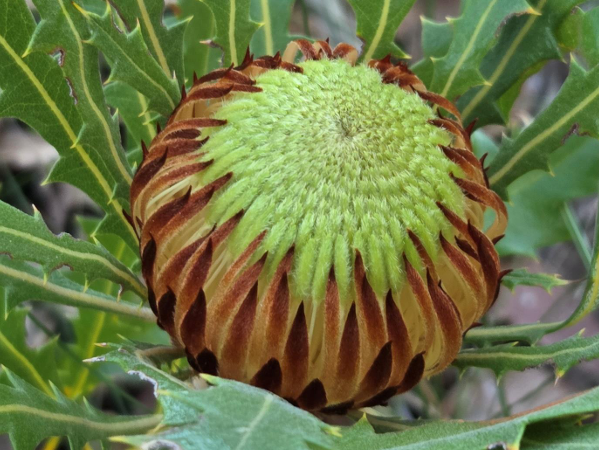
Dryandras provide the perfect storage capsule for their seed, with only one species known to open its capsule and release seed in storage. The newsletter provides updated descriptions and drawings of the capsules of all dryandra species, as an impressive reference tool.
Margaret Pieroni recalls events and accomplishments from the past 50 years of the study group. Some populations documented by the group have been revisited recently.
In commenting on the incorporation of Dryandra into Banksia (a controversial decision), Margaret notes that the two do not interbreed – a point to ponder.
Members of the study group visited Morangup Reserve on the Toodyay Road, W.A. Dryandra nivea “Morangup” was found, as well as D. aurantia and D. drummondii ssp. hiemalis. Further species were also found on a later trip to Lupton Reserve.
Garden Design SG newsletter, no.130, August 2025
The newsletter has a “dynamic gardens” theme, embracing the ever-changing nature of the garden. Ros Walcott identifies the addition of extra paths to the Walcott garden as a dynamic factor. “Cut- throughs” have involved removing plants and installing crushed rock pathways. Neil Skene relates how the appearance of myrtle rust in his garden has affected his decisions about what to plant in the future. The group is compiling a list of “Tenacious – Never say die- small Aussie plants for small gardens” with a focus on SE Queensland. Visits to some members’ gardens have provided candidates.
Bulbine bulbosa (Rock lily) is a hardy attractive species, with dense tufting foliage and clustered yelloe flowers on tall stems. On a taller scale, Syzygium wilsonii ssp. wilsonii (Powder puff lillypilly)is a very beautiful shrub.
Back in the Walcott garden, installation of three ponds has proved a saga, with a lot of problem solving required. Water levels are now holding, to the relief of resident fish, waterlilies and birds. Two public gardens in Melbourne are recommended as significant trailblazing landscape projects, at Westgate Bridge Park and the Laak Boordap Garden at Federation Square. Contact: gdsg@anpsa.org.au
Australian Pea Flower SG newsletter, no.7, June 2025
Shirley McLaran provides a comprehensive account of the parts of the pea flower that aid identification. Their unique arrangement of floral parts is described, and other structures mentioned whose variation permits distinctions between genera and species of the pea family. Taking photos of different parts, and from different angles can be useful to obtain help with identification, as can notes about the foliage, growth habit, habitat and geographic location.
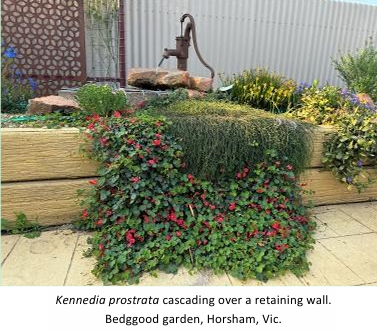
“Pea highlights” of the 2024 ANPSA Biennial Conference are recalled. Species were growing wild in the national parks visited, and in cultivation at “Wartook Gardens” and other private gardens. Over the tours and excursions combined, 29 native pea species were observed, of which the most widespread were Dillwynia sericea, Kennedia prostrata (pictured) and Platylobium obtusangulum. Kennedia prostrata is profiled in the newsletter, as a standout groundcover.
Contact: fabpeamail@gmail.com
Grafting SG newsletter, no.4, September 2025
The group now has a website, a Facebook page and a Youtube channel. With the sales of the grevillea grafting booklet going quite well, a booklet on grafting eremophilas will be produced next.
The science of grafting is outlined. Reconnection of the vascular system, including phloem and xylem, is essential. Formation and strengthening of the callus is key, but is also the weak point. It is recommended that the grafting tape stays in place until it peels away by itself. Darkness can promote callus formation by reducing stress. Group leader Maria Hitchcock is experimenting by comparing Correa grafts kept in either light or dark conditions.
Phil Trickett tabulates his results from grafting Petrophiles and Isopogons this season in collaboration with Tony Henderson. Other members mention attempts to graft the waratah (Telopea) – an ongoing challenge – and a prostrate Acacia (Acacia baileyana).
Contact: graftingstudygroup@gmail.com
Australian Food Plants SG newsletter, No.70, September 2025
Group leader Sheryl Backhouse provides an account of the Macadamia breeding program of Henry Bell. The Bell family is still in the macadamia business. One of the varieties bred (and recently obtained) is the “pinkalicious” Macadamia. A field trip to the Brisbane Botanic Gardens was organised for group members. The focus of the visit was on the ways that humans have used and celebrated plants for food, medicine, ceremony, craft and story for millenia. The book “Mangroves to Mountains” has been released in a fourth edition. It covers the native plants of SE Queensland and northern NSW. The lemon myrtle (Backhousia citriodora) is one of Australia’s most aromatic plants. Its intense citrus hit is due to a compound called citral. Lemon myrtle has become a bush tucker favourite, with its bold flavour, and has been used by Aboriginal Australians for thousands of years, as a soothing tea, and for
cleansing and healing.
Cycad seeds contain toxic compounds which are dangerous to consume. However First Nations people
new how to process them, unlocking their starchy energy stores.
Contact: australianfoodplants@gmail.com