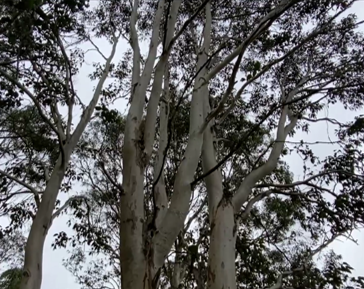
Eucalyptus amplifolia is a tree to around 25 metres tall, forming a canopy to 10 metres wide.
It is a common tree in NSW, although has a mostly coastal distribution, from as far south as Merimbula-Eden, extending northwards, between the coast and as far west as the ACT and Crookwell, to Katoomba-Lithgow and through the lower Hunter Valley, onto Armidale and Tenterfield and finishing just north of Killarney in Queensland; with a disjunct patch at Crows Nest – north of Toowoomba.
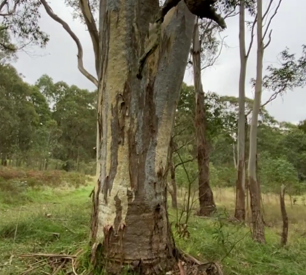
The bark is mostly smooth (gum) mainly white and dappled with darker grey and browish tones in many cases.
It tends to be found in wetter environments – on floodplains and creeklines – often adjoining shale or alluvial soils but sometimes along sandstone creeklines. In some habitats – it can be found on drier hillsides, forming part of dry sclerophyll woodlands.
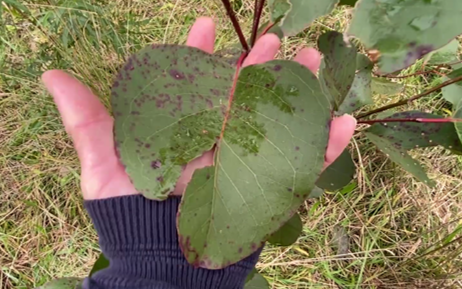
Eucalyptus spp. have simple and usually alternate adult leaves with juvenile leaves starting off opposite to alternate (disjunct). In this species, juvenile leaves and adult leaves are mid-green and large – orbicular to ovate or deltoid; to 22 cm long and 18 cm wide. Often, the juvenile stems have prominent ridges (angular).
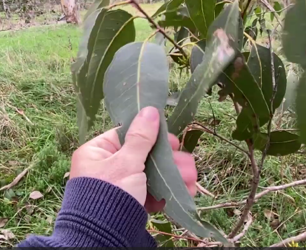
Adult leaves transition to lanceolate to falcate, mid to dark green, concolorous, to 25 cm long and 7 cm wide.
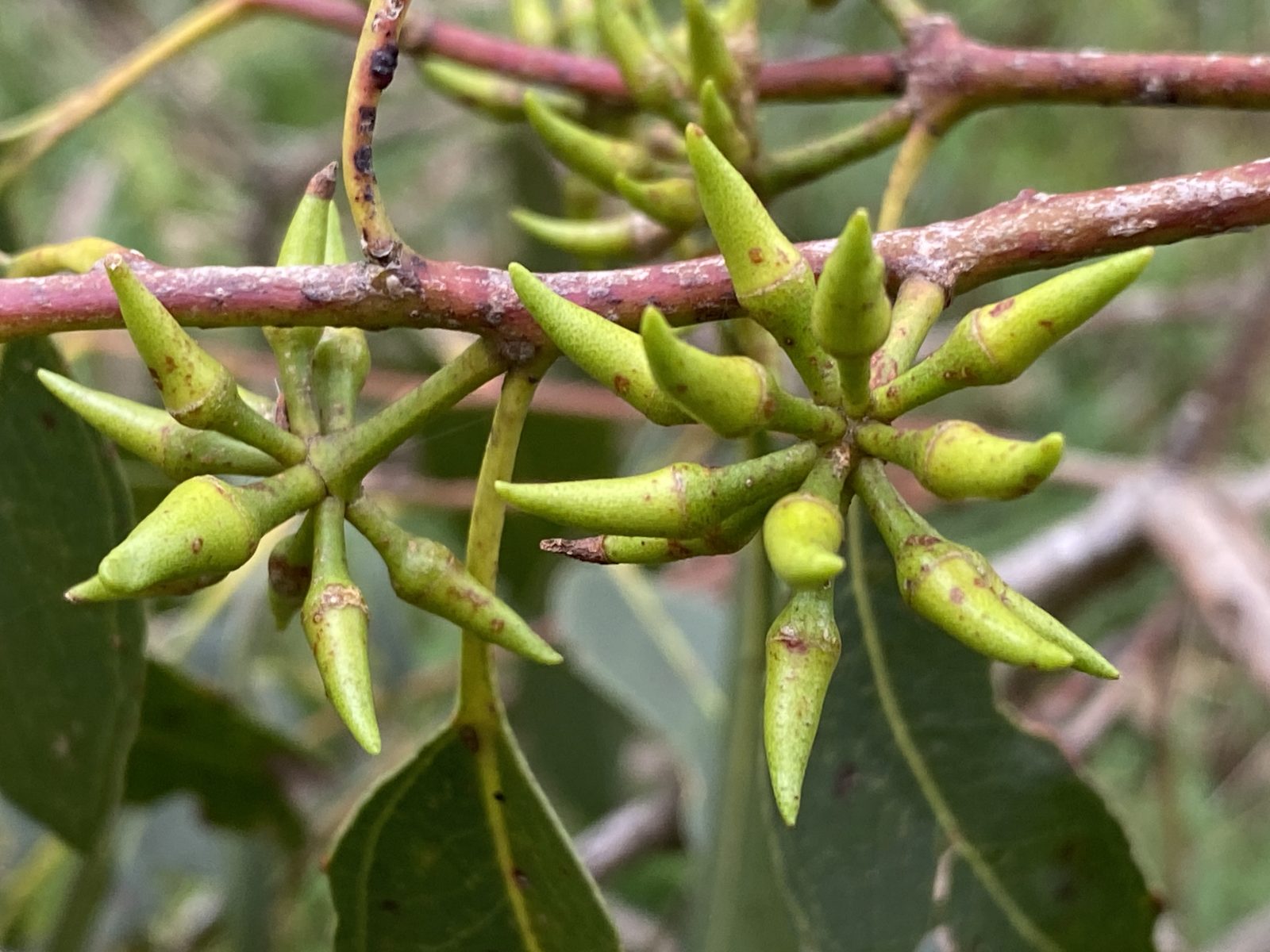
The primary inflorescence of “eucalypts” (Angophora / Corymbia / Eucalyptus) is an umbellaster (an umbel-like cluster of flowers). In the flowers of Corymbia and Eucalyptus, the petals and sepals are fused into the distinctive calyptra / operculum (bud cap) which is shed when the flower opens (in some species, 2 bud caps (opercula) are shed). The flowers are conspicuously staminate – where many stamens are basically taking over the role of the petals, all surrounding one central carpel. In this species, the buds are carried in umbellasters of 11 to 15 (possibly more); narrowly ovoid in shape with horned to conical opercula / calyptras which are often much longer than the hypanthium.
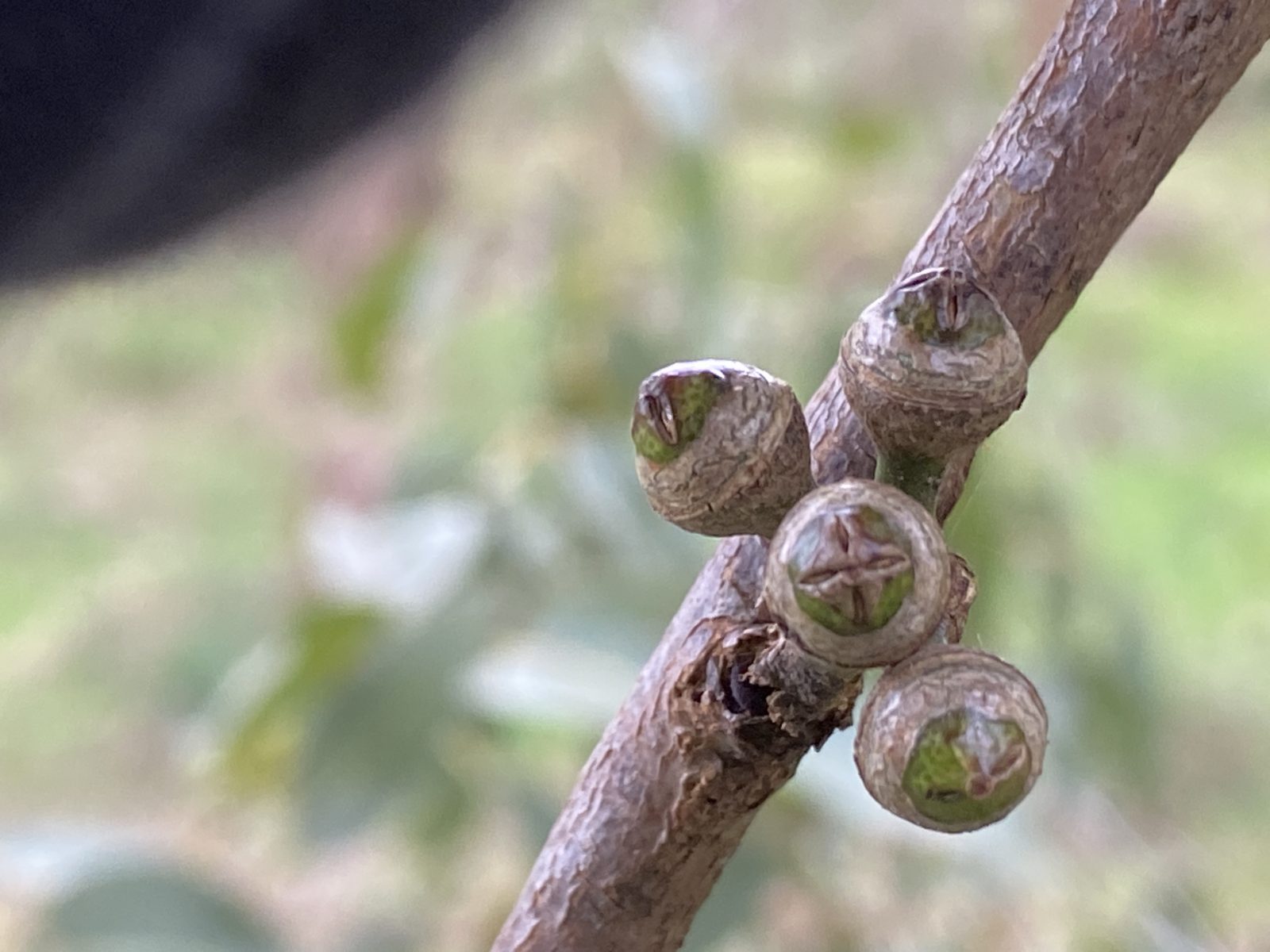
Eucalyptus produce a capsule (gum-nut) which house valves which open to release the seed. The fruits (capsules) of some boxes have a cylindrical to urceolate shape. In this species, they are rounded / hemispherical with a raised disc and strongly exserted valves (in the manner of Eucalyptus tereticornis), about 5 mm long and 6 mm wide.

This species is a handsome tree but may be too large for the average urban garden.
It is a very useful specimen for revegetation projects – especially on creeklines where it is local to the environment (indigenous). Seedlings often regenerate readily on farmland and cleared land where regeneration is allowed to occur.
It could be tried as a street tree or in a larger garden. They can develop a nice handsome form and the trunk can display some very nice mottled patterns throughout the year. It would supply habitat and food resources for birds and insects.
Propagate from seed.
This species can regenerate from fire from lignotubers and epicormic shoots as well as the seed bank.
This species is similar to Eucalyptus tereticornis which it can grow alongside with. It can be distinguished by the more-smooth trunk in most cases; the mid-green and broader canopy and the buds and fruits in well over 7 in most cases.
It is well-known that Eucalyptus is a large and diverse genus. Between 700 and 950 known species are reported, occurring as far north as The Philippines, as well as Indonesia, New Guinea, Timor and Australia. Only 16 species reportedly occur outside Australia. They occur in all Australian states. NSW currently has about 250 species. (See this website for some detailed information: https://apps.lucidcentral.org/euclid/text/intro/learn.htm).
Eucalyptus – from Greek, eu, “well” or “true” and calyptus, referring to the calyptra (καλύπτρo) or operculum, which is a bud cap or covering which covers the developing flowers. The calyptra is a fusion of petals and/or sepals and is shed when the flower opens, leaving a flower with many stamens (staminate) surrounding one female part (carpel).
amplifolia – Latin amplus meaning ample / large and –folia (leaves) – referring to the quite large juvenile leaves which can be seen at 15 x 15 cm or larger in some saplings.
This species is not considered to be at risk of extinction in the wild.
NSW Flora Online (PlantNET) – Eucalyptus amplifolia profile page https://plantnet.rbgsyd.nsw.gov.au/cgi-bin/NSWfl.pl?page=nswfl&lvl=sp&name=Eucalyptus~amplifolia
EUCLID – Eucalypts of Australia – Centre for Australian National Biodiversity Research – Eucalyptus amplifolia subsp. amplifolia profile page https://apps.lucidcentral.org/euclid/text/entities/eucalyptus_amplifolia_subsp._amplifolia.htm
Arcane Botanica YouTube Channel (Dan Clarke) – Eucalyptus amplifolia video https://www.youtube.com/watch?v=qjohfE4P4_c
Arcane Botanica YouTube Channel (Dan Clarke) – Eucalypt Theory Video https://www.youtube.com/watch?v=m89bALPO4uc