
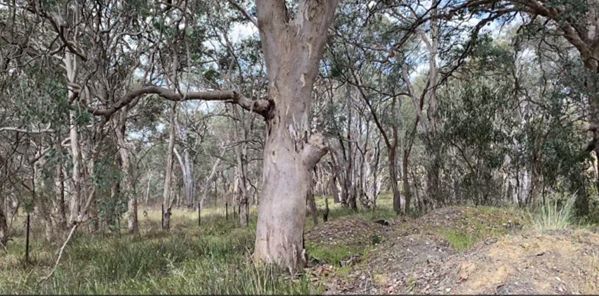
A tree reaching 20 metres tall with a canopy spread to 10 metres, forming a lignotuber.
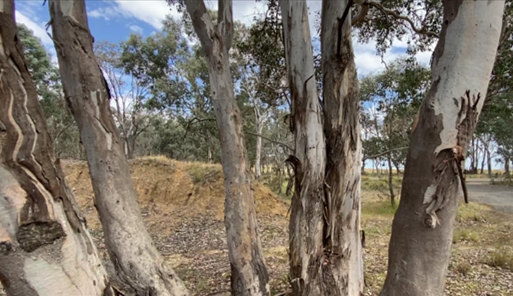
The bark can be a mixture of smooth to fibrous – sometimes with long sinuous strips or bare with different coloured patches with some fibrous material and with upper branches typically smooth.
It can be found commonly in NSW and Victoria, found on the tablelands and western slopes, south from a line between Taree and Dubbo – heading south to as far west as around Forbes, through Wagga Wagga and then extending into the far south coast. It occurs threough much of eastern Victoria and into the western half to around Ararat. It has become a weed in Western Australia.
Eucalyptus polyanthemos is typically found on higher ground in rocky country but can also be found lower down the landscape on more fertile soils, forming part of dry sclerophyll woodlands.
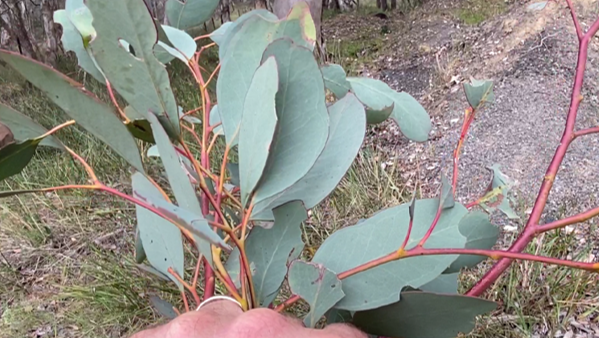
Eucalyptus spp. have simple and usually alternate adult leaves with juvenile leaves starting off opposite to alternate (disjunct). In this species, the juvenile foliage / coppicing growth is ovate to robicular, to 8 cm long and 6.5 cm wide, base truncate to rounded and the apex rounded, green to blue-green or blue-grey.
The adult leaves are disjunct, and are intermediate between juvenile and more-adult usually, to 11 cm long and 5 cm wide, concolorous, dull-green-blue or blue-grey.
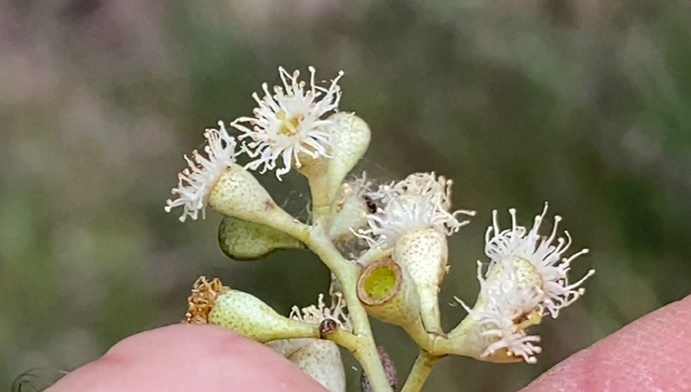
The primary inflorescence of “eucalypts” (Angophora / Corymbia / Eucalyptus) is an umbellaster (an umbel-like cluster of flowers). In the flowers of Corymbia and Eucalyptus, the petals and sepals are fused into the distinctive calyptra / operculum (bud cap) which is shed when the flower opens (in some species, 2 bud caps (opercula) are shed). The flowers are conspicuously staminate – where many stamens are basically taking over the role of the petals, all surrounding one central carpel. In this species, the flower buds are arranged in leaf axils in compound groups (umbellasters) of 7. Mature buds are diamond-shaped to ovoid, to 5 mm long and 3 mm wide with a rounded to conical or slightly-beaked operculum and with the calyptra scar present (hence, each flower has 2 bud caps). Flowering has been observed in Spring to Summer, with flowers white and each flower very small (about 5 mm across).
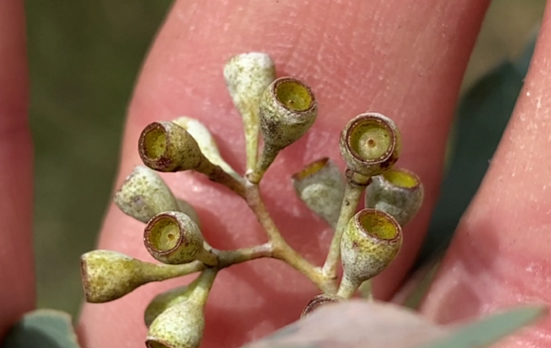
Eucalyptus produce a capsule (gum-nut) which house valves which open to release the seed. The fruits (capsules) of some boxes have a cylindrical to urceolate shape. In this species, the capsules are obconical to barrel-shaped, with the disc descending, with 3 to 4 valves, enclosed, to about 6 mm long by 6 mm wide.
This tree is easy to grow and is sometimes used in revegetation projects on farms and inland rural bushland areas. They also regenerate readily if large adult trees are nearby.
They have an attractive foiliage and colour with many small flowers produced for insects and birds.
Possibly too large for an average urban garden but could be used in a larger space or park or as a street tree.
This author has seen the odd tree planted around farmhouses.
Note it has become a weed in Western Australia which is unfortunate but does mean it is likely easy and hardy once established.
Propagate from seed.
This species can regenerate from fire from lignotubers and epicormic shoots as well as the seed bank.
Two subspecies are currently recognised in NSW: subsp. polyanthemos and subsp. vestita; the latter has rough bark over the whole trunk and branches and is typically seen from Albury to Bombala in NSW.
It is well-known that Eucalyptus is a large and diverse genus. Between 700 and 950 known species are reported, occurring as far north as The Philippines, as well as Indonesia, New Guinea, Timor and Australia. Only 16 species reportedly occur outside Australia. They occur in all Australian states. NSW currently has about 250 species. (See this website for some detailed information: https://apps.lucidcentral.org/euclid/text/intro/learn.htm).
Eucalyptus – from Greek, eu, “well” or “true” and calyptus, referring to the calyptra (καλύπτρo) or operculum, which is a bud cap or covering which covers the developing flowers. The calyptra is a fusion of petals and/or sepals and is shed when the flower opens, leaving a flower with many stamens (staminate) surrounding one female part (carpel).
polyanthemos – from Greek – “poli” (πολύ) and -anthemion (ανθέμιον) – relating to flowers – capturing the many small flowers that this species produces
This species is not considered to be at risk of extinction in the wild.
NSW Flora Online (PlantNET) – Eucalyptus polyanthemos profile page https://plantnet.rbgsyd.nsw.gov.au/cgi-bin/NSWfl.pl?page=nswfl&lvl=sp&name=Eucalyptus~polyanthemos
EUCLID – Eucalypts of Australia – Centre for Australian National Biodiversity Research – Eucalyptus polyanthemos profile page https://apps.lucidcentral.org/euclid/text/entities/eucalyptus_polyanthemos_subsp._polyanthemos.htm
Arcane Botanica YouTube Channel (Dan Clarke) – Eucalyptus polyanthemos video https://www.youtube.com/watch?v=hEhg_iCWvwU&t=201s
Arcane Botanica YouTube Channel (Dan Clarke) – Eucalypt Theory Video https://www.youtube.com/watch?v=m89bALPO4uc