
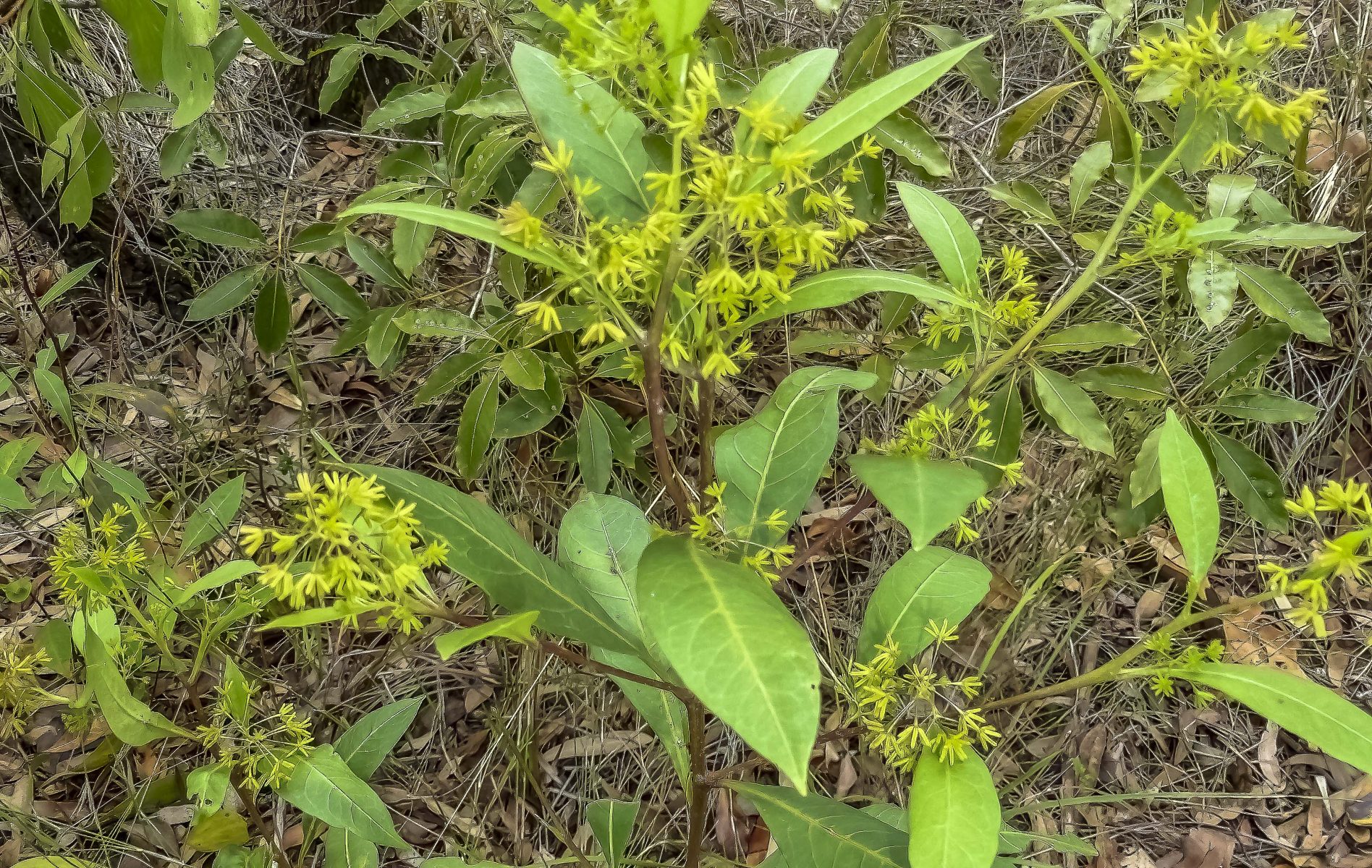
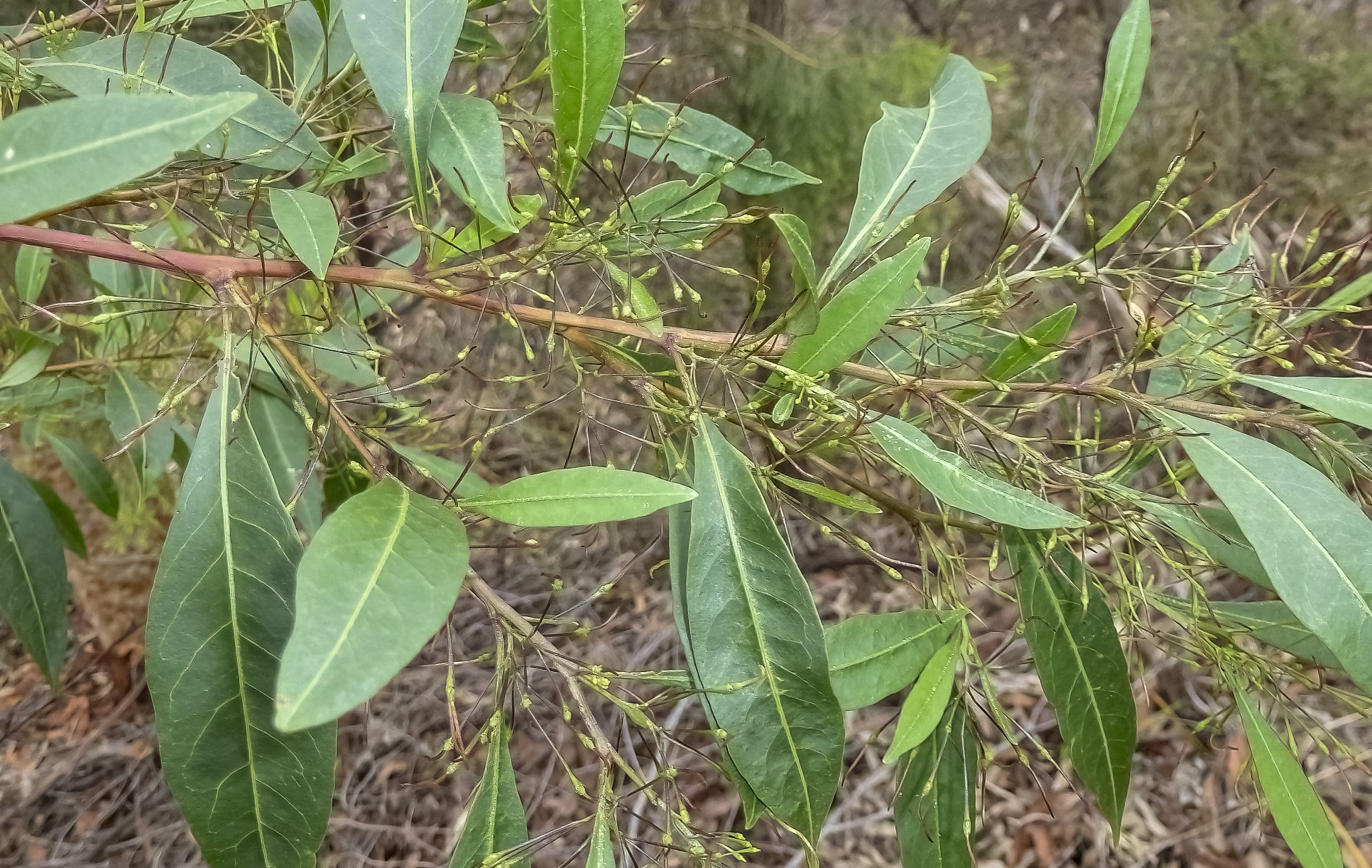
Dodonaea triquetra, is often a narrow-spindly shrub, potentially reaching 3 m tall, often seen smaller, to about 2 metres.
It is a very common species, native to Victoria, NSW and Queensland. It occurs in eastern Victoria to as far west as about Lakes Entrance. It extends north through virtually all of the NSW coast, as far west as around Kandos, Attunga and Ashford – extending into Queensland – with a very patchy distribution to Cape Bedford north of Cooktown.
It occurs in a range of habitats such as wet and dry sclerophyll forest and woodland, sometimes in open shrubland, usually on sand or sandstone-based soils as well as serpentinite. Plants can regenerate after fire en masse and dominate the midstorey for many years.
Dodonaea is a genus containing species with either simple or compound leaves, arranged alternately. In this species, they are simple, variable in size but often elliptic to ovate or lanceolate, to 12 cm long and 5 cm wide with an acuminate or acute apex with entire margins (sometimes wavy) – mid to dark green.
Dodonaea spp. have male and female flowers usually carried on different plants (dioecious). Both male and female flowers are inconspicuous and are carried in cymose-inflorescences. Flowers have 4 to 7 sepals and petals are absent. Male flowers have up to 16 stamens. Female flowers have 1 carpel. Flowers are a mix of cream to green with some brown tones. In this species, flowers are in terminal panicles; yellow to creamy-green with each flower on a pedicel to 10 mm long.
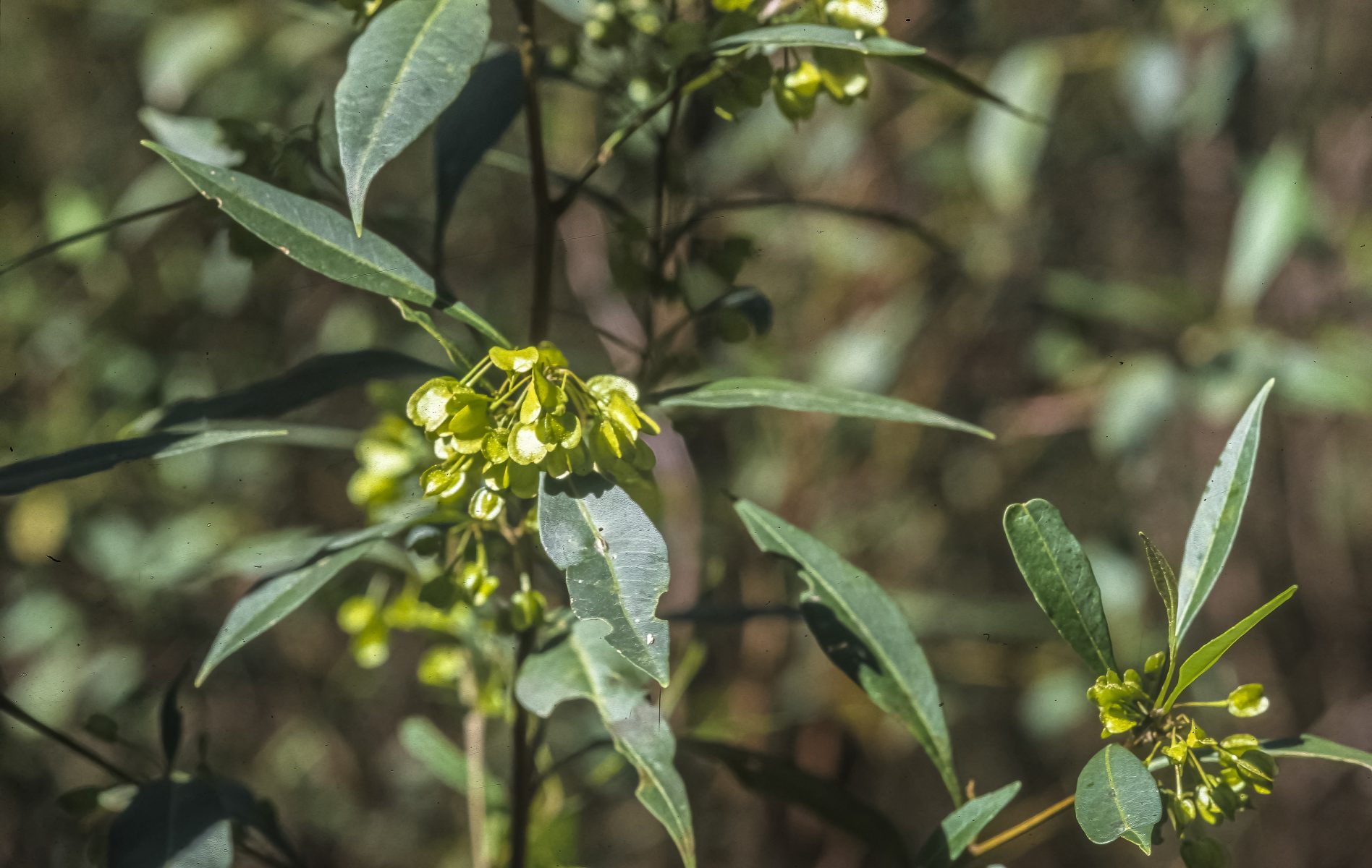
The fruits are much more conspicuous than the flowers; consiting of a 2-4-winged papery to leathery capsule. These ripen to purple-red in colour and are about 2 cm long and wide. A hard-coated seed is held in each wing. Unfertilized flowers will produce capsules without seeds. In this species, the fruit is up to 15 mm long by 15 mm wide, papery and hairless. Spring is the main flowering period. At this time, although they are inconspicuous, the male flowers sometimes attract honey bees in large numbers. The fruits attract many species of parrots and are considered to be an important resource for them.
This is an easy species to grow in a garden but does not create a lot of cover or form. It would likely be overlooked for plants which give more in terms of cover and density.
This author did grow a copse of them in a garden in Sydney many years ago and it formed a “bonsai-landscape-like” copse of tall shrubs in the garden which looked somewhat like a miniature forest.
They are very hardy and often used in bushland regeneration revegetation projects. They could be used in garden areas where other plants are hard to grow, to make some cover and as a shelter for other plants.
They can be pruned to encourage density. Very hardy once established.
Propagate from seed or cuttings. Seed should be soaked in boiling water before sowing. We have found that cuttings take root rapidly. Propagating cuttings from female plants will ensure that you will have the attractive capsules.
D. triquetra was used by First Nations Peoples to treat toothache, cuts and stingray stings. Dodonaeas were also used by early settlers to make beer (hence the common name).
The genus is named after Rembert Dodoens, a 16th century Flemish botanist.
This species regenerates in very large numbers after fire, from the seedbank and can become quite dominant.
Dodonaea (Hop Bushes) is a genus of about 68 species, occurring in tropical to temperate Africa, as well as the Pacific Islands and Australia. It belongs in a family with a lot of rainforest-species. A total of 61 species are native to Australia with 59 of these endemic, occurring in all states. Although reasonably common in the Australian bush, few Dodonaeas are widely cultivated. This is a pity because many species have interesting foliage and colourful fruits. NSW currently has 29 species.
Dodonaea – named in honour of Rembert Dodoens (Rembertus Dodonaeus) (1517-1585), a Flemish Physician and Botanist who is regarded as one of the fathers of modern botany. His book, The Cruydeboeck – was one of the most famous and translated plant books of the 16th Century.
triquetra – Latin – meaning ‘three-cornered’ – referring to the tri-lobed nature of the fruits.
This species is not considered to be at risk of extinction in the wild.
NSW Flora Online (PlantNET) – Dodonaea triquetra profile page https://plantnet.rbgsyd.nsw.gov.au/cgi-bin/NSWfl.pl?page=nswfl&lvl=sp&name=Dodonaea~triquetra
Wrigley, J.W. & Fagg, M.I. (2001). Australian Native Plants – Propagation, cultivation and use in landscaping. 4th edition. New Holland Publishers, Pty. Ltd. Australia.
Australian Tropical Rainforest Plants – Dodonaea triquetra profile page https://apps.lucidcentral.org/rainforest/text/entities/dodonaea_triquetra.htm