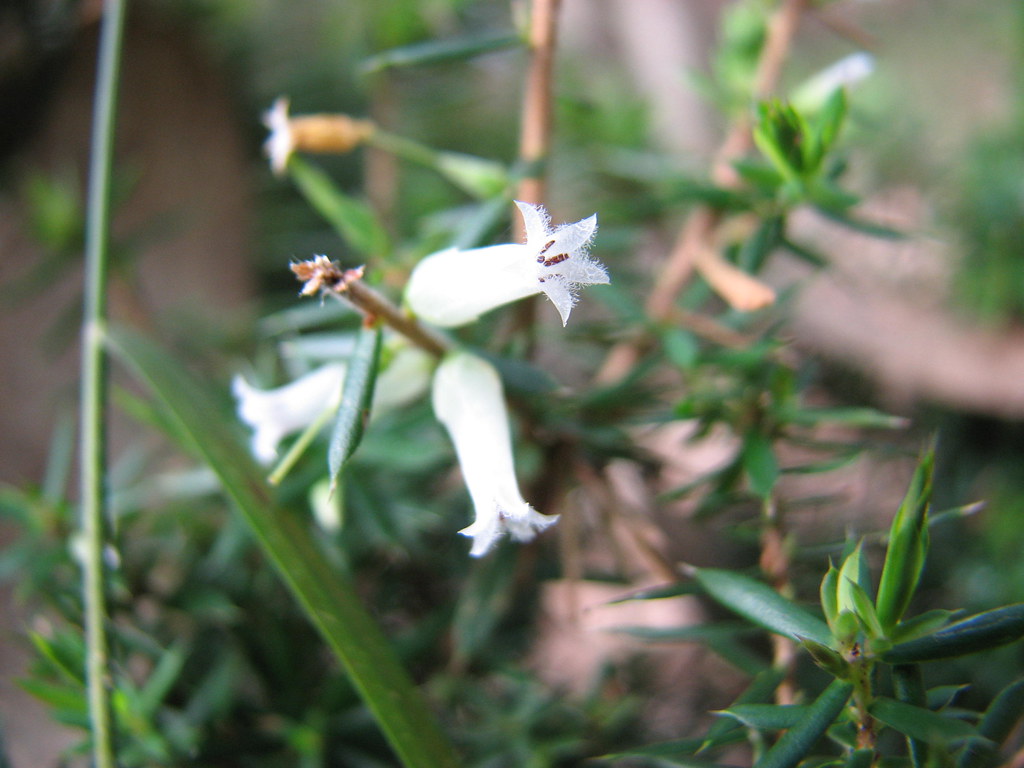
Leugopogon juniperinus (flowers) (Image: Dan Clarke
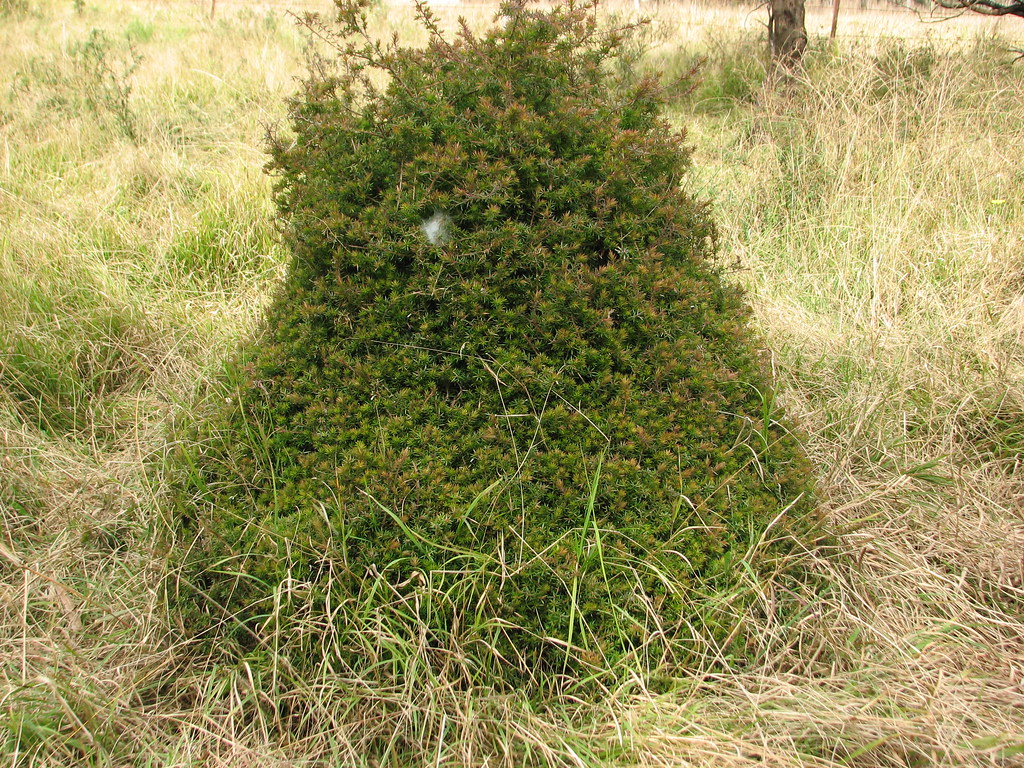
Leugopogon juniperinus (in paddock – browsed by cows) (Image: Dan Clarke)
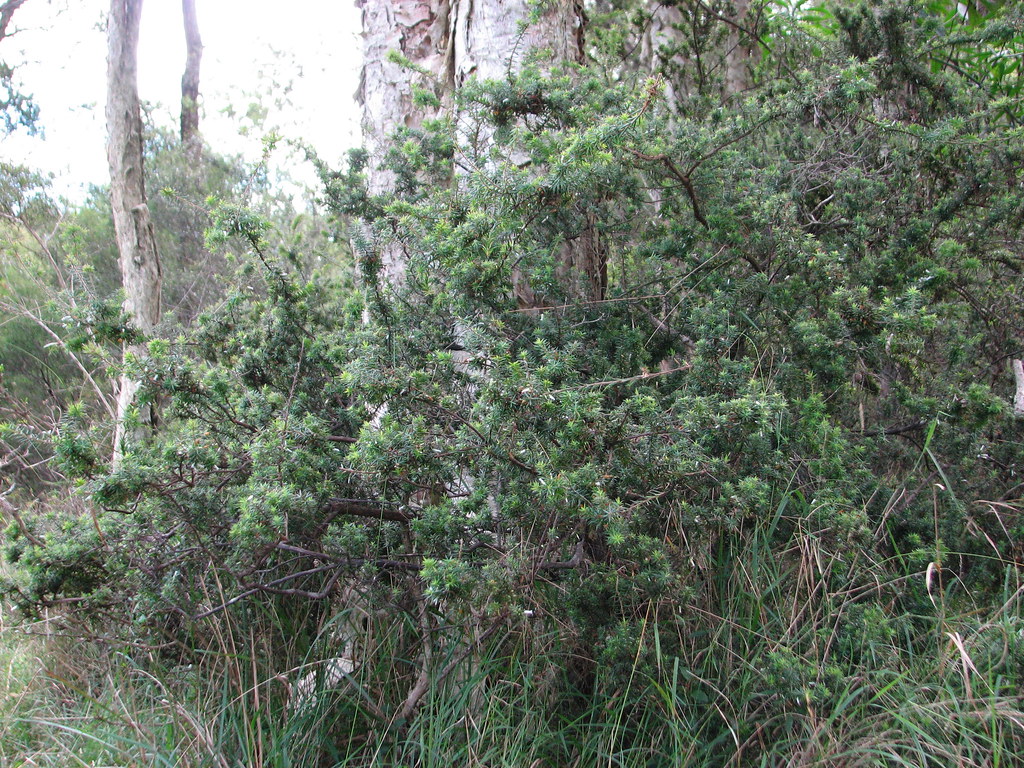
Leugopogon juniperinus (in forest) (Image: Dan Clarke)
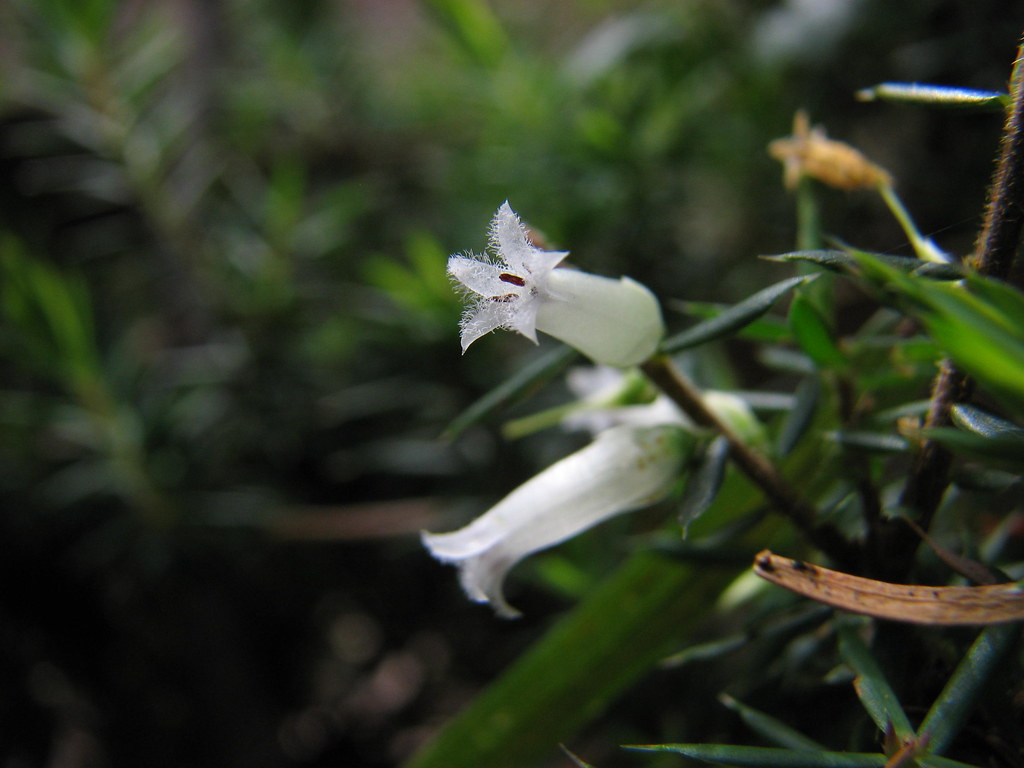
Leugopogon juniperinus (flowers) (Image: Dan Clarke)
Family: Ericaceae subfam. Epacridoideae
A shrub to potentially 2 m tall but often seen much smaller at about 1 m – often spreading to around 1 metre wide with well-spaced stems in the fashion of the related Woollsia or Epacris.
It is native to Victoria, New South Wales and Queensland, growing in eastern Victoria – in a somewhat disjunct patch around Bairnsdale-Omeo-Mt Beauty; then found commonly along the NSW coast and hinterland, as far west as Scone and Guyra but usually further east, extending to west of Maryborough in Queensland.
It can be found in dry and moister (wet) sclerophyll forests and woodlands, on a range of soils from sandy-sandstone to shale and more enriched (volcanic / igneous).
Leucopogon have simple prickly leaves with parallel venation, often heavily clustered along stems; spiral to alternate. In this species they are mid to dark green (new shoots often paler), to 12 mm long and 2.5 mm wide, margins recurved, finely toothed with a sharp tip about 1 mm long; prickly to the touch.
The main feature about Leucopogon flowers is the densely hairy upper surface of the petals (the basis for the genus name). Flowers are 5-merous with 5 densely hairy white petals; sometimes odorous. This species is a little different with the petals fused into a tube. These tubular flowers are about 8 mm long, produced solitarily in leaf axils; white in colour.
Leucopogon produce a drupe (a fleshy fruit with a single hard seed within). In this species, they are about 4 mm long, without hairs and bright yellow at maturity.
In the garden
This species does not have a long history of being cultivated. The “epacrids” generally, although highly desired in gardens, are a difficult group of plants in cultivation. This is likely due to often having very specific mycorrhizal fungi connected to their roots in harsh environments.
This author has observed this species being propagated at Blacktown City Bushcare Nursery in Sydney. However, it is not known how plants go in the field once planted. The Wrigley and Fagg Publication in Other Information below have interesting notes on the cultivation of this group.
It would certainly make an interesting garden plant and can create a dense habit which would shelter birds and small fauna (see images below).
Check with local nurseries for availability.
Propagation
Propagate from seed.
Other information
This species likely regenerates from seed after fire. Resprouting of root stocks may be possible.
Leucopogon is a genus of around 230 species and is subject to ongoing taxonomic revision. It is distributed through Australia, Malaysia, Indo-China and the Pacific as well as New Zealand. Australia has around 200 species – mostly endemic. NSW currently has about 35 taxa (some formal and some informal).
Note: In Victoria, this species is known as Styphelia sieberi and this name may be adopted in time in NSW.
Leucopogon – from Greek – Leuco (λεῦκο) – meaing “white” and -pogon (πώγων) meaning “beard” – referring to the white hairs or “beard” on the flowers.
juniperinus – from Latin – resembling a juniper (genus: Juniperus).
This species is not considered to be at risk of extinction in the wild.
Wrigley, J.W. & Fagg, M.I. (2001). Australian Native Plants – Propagation, cultivation and use in landscaping. 4th edition. New Holland Publishers, Pty. Ltd. Australia.