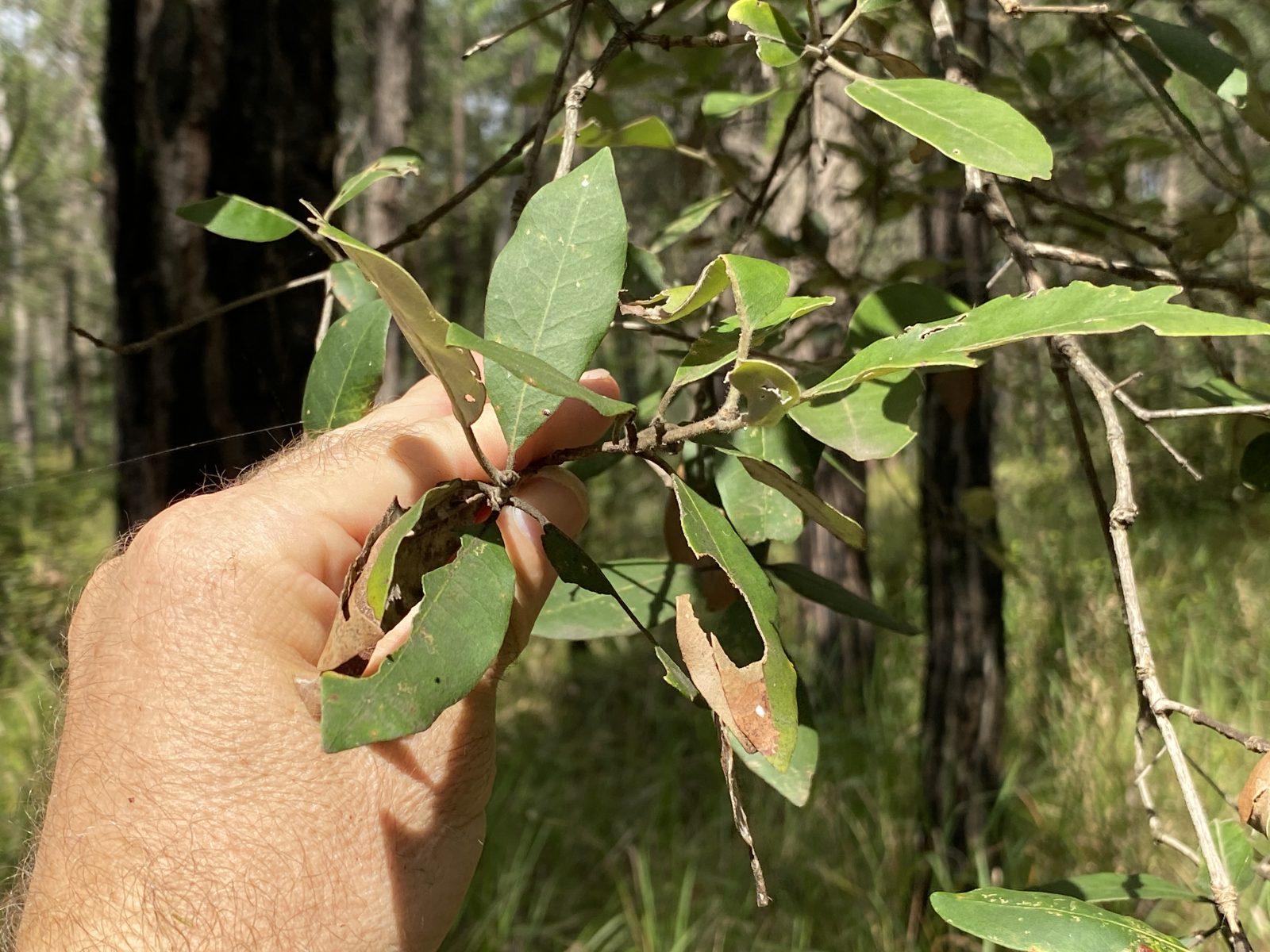
Syncarpia glomulifera – foliage (Image: Dan Clarke)
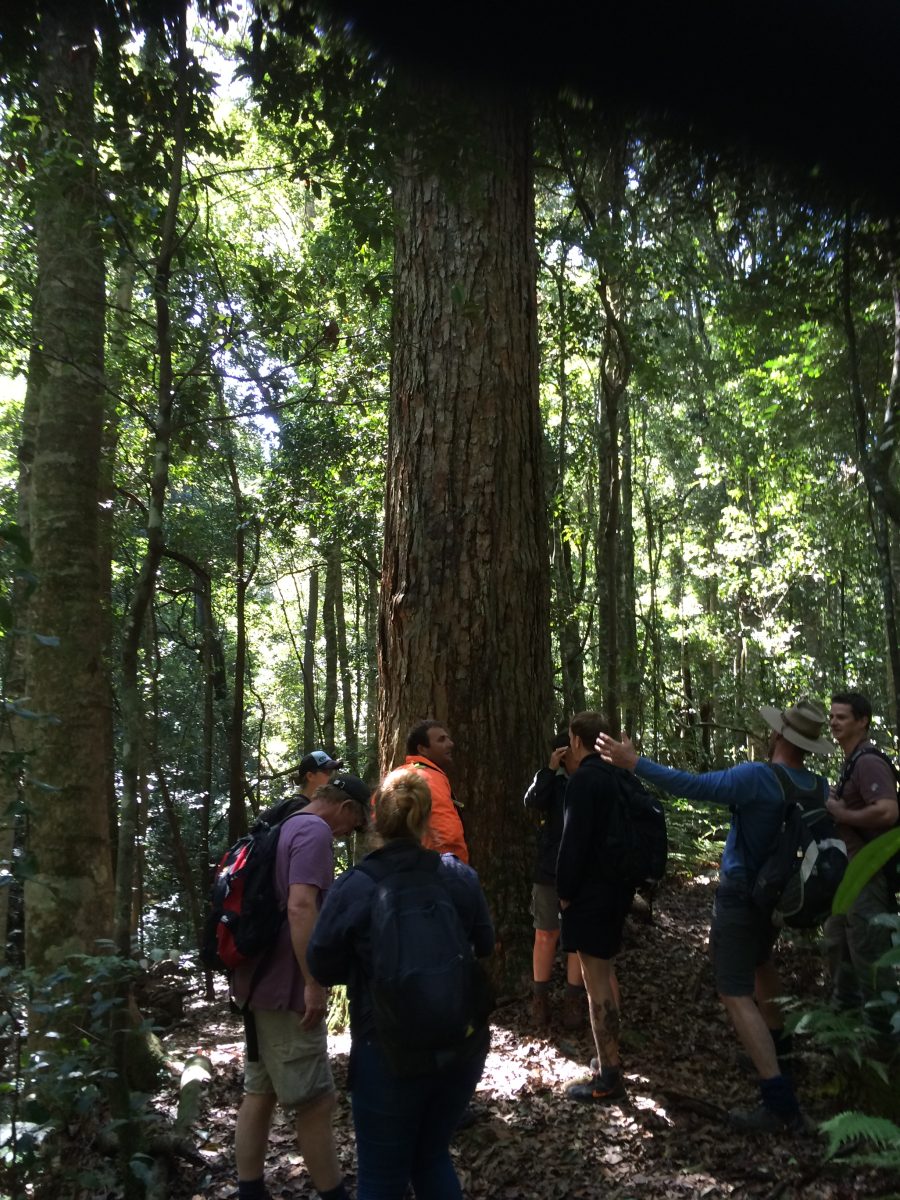
Syncarpia glomulifera – large tree, Royal NP (Image: Kelly Upton)
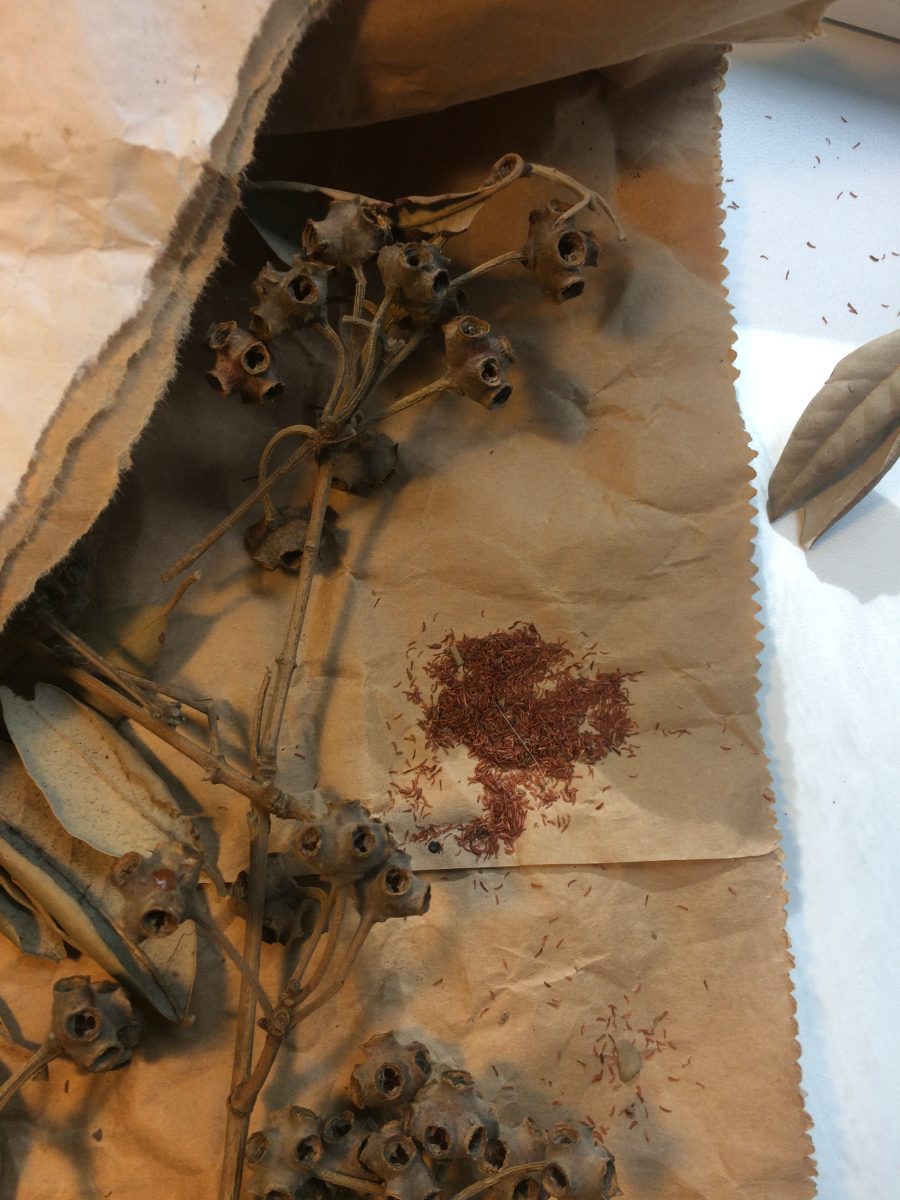
Seed of Syncarpia with fruit (Image: Dan Clarke)
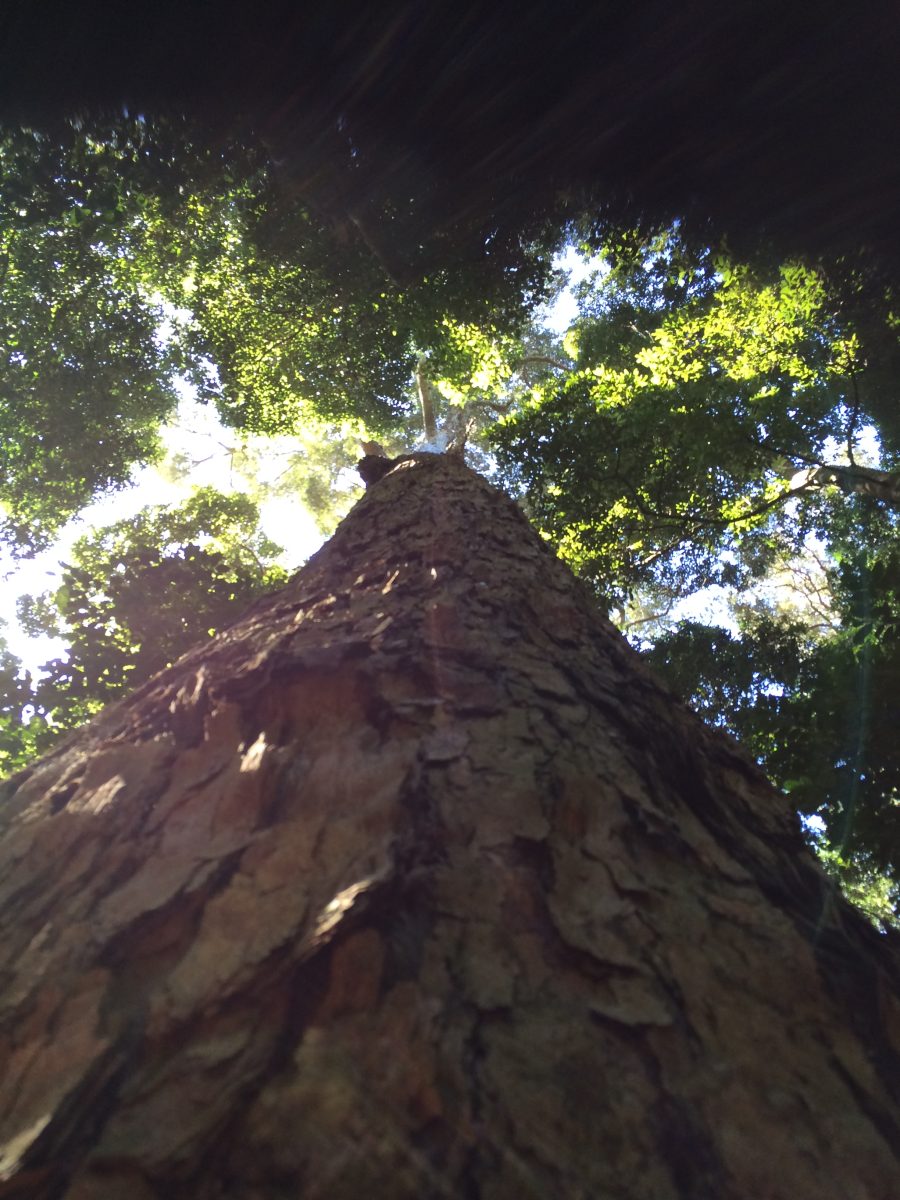
Syncarpia glomulifera (Royal NP, Image: Dan Clarke)
Family: Myrtaceae
A tree capable of reaching 60 metres, often with a wide canopy-spread
It has a trunk of stringy-like bark but with deeper furrows and with bark in shorter and more spongy fibres.
It is native to New South Wales and Victoria, growing mainly close to the coast and into the coastal hinterland; north from around Batemans Bay (Murramarang National Park), as far west as Katoomba, extending north into Queensland, to the Yeppoon Peninsula, as far west as Charters Towers and Blackwater.
It forms part or dry sclerophyll woodlands and forests – often on enriched soils but sometimes on sandstone. It co-dominates with eucalypts in its habitats. There is a vegetation community known as Sydney Turpentine Ironbark Forest in Sydney which is threatened with extinction – occurring on shale-derived clay soils. In such patches – Turpentine can be the main canopy tree overlying a grassy groundlayer which makes for a very attractive forest. Trees on shale soils are usually larger – esepcially when in gullies. Many remnant trees can be observed in Sydney.
Syncarpia spp. have simple and opposite leaves or in whorls of 4 (described as false whorls) – which are presented in this species. Leaves are ovate to narrow-ovate, to 11 cm long and 5 cm wide, with the upper surfaces dark to mid green and the lower surface a much different colour – greay to white due to dense hairs. Often, leaves can have what appears like black sooty mould.
The inflorescences are somewhat similar to eucalypts in that they are 7-flowered dichasia. Flowers are staminate. 4 to 5-merous with 4 to 5 small sepals and free petals and with numerous stamens – creating a thoycal “fluffy” Myrtaceae flower; cream in colour and up to 3 cm across. Flowers are often borne near branch terminals but also along branches in leaf axils.
The fruit of Syncarpia is very distinctive. Amazingly, the ovaries of the seven separate flowers fuse (at the hypanthium region) to form one aggrgate fruit (capsule) with 7 chambers (the basis of the genus name). In this species, they are up to 20 mm diameter, about 6 to 10 mm tall and distinctly 7-chambered (with comments often made that they resemble drawings of “alien space craft” or “flying saucers”); woody in texture. They can litter the ground in large numbers.
In the garden
This species can be grown readily. It makes a very nice specimen tree and is planted in bushland revegetation projects. Tubestock saplings are often available at native nurseries.
It makes a very sturdy tree – the timber is very durable and has been used in wharf and pier constuction, as well as for houses, floor boards and furniture.
It is a distinctive species in a landscape and can make a beautiful shade tree. Needs planty of room to grow and spread out.
They can tolerate a range of soils but typically do better on shale-based soils. However, they will grow in sandstone-based environments.
Some advanced trees can be multi-trunked.
It is likely too large for the average modern urban backyard but it a very attractive, hardy and useful tree.
Propagation
Propagate from seed.
Other information
This species can regenerate after fire epicormic shoots as well suckering from the base.
Syncarpia is a genus of only two species – endemic to Queensland and NSW. The other species is Syncarpia hillii (Fraser Island Turpentine).
Syncarpia – from Greek – Syn-karpos – meaning – “fused-fruit” – referring to the fused hypanthia of the flowers to form an aggregate fruit.
glomulifera – from Latin – glomulus – meaning “lump” – and with fera meaning “lump-bearing” or producing – referrring to the globular fruits produced.
This species is not considered to be at risk of extinction in the wild.